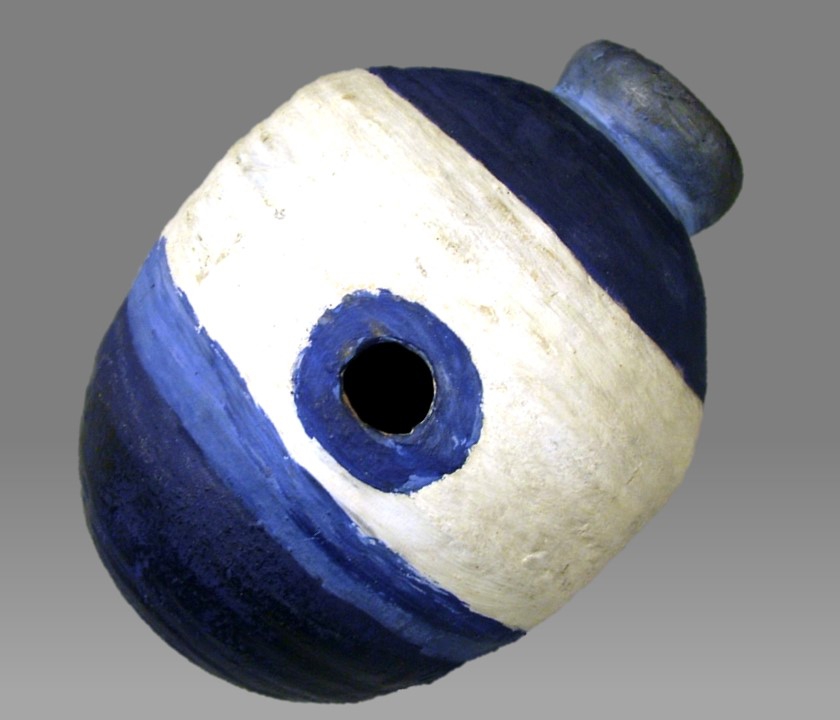
Image: The Crosby Brown Collection of Musical Instruments, 1889, CC0 — via Wikimedia Commons
Botija
| Category | Wind (vessel aerophone) |
|---|---|
| Country of origin | Cuba |
| Classification | plosive aerophone |
| Wikipedia | en.wikipedia.org |
| Wikidata | Q122966268 |
Overview
The botija is a clay jug used as a bass aerophone in early Cuban son and rural folk ensembles. The player blows across a small opening cut into the side of a large earthenware vessel — originally a repurposed olive-oil container imported from Spain — producing a deep, soft bass note. By varying breath pressure and partly covering the main neck of the jug with the hand, a skilled player can produce two or three different pitches, enough to outline the simple bass lines that anchored early son rhythms.
Origin & History
The botija entered Cuban music in the late nineteenth and early twentieth centuries, when imported earthenware oil jugs were widely available in eastern Cuba and were repurposed as low-cost bass instruments by rural musicians. The jug appears prominently in early son sextetos and septetos before being supplanted by the marímbula and, later, the contrabass and electric bass. Recordings from the 1920s and 1930s document the botija in early son ensembles such as the Sexteto Habanero before the transition to plucked-bass instruments.
How It’s Played
The botija is played seated, with the jug held in the lap or on the floor. The player blows across the side opening — much like sounding a large bottle — to set the air column inside the vessel into resonance. The thumb or palm partly covers the main mouth of the jug to vary the pitch; a few specific notes are used in practice. Breath control determines volume and articulation, and the resulting voice is soft, woody, and indistinct in the way that suits the relaxed early-son groove.
Cultural Significance
The botija is part of the foundational bass-line tradition of Cuban son and is one of several improvised bass instruments — alongside the marímbula and the gourd-bodied serrucho — that supplied low-frequency support in the music’s early decades. As the son moved from rural eastern Cuba to Havana and into commercial recording, the contrabass largely replaced these earlier instruments. The botija survives today mainly in folkloric performance and in conservatory programmes documenting the music’s history.
Related Instruments
- – the plucked-bass successor in early son
- – the Cuban son’s lead string instrument
- – classic son percussion partner
- – classic son percussion partner
- Conga – later Cuban percussion development
Frequently Asked Questions
Was the botija originally designed as a musical instrument?
No — the jugs were imported as oil containers and repurposed for music.
How many notes can the botija play?
Typically two or three, enough for early son’s simple bass lines.
Is it still used in Cuban music?
Mostly in folkloric and historical-revival contexts; commercial son moved to contrabass and electric bass long ago.