

Bullroarer
Bullroarer
| Category | Other |
|---|---|
| Country of origin | Worldwide (Paleolithic origin) |
| Classification | type of musical instrument |
| Wikipedia | en.wikipedia.org |
| Wikidata | Q666971 |
Listen
Audio: Jeuwre, CC BY-SA 4.0 / via Wikimedia Commons
Audio: Michael Drake, CC BY-SA / via Internet Archive
Overview
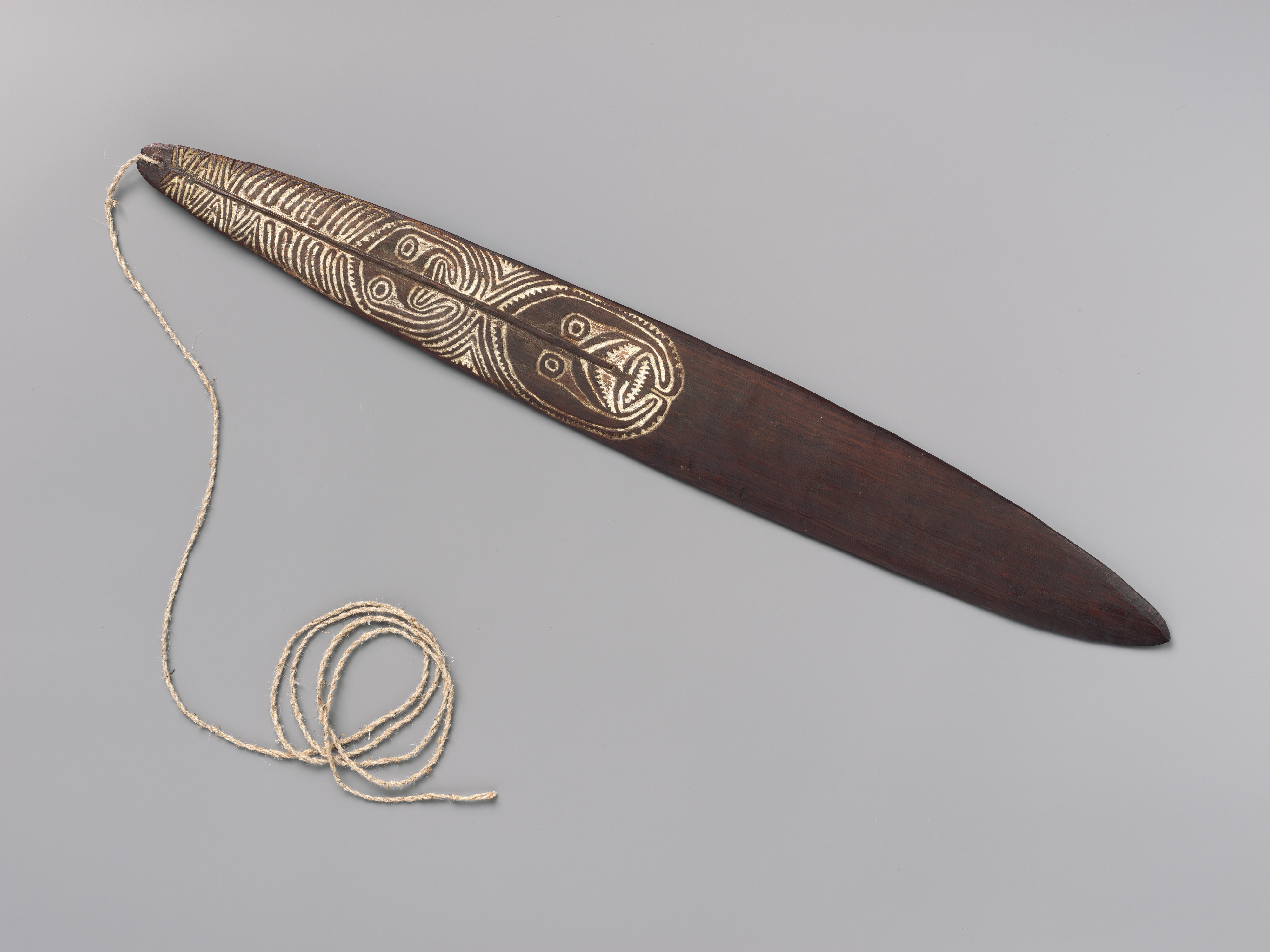
The bullroarer (also called the rhombos in classical Greek, the tjurunga in Western Desert Aboriginal Australian usage, the imunu viki in Papuan, and many other regional names) is a simple whirling-slat aerophone. It consists of a flat oblong slat of wood, bone or another rigid material tied at one end to a length of cord. The player swings the slat in a wide arc around the body so that the slat itself spins about its own minor axis while it traces the larger arc, producing a low rhythmic roaring whose pitch shifts with rotation speed.
Wikidata classifies the bullroarer as a noisemaker and as a whirling aerophone. The Wikipedia article frames it as a ritual instrument also used to send signals across long distances of open landscape. The instrument is the simplest documented free aerophone — there is no resonator, no enclosed air column, no reed and no membrane — and produces sound entirely through the aerodynamic interaction between the spinning slat and the surrounding air.
Origin & History
The bullroarer is among the oldest documented musical instruments in the archaeological record. A bone bullroarer dating to around 17,000 BCE was recovered from the Magdalenian-period cave of Laugerie-Basse in the Vézère valley of southwest France, and similar finds have been made at sites across Upper Paleolithic Europe. The instrument has been used continuously somewhere in the world from the Paleolithic to the present.
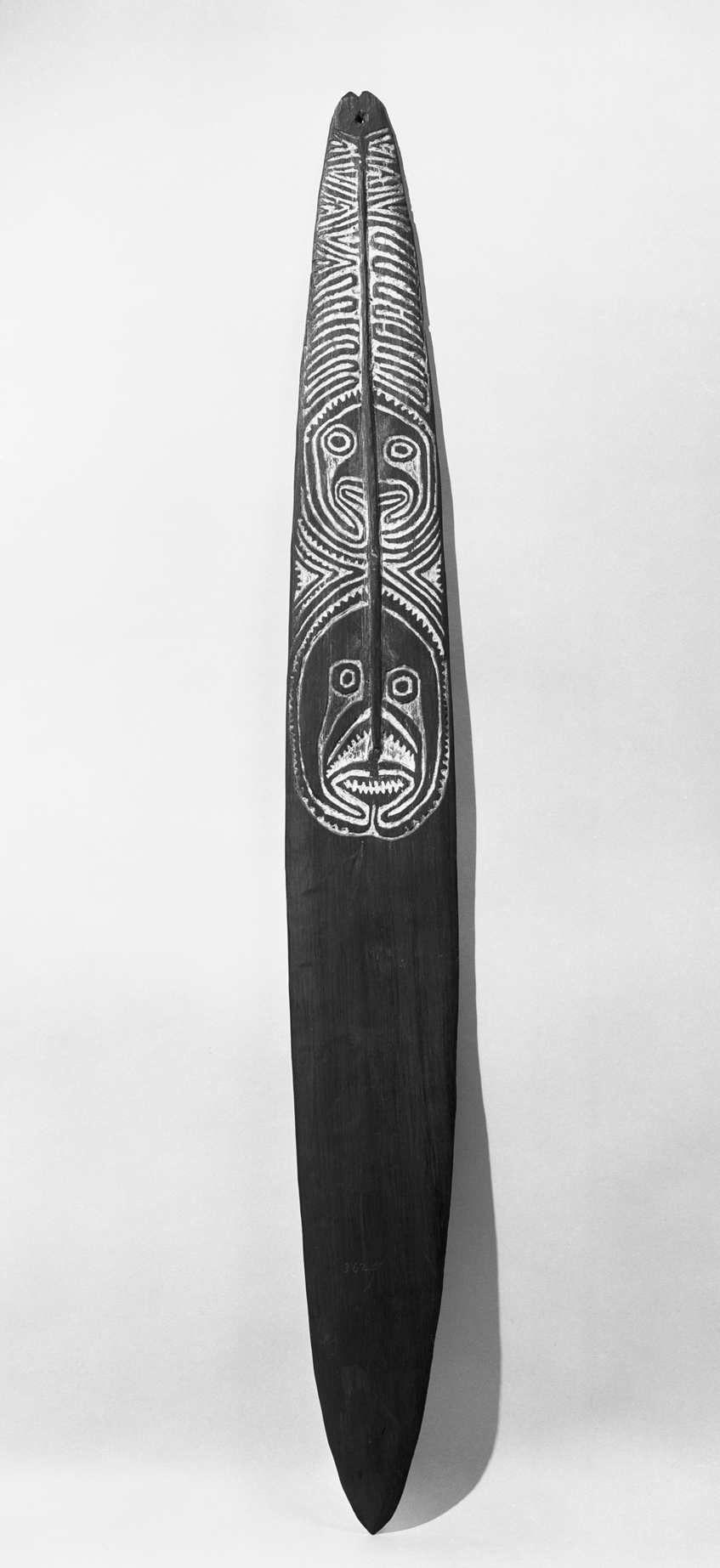
The bullroarer’s distribution is genuinely worldwide. It is documented archaeologically and ethnographically across Aboriginal Australia (where it carries the tjurunga or churinga name in many language groups and is central to men’s initiation ceremonies); across Papua New Guinea and Melanesia (where the Metropolitan Museum’s specimen, object 504985, an Imunu Viki from the late 19th century, illustrates the regional tradition); across many Native American cultures (including the Pueblo, Navajo, Plains and Inuit peoples); across sub-Saharan Africa; in classical Greece (where the rhombos was associated with the cult of Dionysus); in pre-Roman Britain; and in many other regions.
The MET’s Papua New Guinean bullroarer (object 504985) is made of wood with lime decoration and is described as a late-19th-century instrument. The MET’s catalogue note flags the Imunu Viki designation, the Papuan term for this category of ritual object, indicating the museum’s recognition of the instrument’s specifically ritual rather than secular role.
Construction & Materials
A bullroarer consists of two parts: a flat oblong slat and a long cord. The slat is typically 8 to 30 centimetres long, 2 to 6 centimetres wide, and 0.5 to 1.5 centimetres thick, with one or both edges rounded or bevelled to produce a controlled aerodynamic interaction. Materials vary widely: wood is the most common (with hardwoods preferred for their density and durability), but bone, ivory, slate, fired clay and modern plastics have all been used in different traditions. One end of the slat carries a hole or notch through which the cord is tied; the cord is typically 1 to 2 metres long and made of leather, sinew or plant fibre.
The MET’s Papuan specimen incorporates lime — a white pigment made from burnt coral or shell — as decoration. Aboriginal Australian tjurunga are typically incised with sacred designs that identify the specific dreaming-track and ceremonial purpose of the object. Many regional traditions decorate the slat with carved or painted designs; the decoration carries ritual meaning rather than affecting the sound.
How It’s Played
The player holds the free end of the cord and swings the slat in a circle around the body, either over the head or to one side. The slat itself spins on its own short axis as it follows the larger circle, and this combination of two simultaneous rotations produces the characteristic roaring or whirring sound. Pitch varies with rotation speed: faster rotation produces higher pitch, slower rotation lower pitch.
The bullroarer’s sound is genuinely loud and travels considerable distance — the long-distance signalling association noted in the Wikipedia summary is well supported acoustically. In open landscape conditions a bullroarer can be heard several kilometres away, and the directional, pulsating, low-frequency character of the sound makes it carry through forest and across water more effectively than higher-pitched signals.
Cultural Significance
The bullroarer’s cultural significance is overwhelmingly religious or ritual rather than secular. In Aboriginal Australian traditional culture the tjurunga is one of the most sacred ceremonial objects, used in men’s initiation and other restricted ceremonies, and is generally hidden from women, children and uninitiated men. The depth of restriction on the tjurunga in many Aboriginal language groups means that any photograph, recording or detailed description of the object is considered a serious cultural violation; this article does not include images or recordings of any specifically Aboriginal tjurunga and instead uses a generic Wikimedia Commons image.
In Papua New Guinea and Melanesia the bullroarer (Imunu Viki and other regional names) is similarly used in restricted men’s-house ceremonies. In classical Greek religion the rhombos was associated with the Dionysian and Orphic mystery cults and was used in initiation rituals. Across Native American traditions the bullroarer appears in many distinct ceremonial contexts including the Pueblo katsina dances, the Navajo healing chants and various Plains medicine traditions.
This widespread association of a single instrument with restricted, often men-only ritual contexts on multiple continents has been the subject of considerable anthropological discussion. The 19th-century anthropologist Andrew Lang documented many of these traditions; more recent scholarship including Mircea Eliade’s work has placed the bullroarer in a wider comparative framework of initiation symbolism.
Notable Examples & Recordings
- The MET’s Papuan specimen (object 504985, late 19th century, Imunu Viki?) is one of the few well-documented Melanesian bullroarers in a Western museum.
- The Laugerie-Basse Paleolithic bullroarer (around 17,000 BCE) at the French national archaeological collection is the oldest documented specimen.
- The Pitt Rivers Museum in Oxford holds a substantial bullroarer collection from across the British colonial-era ethnographic gathering.
- The Smithsonian National Museum of the American Indian holds Native American bullroarers from multiple cultural traditions.
- Recordings: Smithsonian Folkways and the Berlin Phonogramm-Archiv hold historical recordings of bullroarer sounds in various ethnographic settings, but contemporary recordings are deliberately limited because of the ritual restrictions on the instrument.
Related Instruments
- – the secular whirling-aerophone toy of Western European folk-craft tradition.
- – the classical Greek ritual bullroarer.
- – the Aboriginal Australian sacred bullroarer.
- – the simpler twirling-disc-on-a-cord aerophone toy.
- – a related but stationary aerophone toy.
Where to Hear It
The bullroarer is rarely encountered in public concert performance because of its ritual restrictions in most surviving traditions. Demonstration uses occur in some museum education programmes, in archaeological reconstruction settings, and in a small number of contemporary art-music compositions. Recordings appear in ethnographic catalogues including Smithsonian Folkways and the Berlin Phonogramm-Archiv, with appropriate cultural-restriction notes for the Aboriginal Australian recordings.
- Wikipedia: Bullroarer
- Wikidata: Bullroarer (Q666971)
- The MET: Bullroarer (object 504985)
- Wikimedia Commons: Bullroarers
Learning Resources
The bullroarer is not a conservatory or formally taught instrument in any major tradition. The simple construction (a flat slat and a length of cord) means a working bullroarer can be made with basic tools in a few minutes, and many museum education programmes include bullroarer construction as a hands-on activity for visitors. For scholarly study, Andrew Lang’s Custom and Myth (1884), Mircea Eliade’s Rites and Symbols of Initiation (1958) and the wider anthropological literature on initiation provide context. The cultural restrictions on Aboriginal Australian tjurunga and on Papuan ritual bullroarers should be respected — researchers and demonstrators should not attempt to acquire, display or discuss specifically restricted objects from these traditions.
Frequently Asked Questions
What is a bullroarer?
A simple whirling-slat aerophone — a flat oblong piece of wood, bone or other material attached to a long cord, swung in a circle to produce a low roaring sound.
How old is the bullroarer?
At least 17,000 years old. A Magdalenian-period bone bullroarer of around that age was recovered from the cave of Laugerie-Basse in southwest France, and the instrument has been used continuously somewhere in the world from the Paleolithic to the present.
Where in the world is the bullroarer found?
On every inhabited continent. Major traditions include Aboriginal Australian (the tjurunga), Papua New Guinean and Melanesian (the Imunu Viki and many regional names), Native American (across many cultures including Pueblo, Navajo, Plains and Inuit), classical Greek (the rhombos), pre-Roman British and many sub-Saharan African traditions.
Why is the bullroarer often restricted?
In many of its surviving ritual contexts — especially in Aboriginal Australia, Papua New Guinea and several Native American traditions — the bullroarer is a sacred ceremonial object restricted to initiated members of specific groups (often men). Public photography, recording or display of these specifically restricted objects is considered a serious cultural violation in those traditions and should be avoided.
Is the bullroarer the same as a whirligig?
No, although the principle is related. A whirligig is a secular spinning-toy aerophone of European folk-craft tradition; a bullroarer is the ritual whirling-slat-on-a-cord instrument. The two share aerodynamic principles but differ fundamentally in cultural role.


