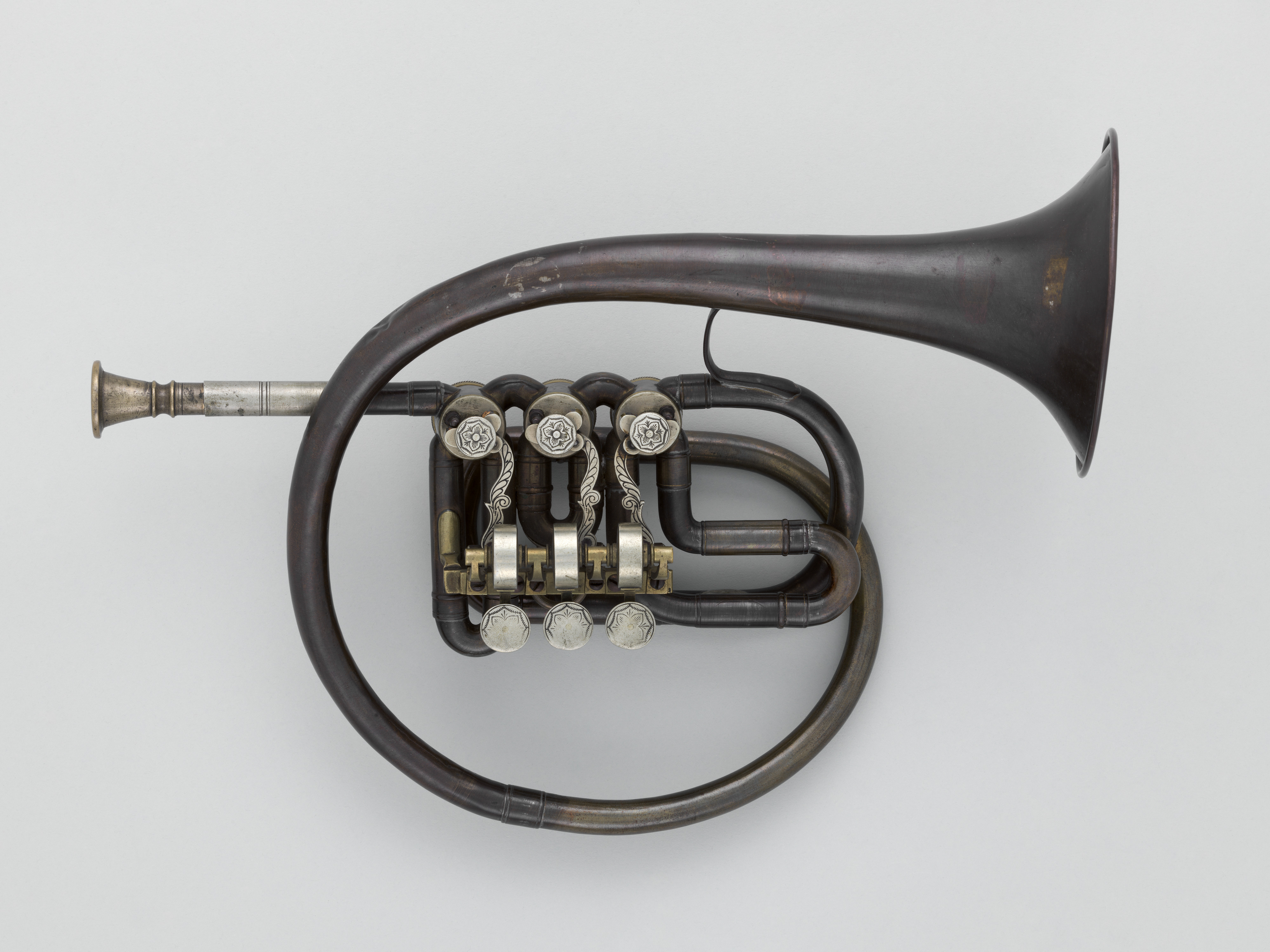
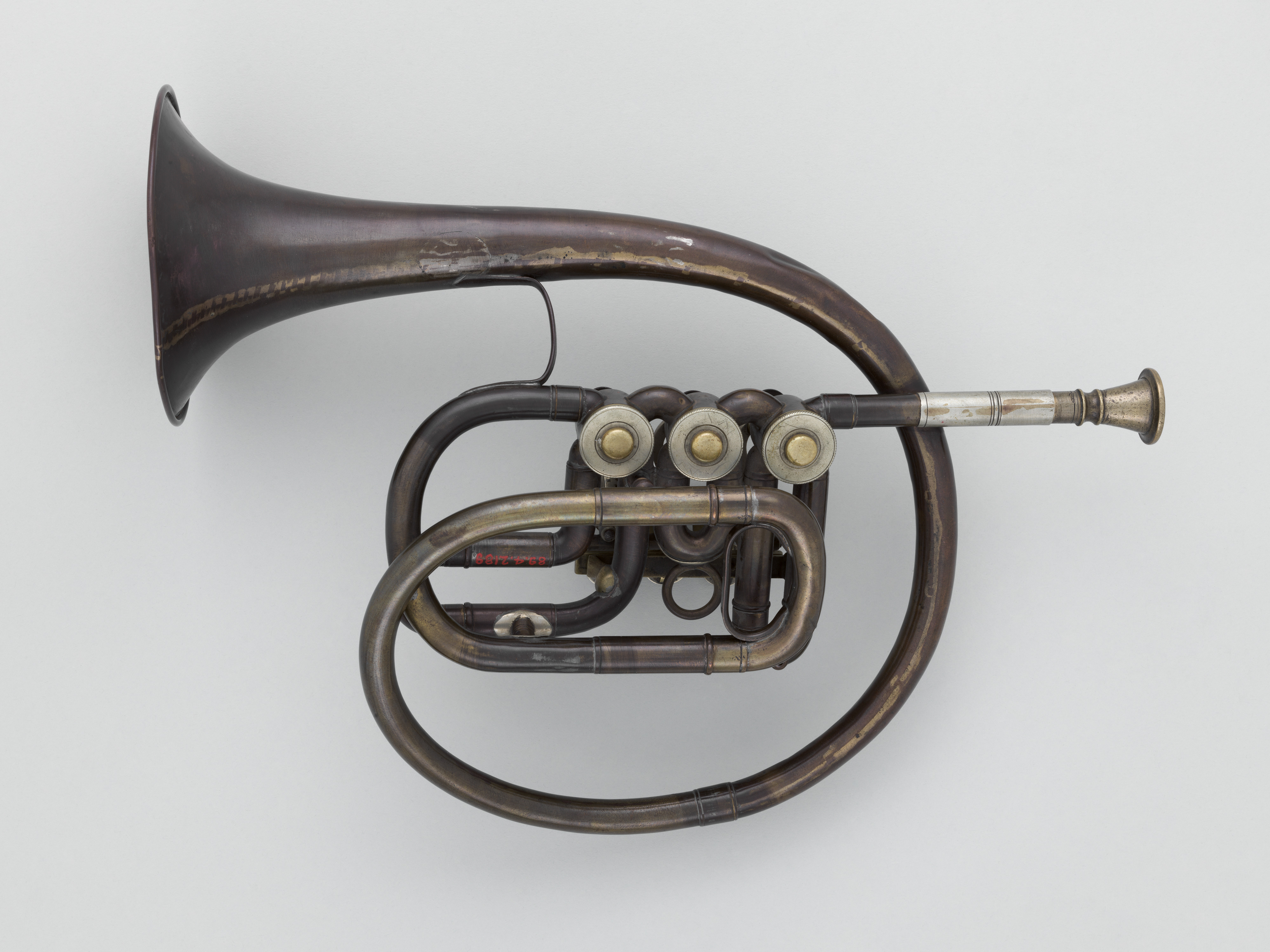


Helicon
Helicon
| Category | Brass |
|---|---|
| Country of origin | Russia / Central Europe (mid-19th century) |
| Classification | bass, brass instrument, valve horn |
| Wikipedia | en.wikipedia.org |
| Wikidata | Q779650 |
Listen
Audio: OKK, CC0 / via Internet Archive
Audio: lodsb, CC BY-SA / via Internet Archive
Audio: Helicon, CC0 / via Internet Archive
Overview
The helicon is a large valved brass instrument bent into a circular coil that fits around the performer’s torso, with the bell projecting upward and slightly forward across the left shoulder. Wikidata files it under the tuba family as a brass-instrument variant; DBpedia adds the Hornbostel-Sachs reading 423.232 — a valved aerophone sounded by the lips. It is a tuba in everything but shape: same fundamental pitch, same valve mechanism, same playing technique, redesigned for portability.
The wraparound layout was the answer to a 19th-century practical problem: how to put a true contrabass voice on horseback or in a marching column without breaking the player’s back. The instrument is still in routine use today in Balkan and East European brass bands, in some military and equestrian bands worldwide, and as the immediate design ancestor of the American sousaphone.
Origin & History
The helicon emerged in Russia in the 1840s, generally attributed to instrument makers working with the Imperial cavalry’s musical needs, and reached its mature form in Vienna shortly after, where the maker Ignaz Stowasser is repeatedly named in 19th-century sources as the figure who codified the wraparound geometry that survives today. The MET’s specimen 504667 — a mid-19th-century soprano helicon in B-flat, possibly Italian, classified as Aerophone-Lip Vibrated and assembled from brass and nickel-silver — sits squarely in this first generation of the instrument.
Uptake was swift in eastern and central European military bands because the helicon was the first brass bass that could be played reliably by a marching or mounted musician. The Austrian, Russian, Italian, and later Yugoslav military traditions all built it into standard cavalry and infantry-band scoring through the second half of the 19th century. Civilian brass bands in the same regions followed.
In the United States the bandleader John Philip Sousa famously asked the maker J. W. Pepper, and later C. G. Conn, for a redesigned helicon with a more forward-pointing bell, which became the sousaphone in the early 1890s. The helicon proper continued in use in the US for some decades but was steadily displaced by the sousaphone in marching contexts, while in central and eastern Europe the original wraparound helicon design has remained the standard.
Construction & Materials
A helicon is a single continuous brass tube — typically about 5 to 5.5 metres long for the standard BB-flat contrabass, longer for the rarer CC variant — bent into a coil whose inner diameter fits over the player’s left shoulder. Three or four piston or rotary valves are mounted at chest height. The bell is small to moderate in diameter (about 35 to 45 cm) and points upward and slightly forward.
Materials are conventional brass-instrument materials: yellow brass for the body, with nickel-silver bracing and trim on better-quality instruments. The MET’s 504667 specifically combines brass with nickel-silver, a typical mid-19th-century pairing. Total weight is in the 8 to 12 kg range — heavy, but distributed across the shoulder rather than balanced in the hands, which is the entire design point.
How It’s Played
Embouchure, breath support, and valve technique are identical to those of any other tuba. The instrument rests on the left shoulder; the player’s left arm passes through the coil; the right hand operates the valves. Most playing is done seated or standing on parade, but the design allows comfortable performance while marching, riding, or moving on stage.
Repertoire technique includes the full standard tuba range — about three and a half octaves usable from the contrabass register — and the same articulation, dynamics, and ensemble-balance roles as the orchestral tuba. The instrument’s bell direction (upward) gives a slightly different projection profile from the upright concert tuba, particularly in outdoor settings.
Cultural Significance
The helicon is most strongly associated today with the Balkan brass-band tradition — the village and military brass ensembles of Serbia, Macedonia, Bulgaria, and Romania that supply the soundtrack to weddings, festivals, and the Guča Trumpet Festival. In these bands the helicon supplies the rhythmic-and-harmonic floor that allows the trumpet section to push the melody forward without losing the dance pulse.
The instrument also retains a place in Italian banda traditions of southern Italy, in some Russian and Ukrainian military bands, and as a specialist period instrument in 19th-century music reconstruction projects. In US contexts it is mostly a museum object today, though some collegiate and historical-band programmes maintain working examples.
Notable Examples & Recordings
- MET object 504667 — mid-19th-century soprano helicon in B-flat, brass and nickel-silver.
- Boban Marković Orkestar, Fanfare Ciocărlia, Kočani Orkestar — Balkan brass-band recordings with helicon as the fixed bass voice.
- Goran Bregović’s Underground film score (Emir Kusturica, 1995) and Time of the Gypsies — both built around the Balkan brass-band sound.
- Standard repertoire reference: any brass-band field recording from the Guča festival in Serbia.
Related Instruments
- Tuba — the upright concert relative; same pitch, different geometry.
- Sousaphone — the American 1890s redesign of the helicon for marching bands.
- Euphonium — the tenor member of the wider conical-bore brass family.
- — Adolphe Sax’s 1840s-onward family of valved brass that competed with the helicon for military-band space.
- French horn — the orchestral upper-brass cousin.
- Flugelhorn — the conical-bore soprano-brass cousin.
Where to Hear It
Live: the Guča Trumpet Festival in western Serbia (every August) is the largest single annual gathering of working helicons in the world. Balkan brass bands tour internationally; Italian banda festivals in Puglia and Calabria are a second reliable venue. In museum settings, the MET in New York, the Musikinstrumenten-Museum in Berlin, the Kunsthistorisches Museum’s collection of historic musical instruments in Vienna, and the Russian National Museum of Music in Moscow all hold significant 19th-century specimens.
- Wikipedia: Helicon (instrument)
- Wikidata: Helicon (Q779650)
- DBpedia: Helicon
- MET Object 504667 (Soprano helicon, mid-19th c.)
- Wikimedia Commons: Helicons
Learning Resources
A new student or intermediate helicon from a working European maker (Cerveny in the Czech Republic and B&S in Germany are the two main contemporary manufacturers) costs roughly 4,000 to 8,000 USD; period and antique instruments range much wider. Pedagogically the instrument is approached through standard tuba method works — Arban’s Complete Method (in the tuba edition), Phillips’s Solos for the Tuba Player, and Roger Bobo’s pedagogy — supplemented by Balkan brass-band ensemble experience for players targeting that repertoire.
Frequently Asked Questions
Is the helicon the same as a sousaphone?
No, but the sousaphone is a direct descendant. John Philip Sousa commissioned the redesign in the early 1890s, asking for a more forward-pointing bell. The wraparound coil and the shoulder-mounted weight distribution are essentially identical.
Why is the helicon shaped like a circle?
So that the player can carry it comfortably across the shoulder while marching, riding, or standing for long periods. The original 19th-century military requirement was for a true brass bass usable on horseback.
Is the helicon still made today?
Yes. Cerveny (Czech Republic), B&S (Germany), and a small number of specialist Balkan and Italian makers produce new instruments. The Balkan brass-band tradition keeps demand alive.
Does it sound different from a regular tuba?
The fundamental sound is identical, but the upward-pointing bell projects differently from the upward-and-back-facing tuba bell, and the shoulder posture changes the player’s body resonance. In ensemble contexts the difference is audible mainly in outdoor or marching settings.
What range does it cover?
The standard contrabass helicon in BB-flat covers roughly the same three-and-a-half-octave working range as the orchestral BB-flat tuba — from about BB1 upward.