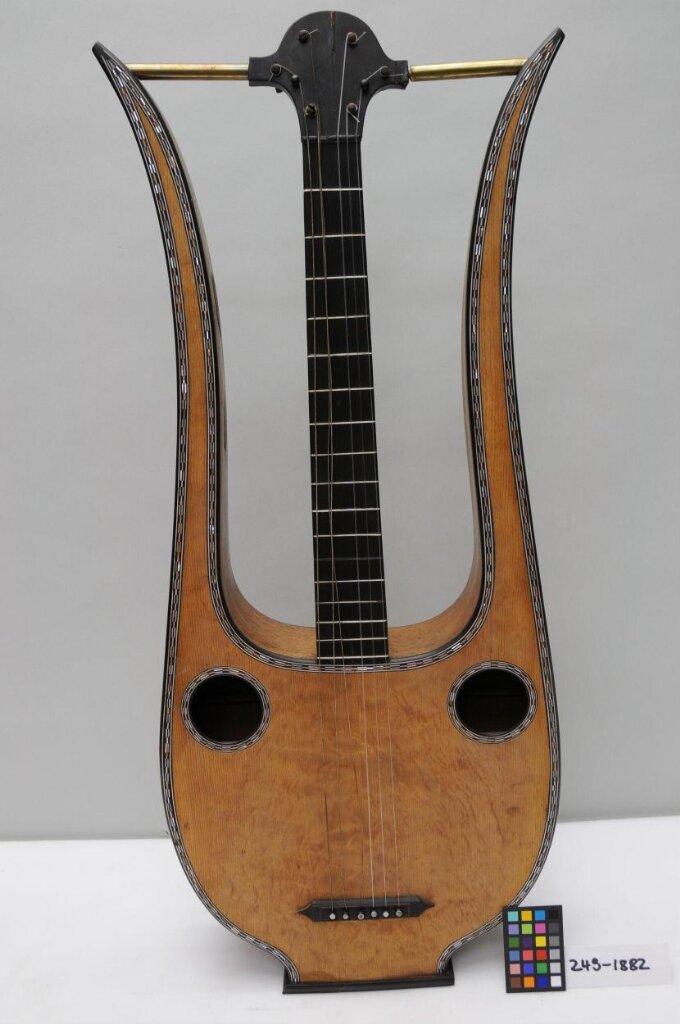
Image: Victoria and Albert Museum, London, CC BY 4.0 — via Wikimedia Commons
Kent guitar
| Category | Strings (electric guitar) |
|---|---|
| Country of origin | Japan / USA (importer) |
| Classification | brand, electric guitar, product |
| Wikipedia | en.wikipedia.org |
| Wikidata | Q6391253 |
Overview
Kent was a brand of inexpensive Japanese-built electric guitars and basses imported into the United States during the 1960s by the New York distributor Buegeleisen & Jacobson. The Kent name appeared on instruments built by several Japanese factories, including Teisco, Guyatone, and Hayashi, and the resulting line ranged from very basic student instruments to more ambitious models with multiple pickups, vibrato units, and unusual body shapes typical of the Japanese guitar industry of the period.
Origin & History
Buegeleisen & Jacobson began importing Japanese instruments under the Kent brand in 1962 to meet the surge in American demand for affordable electric guitars during the early-1960s rock-and-roll boom. The instruments were sourced from a rotating set of factories in Japan, which is why surviving Kent guitars vary widely in construction, hardware, and pickups. The brand survived through the late 1960s before being squeezed out by stronger Japanese-import brands and by the rapid quality improvement of those competitors. By the early 1970s the Kent name had largely disappeared from the US market.
How It’s Played
A Kent guitar plays as a mid-quality 1960s electric. Most models were short or medium scale, with thin necks and high-output ceramic pickups that deliver a bright, somewhat raw tone. Bridges and vibrato units were often the simple sheet-metal designs common to Japanese instruments of the era — adequate for casual playing, less precise for demanding work. With careful setup many examples make capable garage-rock and surf instruments, which has driven their modern popularity.
Cultural Significance
Kent guitars are part of a wider story about how Japanese makers entered the global guitar market in the 1960s. They are now collected as a budget-friendly window into 1960s Japanese manufacturing and as instruments with a distinctive jangly, slightly trebly voice prized in garage-rock revival circles. They also illustrate how American distributors built private-label programmes to meet demand that domestic factories could not satisfy.
Related Instruments
- Yamaha BB – later Japanese instrument with international reputation
- Cort MBC-1 Matthew Bellamy Signature – Korean-built modern import
- Fender Katana – a Japan-only Fender
- Ibanez Universe – major Japanese export brand
- Vox Phantom – contemporary low-cost European/Italian import
Frequently Asked Questions
Was Kent a guitar manufacturer?
No — Kent was an import brand. The instruments were built in Japan by various factories.
Which factories built Kent guitars?
Teisco, Guyatone, and Hayashi are among the documented makers.
Are Kent guitars valuable today?
They are inexpensive on the vintage market but are increasingly collected by garage-rock and surf-music players.