

Mouth Bow
Musical bow / mouth bow
| Category | Chordophone |
|---|---|
| Country of origin | Pan-global (Paleolithic) |
| Classification | family of musical instruments |
| Wikipedia | en.wikipedia.org |
| Wikidata | Q1630744 |
Listen
Audio: Aarchiba~commonswiki, Public domain / via Wikimedia Commons
Overview
The mouth bow — also known as the musical bow — is the simplest functional chordophone: a single flexible stick bent into an arc by a single string stretched between its two ends. Wikidata classifies it under bar zither. To produce a tonal result the player either uses the mouth as a variable resonator (the mouth bow proper), attaches a gourd or other physical resonator (the gourd bow), or strikes the string against a fixed cavity such as a pit dug in the ground (the earth bow).
The instrument is reasonably regarded by historians of music as one of the oldest surviving chordophone designs, and its possible derivation from the hunting bow has been a long-running argument in ethnomusicology since the early 20th century. It survives in regular musical use across southern Africa, Brazil (via the Afro-Brazilian berimbau), the Appalachian United States, parts of central Asia, and a number of Pacific and South American traditions.
Origin & History
The hunting-bow-as-music-instrument hypothesis was set out in the 1929 work of Curt Sachs and his colleagues, drawing on Henry Balfour’s earlier comparative survey of musical bows (1899). The argument is straightforward: the hunting bow predates documented history; a hunter who plucks the bowstring while holding the bow near the mouth produces a faintly audible tone whose pitch the mouth can shape; from this trivial observation a musical practice can develop, and the same practice can be invented independently in any culture that uses bows. The argument cannot be proved, but it is consistent with the global distribution of the instrument.
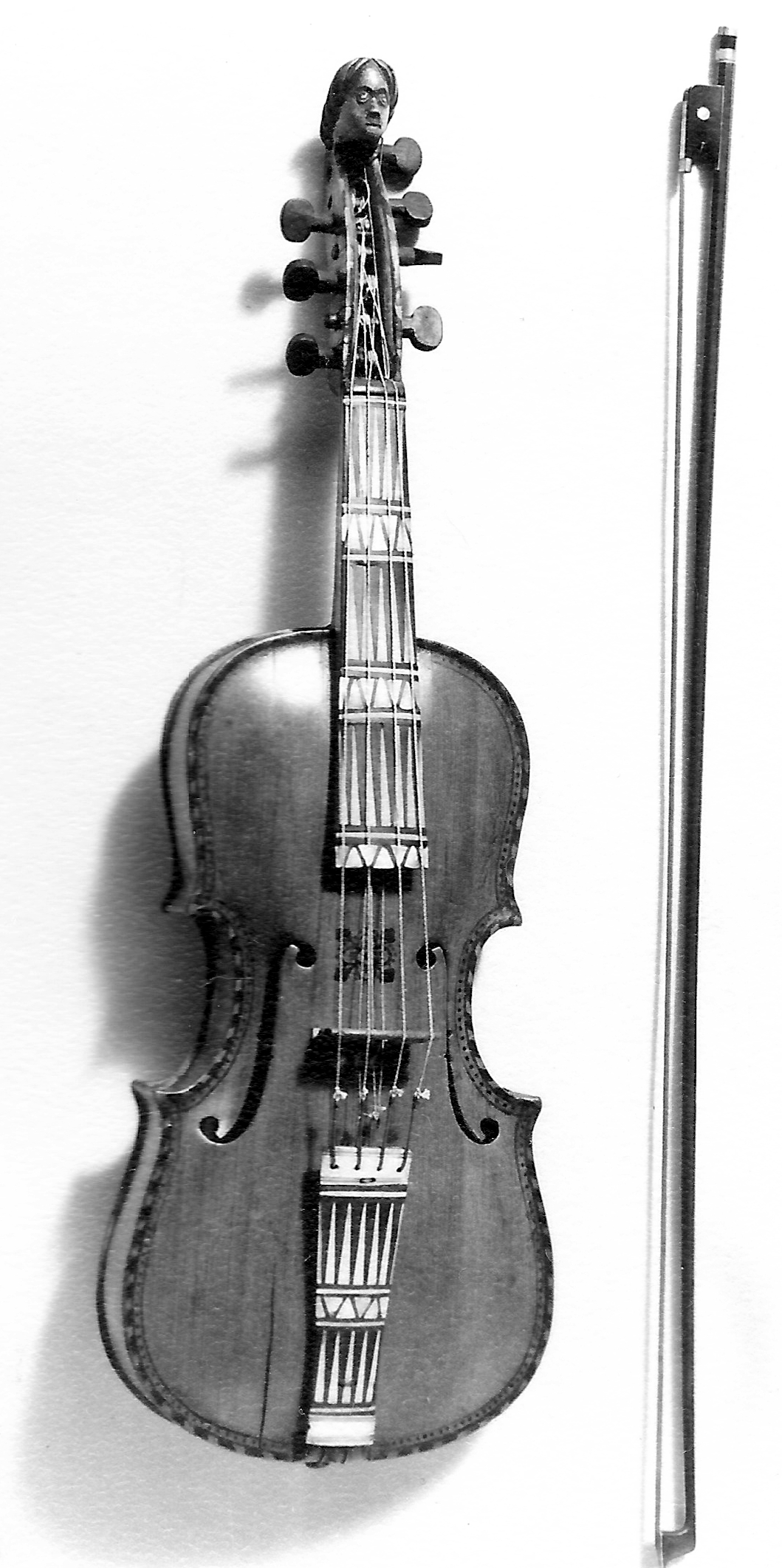
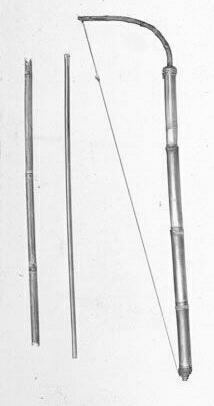
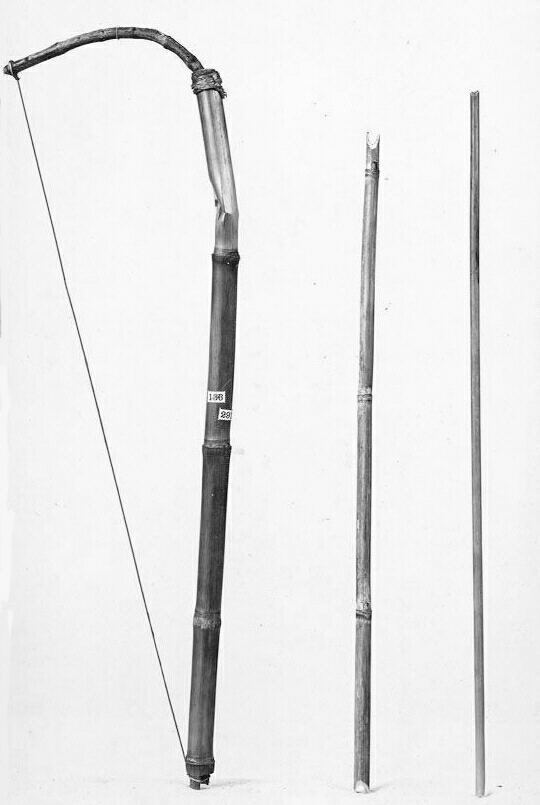
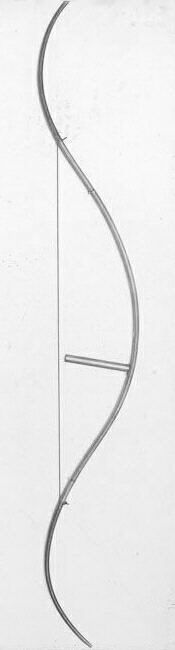
The MET collection illustrates this distribution at object level. Specimen 505233 is a 19th-century Norwegian wood-and-hair bow; 505372 is a Chinese bamboo musical bow from about 1850-89; 501165 is a late-19th-century South African bamboo bow; 502272 is a late-19th-century African bow of wood, bamboo, and string. The Norwegian object is unusual — bow-music traditions are rare in northern Europe — and is more likely a hunting-bow specimen included in the musical-instruments classification because of its bow shape. The other three are textbook examples of the southern African and East Asian musical-bow traditions.
The earliest convincingly musical-bow imagery is the so-called Trois-Frères cave in the French Pyrenees (Magdalenian period, roughly 13,000 BCE), where a figure appears to hold a curved object to the mouth. The interpretation is debated, but most archaeologists who accept any musical reading place it as the earliest possible chordophone evidence.
Construction & Materials
A working mouth bow requires only three components: a flexible piece of wood or bamboo (typically 60 cm to 1.5 m long), a single string (gut, sinew, plant fibre, wire, or in modern instruments steel), and a way to keep the string under tension. The string is fixed at both ends of the stave; the stave’s elastic tension keeps the string taut.
In gourd-bow variants — the southern African uhadi and umrhubhe, the Brazilian berimbau — a half-gourd is attached near one end of the stave to function as a fixed resonator. In mouth-bow variants the player holds one end of the bow against the open mouth and uses tongue, cheek, and jaw position to select which harmonic of the fundamental string note is amplified. In earth-bow variants the string passes over a flexible stick anchored above a covered hole in the ground.
How It’s Played
The mouth-bow technique is the most distinctive. The player plucks the string with a finger or a small wooden tapper while holding one end of the stave near the open lips. The mouth cavity acts as a tunable resonator: changing mouth shape selects which natural overtone of the string is heard most strongly. The resulting effect is a single low fundamental note with a clear melodic line of overtones layered above it — broadly comparable to the technique of Tuvan and Mongolian throat-singing, transposed onto a string instrument.
In gourd-bow technique the resonator is fixed, so melody is produced by stopping the string at one point along its length (often with a coin or a small stone, as in the Brazilian berimbau). In earth-bow technique the player stamps on the stick or plucks directly.
Cultural Significance
In southern Africa the musical bow remains an active part of Xhosa, Zulu, San (Khoisan), and Tsonga musical practice. The Xhosa uhadi and umrhubhe are central to women’s vocal tradition; Madosini (Latozi Mpahleni, 1943-2022) was the most internationally recognised modern uhadi player and won the 2004 Tobacco Road Music Award for her recordings.
In Brazil the berimbau — a gourd-bow with a coin or stone for stopping — is the rhythmic and ritual centre of capoeira, the Afro-Brazilian martial art and dance. The instrument arrived from Angola with enslaved Africans and developed its modern form in Bahia.
In the United States the Appalachian mouth bow survives in southern folk traditions and was popularised in the 20th century by performers including Jim Couza and Jimmy Driftwood. The basic technique — bow held to the mouth, string plucked, melody shaped by oral cavity — is identical to the southern African form.
Notable Examples & Recordings
- Madosini, Power to the Women (M.E.L.T. 2000, 2003) — Xhosa uhadi and umrhubhe traditional repertoire.
- Mestre Bimba — historical recordings of capoeira berimbau (the gourd-bow form) from 1940s and 1950s Bahia.
- Naná Vasconcelos, Saudades (ECM, 1980) — solo berimbau in a contemporary jazz idiom.
- Jimmy Driftwood, The Wilderness Road — Appalachian mouth-bow on a US folk-music recording.
Related Instruments
- Berimbau — the Afro-Brazilian gourd-bow used in capoeira.
- — the Xhosa gourd-bow.
- — the Xhosa mouth-bow.
- — the variant with a ground-anchored resonator.
- — a different instrument family that uses the same mouth-as-resonator principle.
- Khomus — the central Asian Jew’s-harp relative.
- — the probable structural ancestor.
Where to Hear It
In southern Africa the bow appears at festivals such as Cape Town’s Tribal Echoes and the Standard Bank Joy of Jazz; village settings remain the strongest venue. Brazilian berimbau is unmissable in any capoeira class anywhere in the world. North American mouth-bow appears at Appalachian folk festivals — the Cosby Folk Festival, the Mountain Music Festival in Galax, Virginia. Recordings on labels such as Smithsonian Folkways, M.E.L.T. 2000, and Lyrichord document the field tradition.
- Wikipedia: Musical bow
- Wikidata: Musical bow (Q1630744)
- DBpedia: Musical bow
- MET Object 505372 (Chinese musical bow, c.1850-89)
- MET Object 501165 (South African musical bow, late 19th c.)
- MET Object 502272 (African musical bow, late 19th c.)
- Wikimedia Commons: Musical bows
Learning Resources
A working Appalachian mouth bow can be built from a hardwood sapling and a length of guitar string in an afternoon — total material cost under 10 USD. South African gourd bows are available from specialist makers in Cape Town and Johannesburg from about 80 USD. Berimbaus are widely available from capoeira-equipment vendors at 30 to 100 USD. Pedagogically, the instrument is best learned in person; the southern African oral tradition has no published method works of note. Madosini’s recordings and the Smithsonian Folkways field recordings are the most accessible audio reference.
Frequently Asked Questions
Is the mouth bow really the oldest string instrument?
It is the oldest design we know of, but no specific physical specimen has survived in the archaeological record because the materials degrade. Probable cave-painting evidence dates to about 13,000 BCE.
Is the mouth bow the same as the berimbau?
The berimbau is the Afro-Brazilian gourd-bow form. It is part of the same wider musical-bow family but has a fixed gourd resonator rather than the mouth.
How do you change pitch on a mouth bow?
By changing the shape of the mouth cavity, which selects which natural overtone of the string fundamental is amplified. Pitch is selected from a fixed harmonic series rather than by stopping the string.
Is the mouth bow related to the hunting bow?
Probably yes — the basic structural identity is too close to be coincidence. The hunting-bow-to-musical-bow hypothesis has been the standard ethnomusicological account for over a century.
Is the mouth bow still played today?
Yes, in southern Africa (Xhosa, Zulu, San), Brazil (berimbau), the southern Appalachian United States, and pockets of central Asia and the Pacific.