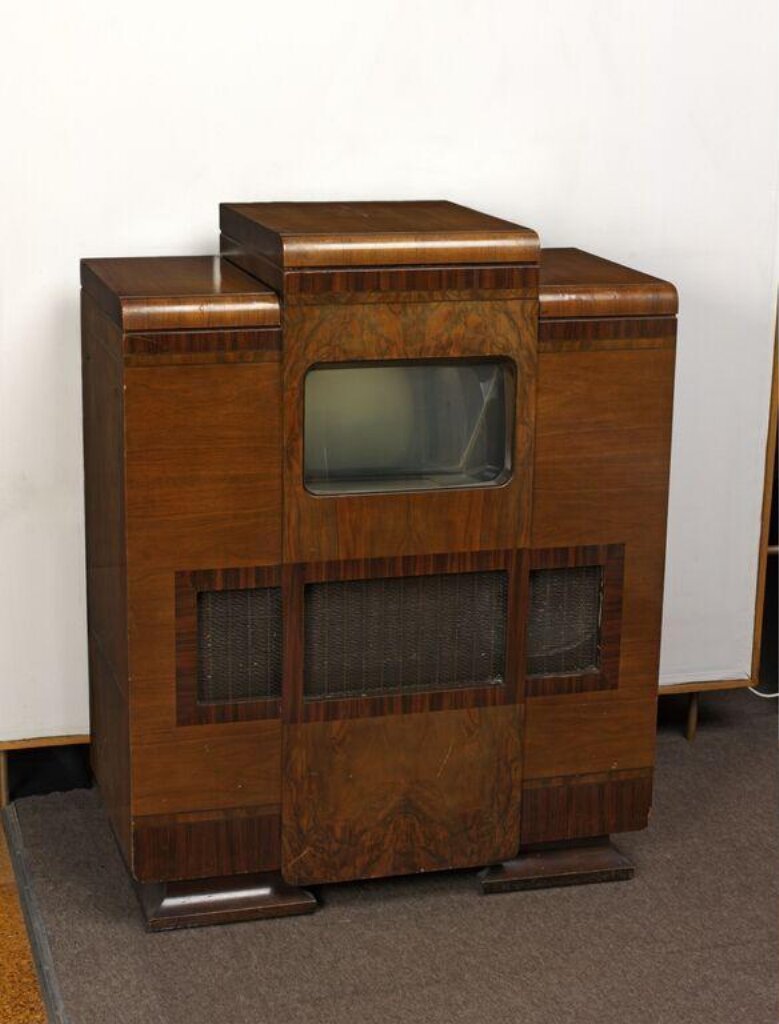
Image: Victoria and Albert Museum, London, CC BY 4.0 — via Wikimedia Commons
Record Changer
| Category | Studio (turntable mechanism) |
|---|---|
| Country of origin | USA / multiple |
| Classification | turntable |
| Wikipedia | en.wikipedia.org |
| Wikidata | Q7302847 |
Overview
A record changer is a turntable mechanism that plays a stack of phonograph records in sequence without operator intervention. Once popular as a feature of home phonographs and consoles from the 1920s through the 1970s, the changer drops each disc from a vertical spindle onto the platter, plays it, lifts and returns the tonearm, and then loads the next record. Modern audiophile turntables generally do not use the format, but the mechanism remains a defining piece of mid-twentieth-century domestic listening hardware.
Origin & History
Early experiments with automatic record changers appeared in the 1920s, and the format matured during the 78 rpm era when long musical works required several discs. The introduction of the LP and the 45 rpm single in 1948–1949 prompted further developments — RCA Victor’s 45 rpm changer with its large central spindle was among the most widely sold mechanisms — and through the 1960s and early 1970s, changers from Garrard, Dual, BSR, and others became standard equipment in family living-room consoles.
How It’s Played
The user stacks several discs on the spindle, sets the tonearm and the speed, and starts the mechanism. After each side, the tonearm lifts and returns to its rest, the next disc drops, and the mechanism resumes. Some changers can play either side of a disc through a flip mechanism; most simply play one side per pass.
Cultural Significance
The record changer shaped how households listened to recorded music in the middle of the twentieth century. Album sequencing in the 78 era was designed around changer drops; the LP format substantially reduced the need for a changer, but the format persisted into the 1970s on consumer hardware. Audiophile and DJ turntable culture from the 1970s onward moved decisively away from changers.
Related Instruments
- Disklavier – mechanical-playback piano relative
- Duo-Art Piano – earlier reproducing-piano kin
- Birotron – tape-replay descendant
- Panharmonicon – mechanical-music ancestor
- Perroquette – historical mechanical relative
Frequently Asked Questions
Are record changers still made?
A small number of new changers are produced for the nostalgia market; serious audiophile and DJ turntables do not use the format.
Are changers bad for records?
Stacking can scuff the playing surface of the disc below; modern audiophile practice avoids the format for that reason.
Which manufacturers were known for changers?
RCA Victor, Garrard, Dual, BSR, Webcor, and Voice of Music among others.