

Balalaika
балалайка
| Category | Strings |
|---|---|
| Country of origin | Russia |
| Classification | type of musical instrument |
| Wikipedia | en.wikipedia.org |
| Wikidata | Q178389 |
Listen
Audio: Jeuwre, CC BY-SA 4.0 / via Wikimedia Commons
Audio: Rovdyr, CC BY 2.5 / via Wikimedia Commons
Audio: Isaacmayer9, CC BY-SA 4.0 / via Wikimedia Commons

Overview
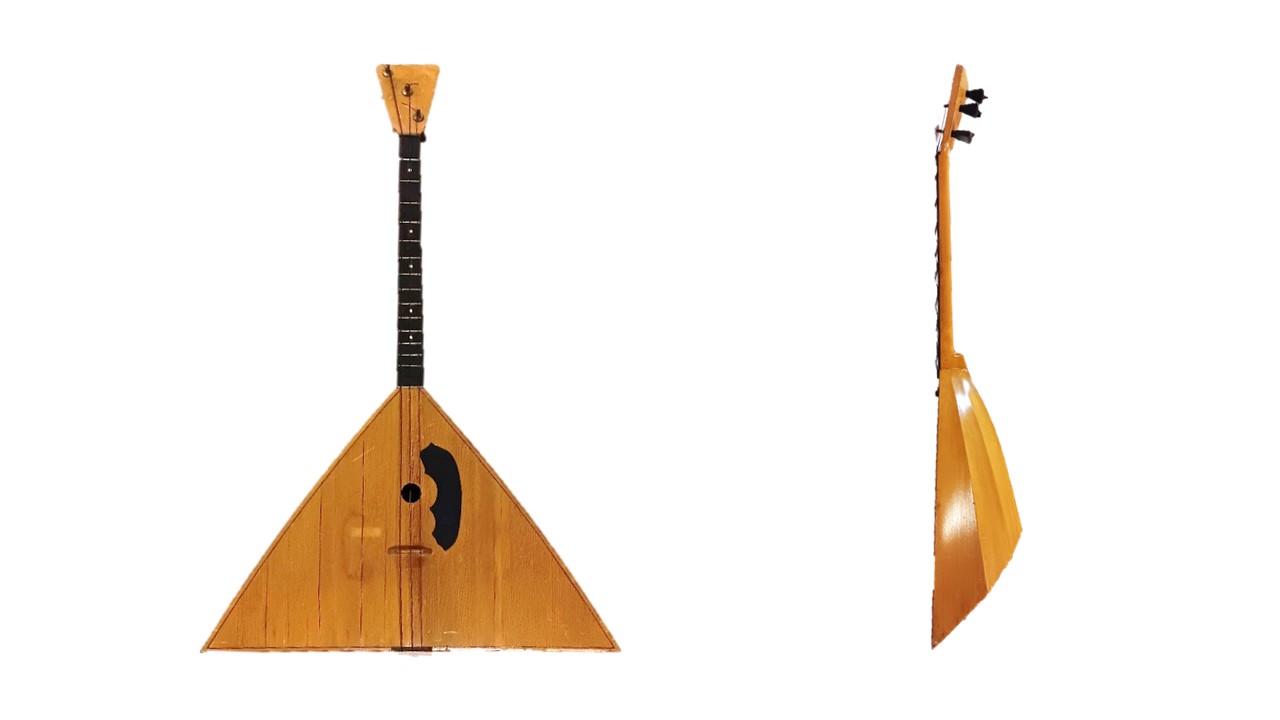
The balalaika is a triangular-bodied long-necked plucked lute with three strings, used across Russia and the wider Russian-speaking world. Its instantly recognisable flat triangular body, made of laminated hardwood, supports a long fretted neck carrying three strings tuned (in the standard prima balalaika) to E-E-A. Played with the fingers or with a thin plectrum, it has a bright, crisp tone with strong sustain, particularly on the rapid tremolo strokes that have become its trademark technique.
The Hornbostel-Sachs system classifies the balalaika as 321.321 — a composite chordophone played with a plectrum or fingers — and DBpedia records its development period as “late 18th to early 19th centuries”, with a separate late-20th-century revival. That two-stage history is important for understanding the instrument: the modern concert balalaika is largely a product of a deliberate late-19th-century reform, not of unbroken folk transmission.
Origin & History
A roughly built triangular-bodied folk lute called the balalaika is documented in Russia from at least the early 18th century. Surviving illustrations and written descriptions show a much simpler instrument than the one used today — handmade, often with gut frets tied to the neck, and used primarily as an accompaniment for folk songs and dances in rural settings.
The decisive transformation came in the 1880s through the work of the musician and arranger Vasily Andreyev. Working with luthier Franz Paserbsky, Andreyev produced a standardised, factory-quality balalaika family with five sizes (prima, secunda, alto, bass, contrabass), proper metal frets in the equal-tempered Western chromatic scale, and a uniform tuning system. He then assembled the world’s first balalaika orchestra in 1888 and toured the new instrument widely across Russia and Europe.
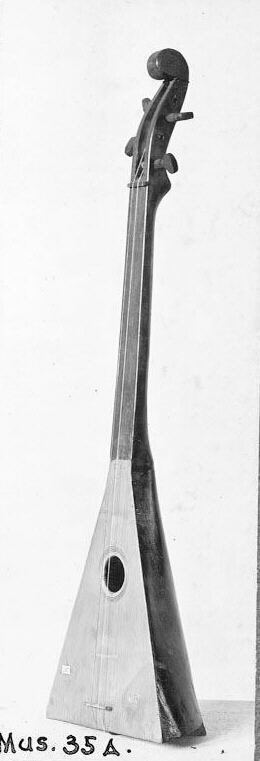
The Metropolitan Museum of Art’s two surviving 19th-century Russian balalaikas (objects 500941 and 500942) date from this period of standardisation and document the modern instrument as it stabilised. Both are listed simply as wood-bodied, reflecting the relatively austere construction of the period.
Construction & Materials
A modern balalaika is built around a flat triangular back assembled from multiple thin staves of hardwood — typically maple, mahogany, or birch — glued edge to edge. The flat soundboard is usually spruce. Three strings (traditionally gut, today most often nylon for the lower two and steel for the highest) run from a fixed bridge to tuning pegs on a flat peg head.
The standard prima tuning — E, E, A — places the bottom two strings at an identical pitch, with the highest string set a fourth above. This unusual tuning is one of the legacies of the Andreyev reform and is essential to the instrument’s chord voicings and tremolo technique. The five sizes of the Andreyev balalaika family (prima, secunda, alto, bass, contrabass) cover a wide range and together form the basis of the Russian balalaika orchestra.
How It’s Played
The player typically holds the balalaika upright on the lap, with the body resting against the abdomen and the neck angled up to the left. Sound is produced by striking the strings with the index finger’s outer edge, by sweeping all four fingers across the strings in a brushing motion, or — in some modern repertoire — by using a small plectrum. The left hand presses the strings against the fretted neck.
The defining technique is the rapid tremolo, produced by alternating up and down strokes with the index finger to sustain a single note or chord across long phrases. Other characteristic techniques include the vibrato produced by left-hand finger pressure, pizzicato with the left hand, and rapid arpeggio sweeps across the three strings.
Cultural Significance
The balalaika in its modern Andreyev form is one of the most recognisable Russian instruments and a central voice in the Russian folk-orchestral tradition. The Andreyev orchestra and its successors created a substantial concert repertoire — including many arrangements of Russian folk songs and Western classical works — and the instrument also became part of the standard Soviet-era folk-music export, touring widely in Europe, North America, and Asia throughout the 20th century.
In contemporary Russia, the balalaika continues to occupy two distinct cultural spaces. The Andreyev orchestral tradition remains active in conservatories and folk-music institutions, with players such as Alexei Arkhipovsky bringing it to large international audiences. A separate revival of pre-Andreyev folk balalaika playing — using older tunings, gut frets, and looser construction — has also gained ground among traditional-music enthusiasts.
Notable Examples & Recordings
Two nineteenth-century Russian balalaikas held by the Met (objects 500941 and 500942) are particularly useful because they date from the period of the Andreyev standardisation and document the instrument as it took its modern form. For listening, recordings by Alexei Arkhipovsky (modern virtuoso playing), the Russian state folk orchestra named for Nikolai Osipov (carrying forward the Andreyev orchestral tradition), and the broader Russian folk revival together cover the instrument’s expressive range.
Related Instruments
- Domra – the round-bodied Russian plucked lute often paired with balalaika in folk orchestras
- Gusli – the Russian plucked zither
- Bandura – the Ukrainian plucked harp-lute
- Kobza – the Ukrainian short-necked lute
- Mandolin – the Western European plucked lute, sharing the tremolo aesthetic
Where to Hear It
Russian folk-orchestra concerts and modern balalaika recitals are the natural settings for the instrument. The balalaika also appears regularly in Russian film and television scoring and in cross-cultural projects with classical, jazz, and rock musicians.
- Wikipedia: Balalaika
- The MET: Balalaika (object 500941)
- The MET: Balalaika (object 500942)
- Wikimedia Commons: Balalaika
Learning Resources
Beginners typically start with the prima balalaika and the standard E-E-A tuning, learning to produce a clean single-string stroke before moving on to the rapid tremolo and basic chord voicings. The Russian conservatory system has a well-established graded curriculum for the instrument, and structured online tuition by Russian and international players is increasingly available.
Frequently Asked Questions
Why is the balalaika triangular?
The triangular shape is a long-standing feature of the folk balalaika and was retained in the Andreyev reform of the 1880s. It is structurally efficient — easy to build from flat staves — and gives the instrument its instantly recognisable silhouette.
Why is the balalaika tuning so unusual?
The standard prima tuning — two strings set at the same pitch, with the highest string a fourth above — is a legacy of the Andreyev reform. It is essential to the instrument’s standard chord voicings and to the rapid tremolo technique that defines much of its modern repertoire.
How many sizes of balalaika are there?
The standard Andreyev family includes five sizes: prima, secunda, alto, bass, and contrabass. Together they form the basis of the Russian balalaika orchestra.
Are old balalaikas displayed in museums?
Yes. New York’s Metropolitan Museum of Art holds at least two 19th-century Russian balalaikas (objects 500941 and 500942), part of the Crosby Brown Collection acquired in 1889.
Is the balalaika difficult to learn?
Producing a basic tone and playing simple chord-based accompaniments is reasonably approachable. The rapid tremolo technique and the more virtuosic concert repertoire typically take several years of consistent practice.


