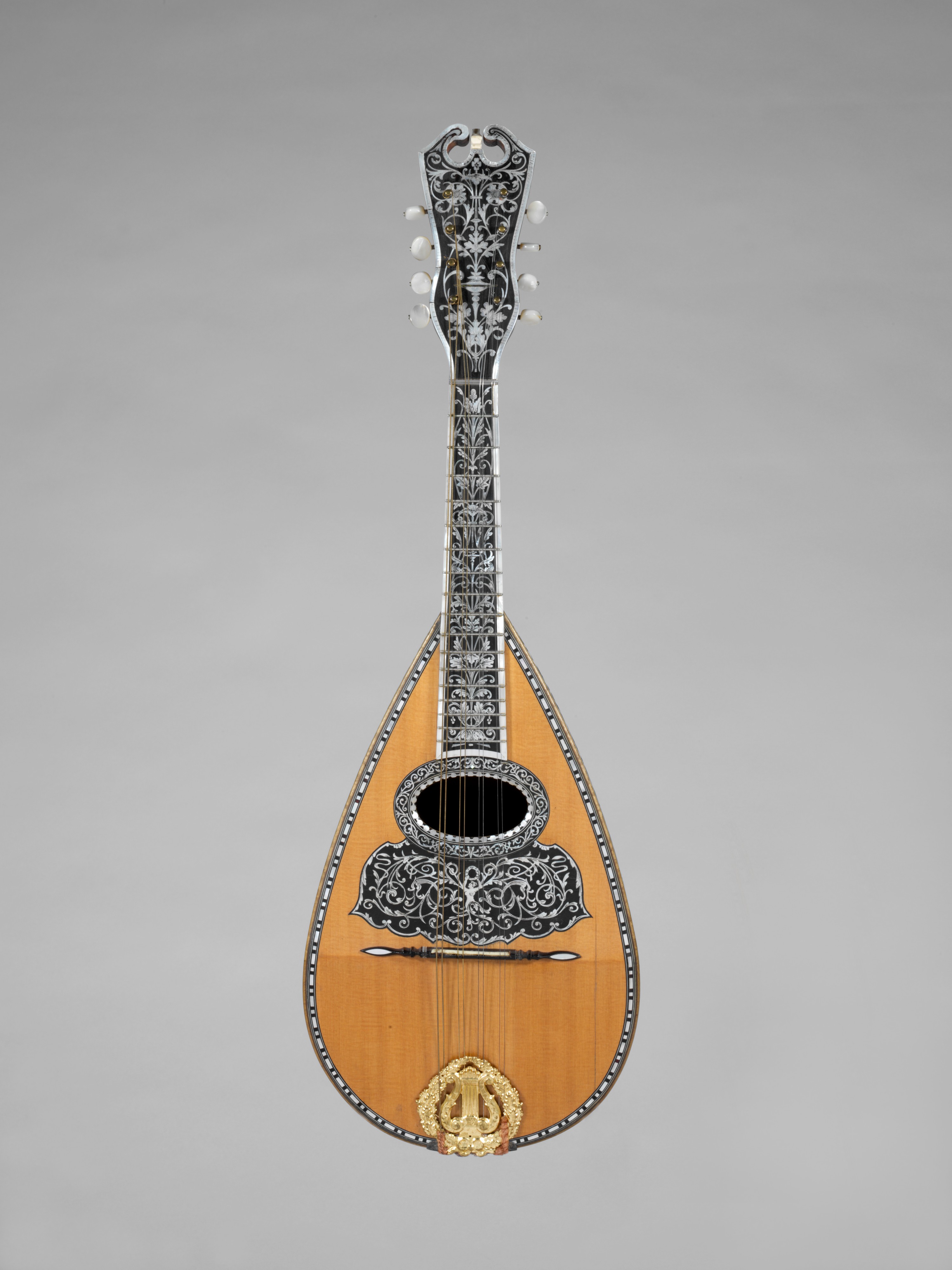

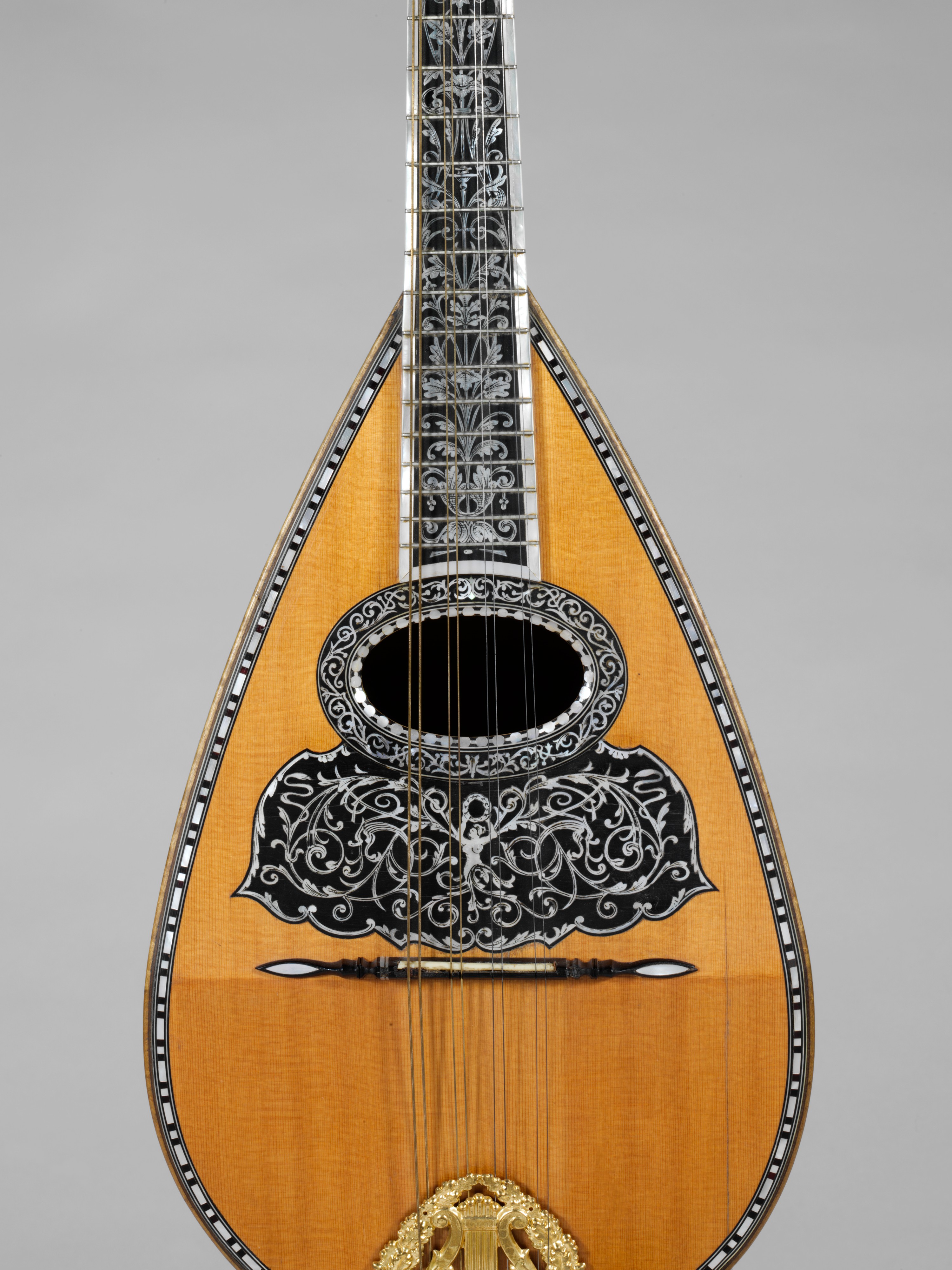
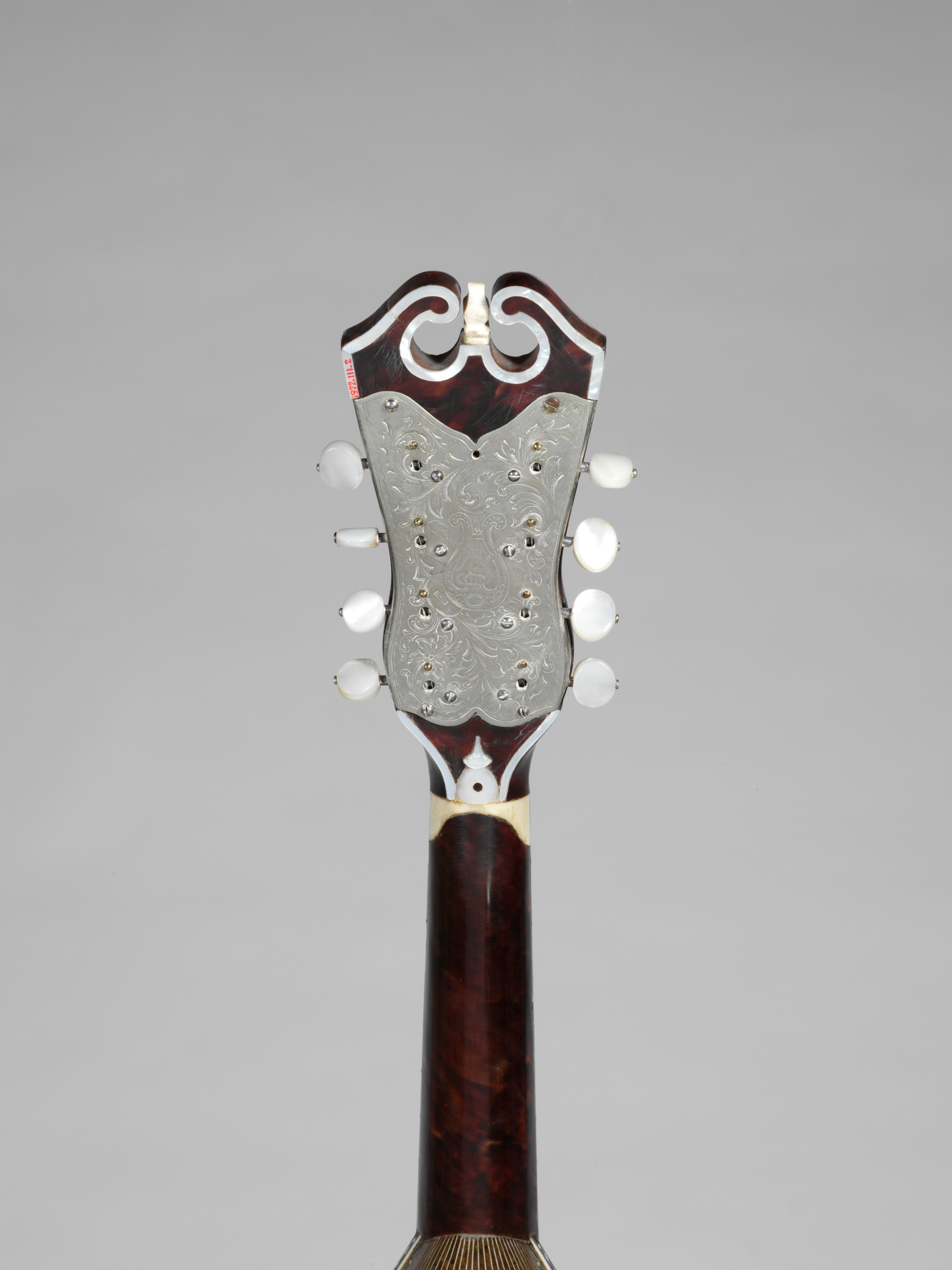
Mandolin
mandolino
| Category | Strings |
|---|---|
| Country of origin | Italy |
| Classification | type of musical instrument |
| Wikipedia | en.wikipedia.org |
| Wikidata | Q302497 |
Listen
Audio: Charles Scheuplein as Recordist & Estudiantina Melizianos as Vocal Group, Public domain / via Wikimedia Commons
Overview
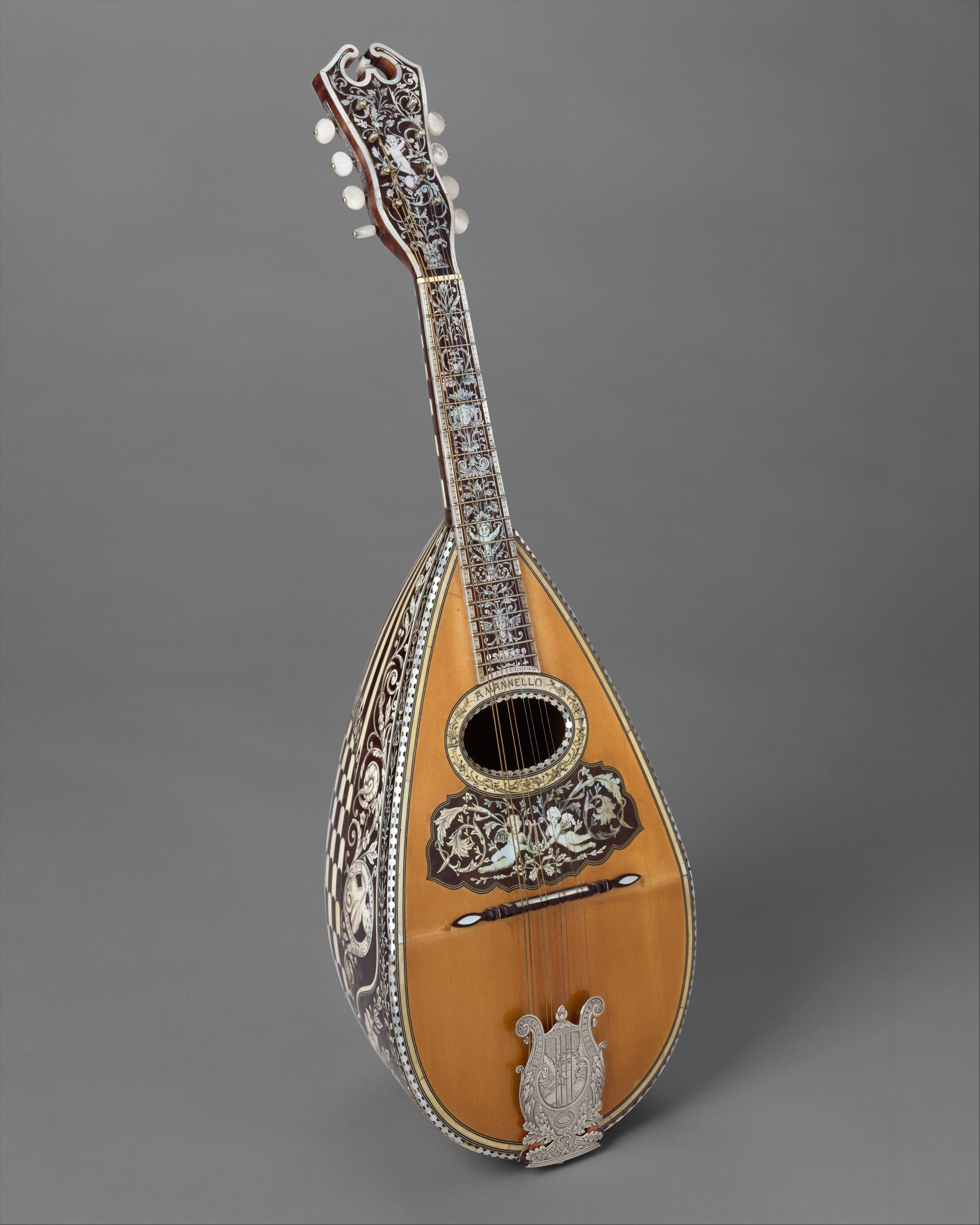
The mandolin is a small plucked string instrument with four pairs (or courses) of metal strings, tuned in fifths in the same intervals as the violin. It is most readily recognised today either as the bright lead voice of bluegrass music or as the round-backed Italian instrument associated with Neapolitan song.
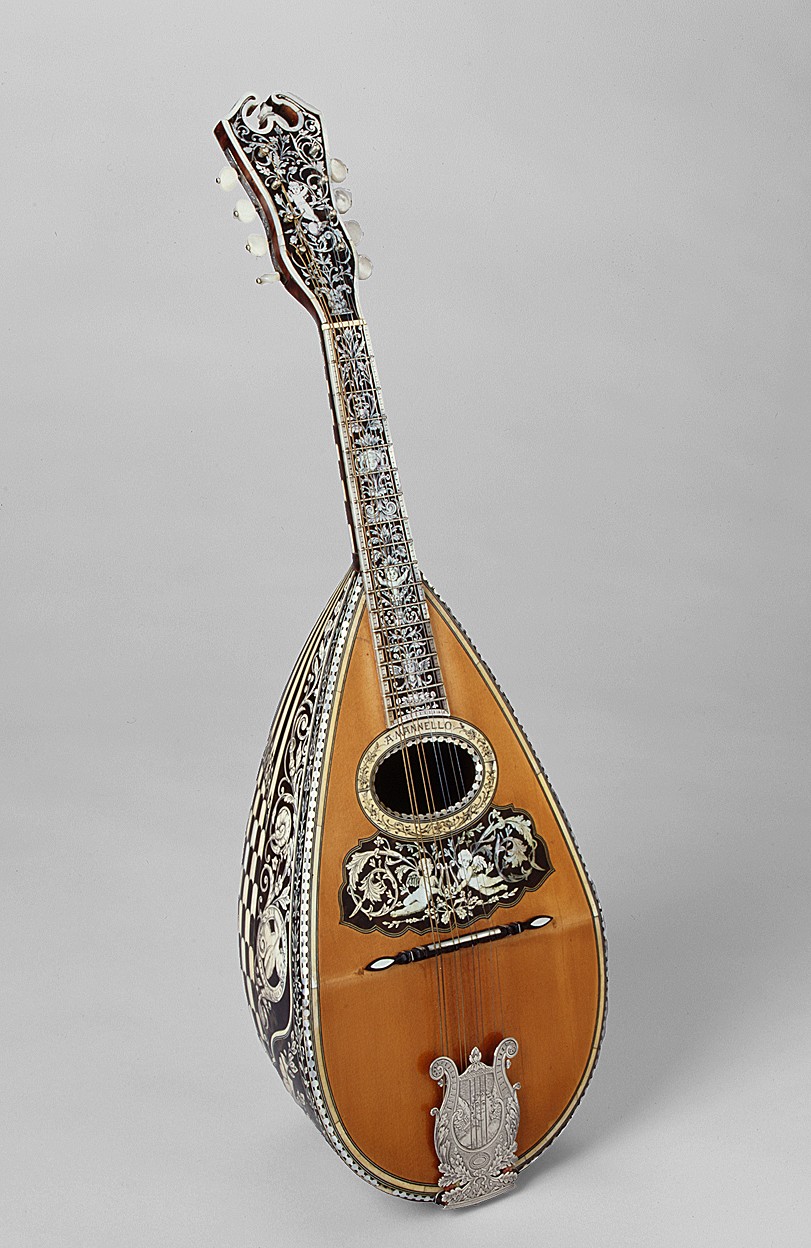
Both images are accurate, and both belong to a single instrument with a divided history: the older European bowlback mandolin and the younger American flatback or carved-top mandolin. The two share a tuning, a string layout, and a name, but almost nothing in their construction.
Origin & History
The mandolin is the modern descendant of the medieval Italian mandola, itself a small lute. The Neapolitan school of the mid-18th century established the instrument’s modern eight-string tuning (G–D–A–E in pairs) and the deeply rounded staved back that defines the European tradition. By the early 19th century the bowlback mandolin was a fixture of European parlour music and a popular accompaniment to song.
The decisive American transformation came at the end of the 19th century, when Orville Gibson in Kalamazoo, Michigan began carving mandolin tops and backs from solid wood — modelled, he said, on violin construction. By 1900 his instruments were on the market, and within twenty years the carved-top design (especially the F-style with its scrolled body) had become the American standard.
The Metropolitan Museum’s collection captures this exact transition window. Three American mandolins from 1898 to 1900 sit together in its Musical Instruments department: an 1898 walnut-and-spruce mandolin (MET object 700485), a 1900 spruce-and-maple instrument (MET 504480) and a circa-1900 spruce-and-tortoiseshell example (MET 503675). All three were made within five years of Gibson’s earliest carved-top experiments.
Construction & Materials
The Hornbostel-Sachs system places the mandolin in 321.321 (composite chordophones, plucked) — the same family number as the lute and the sitar. Strings are stretched over a flat or carved soundboard, anchored at the tail and tuned at the head, with a movable wooden bridge in between.
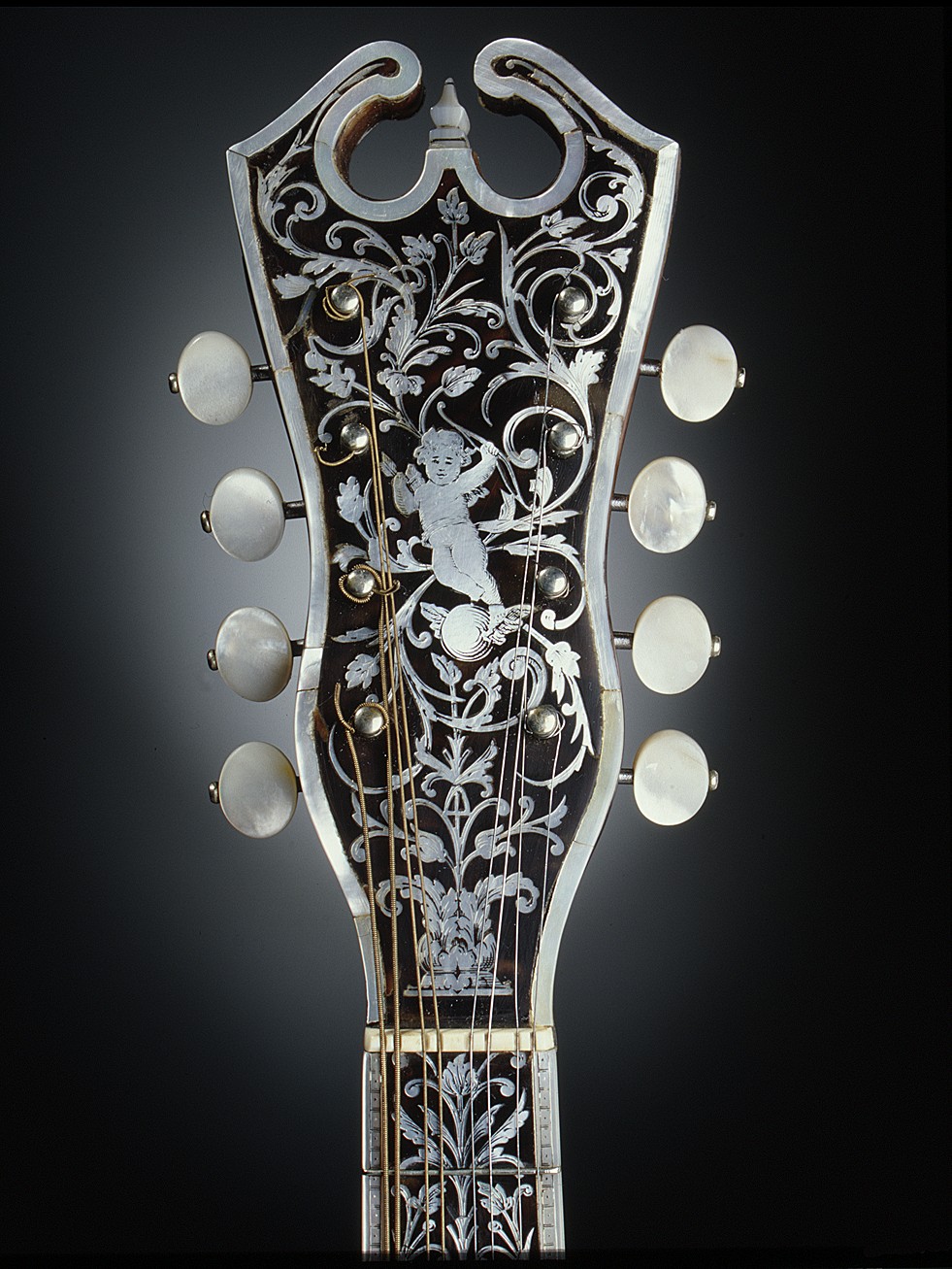
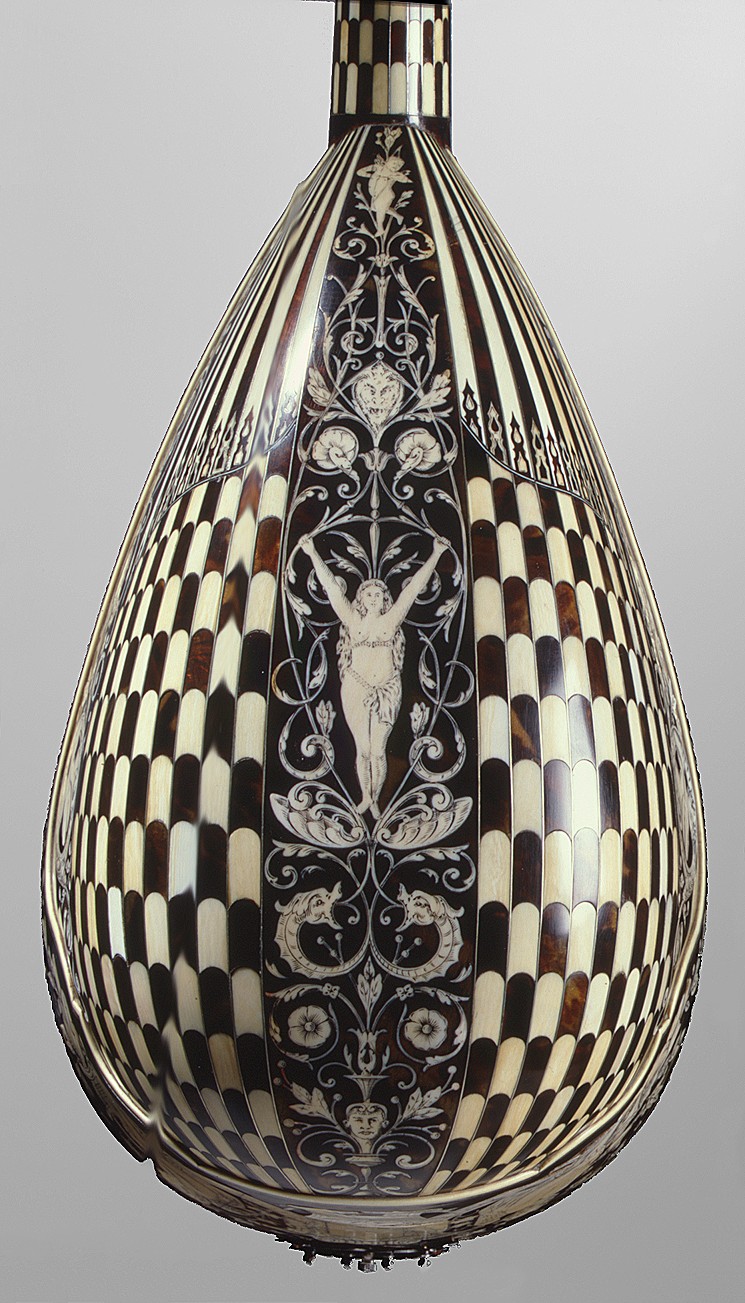
The bowlback Neapolitan mandolin is built from many thin curved staves of hardwood (usually rosewood or maple), with a flat spruce soundboard bent slightly behind the bridge. The American carved-top, by contrast, has a flat back (A-style) or shallow carved back (F-style) and a carved spruce top with f-holes — closely modelled on the violin family. The MET’s three turn-of-the-century specimens (700485, 504480, 503675) all use spruce tops with hardwood backs and decorative tortoiseshell or pearl inlay typical of high-end American workshops at the time.
How It’s Played
The player holds the instrument across the body, supported by a strap or simply against the forearm, and strikes the strings with a small flat plectrum (pick). The technique most closely associated with the mandolin is tremolo — rapid alternating up-and-down picking on a single course that produces a sustained sound from an instrument with otherwise short note decay.
In bluegrass and old-time music the right hand plays a mix of single-string melody, cross-picking patterns and percussive chop chords on the off-beats. The left hand fingerings are identical to violin fingerings, which makes the mandolin a natural second instrument for fiddle players.
Cultural Significance
In Italy the mandolin has been a parlour, serenade and orchestral instrument for two and a half centuries, with a serious solo concerto repertoire by composers from Vivaldi to Beethoven. In the early 20th century mandolin orchestras, often hundreds of players strong, were a common community-music phenomenon across Europe and North America.
In the United States the instrument took its modern bluegrass voice from Bill Monroe in the 1940s. Monroe’s hard-driving F-5 mandolin style — built around aggressive tremolo, percussive chord chops and rapid double-stops — defined what most listeners now hear as “the mandolin sound.” Other branches include Brazilian choro mandolin (where the instrument is called the bandolim) and Irish-traditional mandolin.
Notable Examples & Recordings
The three MET American mandolins (objects 700485, 503675 and 504480), all dated within five years of Orville Gibson’s first carved-top experiments, sit at one of the most important transition points in the instrument’s history. For listening, recordings by Bill Monroe (especially The Music of Bill Monroe), David Grisman, Chris Thile and Sam Bush cover the bluegrass and post-bluegrass traditions. Italian classical mandolin is best approached through Carlo Aonzo and Avi Avital. For Brazilian choro, Hamilton de Holanda is the leading living virtuoso.
Related Instruments
- Lute – the Renaissance ancestor of the mandolin family
- Mandola – the slightly larger, lower-pitched cousin tuned a fifth below
- Bouzouki – the Greek long-necked relative
- – the Brazilian variant central to choro
- – tuned a full octave below the standard mandolin
Where to Hear It
Bluegrass festivals across the United States — Telluride, MerleFest, Wintergrass — feature the mandolin as a central voice. Italian classical mandolin orchestras still perform regularly in Naples, Rome and Milan, and the EGMA (European Guitar and Mandolin Association) sponsors a major biennial competition. Brazilian choro is performed at roda de choro gatherings in Rio de Janeiro most weekends. The Wikimedia Commons category collects images and audio across these traditions.
- Wikipedia: Mandolin
- The MET: Mandolin 1898 (object 700485)
- The MET: Mandolin ca. 1900 (object 503675)
- The MET: Mandolin 1900 (object 504480)
- Wikimedia Commons: Mandolins
Learning Resources
Most beginners start with an A-style flatback mandolin because it is less expensive than an F-style and equally suitable for learning. Method books by Mike Marshall (Homespun) cover bluegrass; Carlo Aonzo’s materials cover Italian classical technique. Bluegrass jam camps such as the Steve Kaufman Acoustic Kamp offer immersive group learning each summer. For Brazilian choro, the Choro: Method for Mandolin materials by Marco Pereira are widely used.
Frequently Asked Questions
What family of instruments is the mandolin in?
It is a composite chordophone, classed as 321.321 in the Hornbostel-Sachs system — in the same broad group as the lute and the sitar.
How is the mandolin tuned?
Standard tuning is G–D–A–E across four paired courses, identical to the violin’s tuning. This is what makes the mandolin a natural second instrument for fiddlers.
What is the difference between a bowlback and a carved-top mandolin?
The bowlback (Neapolitan style) has a deeply rounded back made of many thin staves and a flat soundboard. The carved-top mandolin, developed by Orville Gibson around 1900, has a violin-style carved spruce top with f-holes and a flat or shallow-carved back.
Are old mandolins in museums?
Yes. The Metropolitan Museum of Art holds three American mandolins from 1898-1900 (objects 700485, 503675 and 504480) in its Musical Instruments department, all dating from the years when Orville Gibson was developing the carved-top design.
Where did the mandolin originate?
The modern eight-string mandolin took its standard form in mid-18th-century Naples. The carved-top American variant emerged in Kalamazoo, Michigan around 1900.
Is the mandolin difficult to learn?
Beginners can play simple bluegrass and folk tunes within a few weeks because the small fretboard and short strings make basic chords easy. Tremolo technique and high-speed bluegrass cross-picking take longer to develop.


