
Erhu
二胡
| Category | Strings |
|---|---|
| Country of origin | China |
| Classification | musical instrument |
| Wikipedia | en.wikipedia.org |
| Wikidata | Q726306 |
Listen
Audio: Originally composed and performed by 阿炳 (Abing), record by: David290, performed by :Zhang Peijian, CC BY-SA 4.0 / via Wikimedia Commons
Audio: Folk tune, re-arranged by 黃海懷, record by: David290, performed by :Zhang Peijian, CC BY-SA 4.0 / via Wikimedia Commons
Audio: Composed by 嚴老烈, record by: David290, performed by :Zhang Peijian, CC BY-SA 4.0 / via Wikimedia Commons

Overview
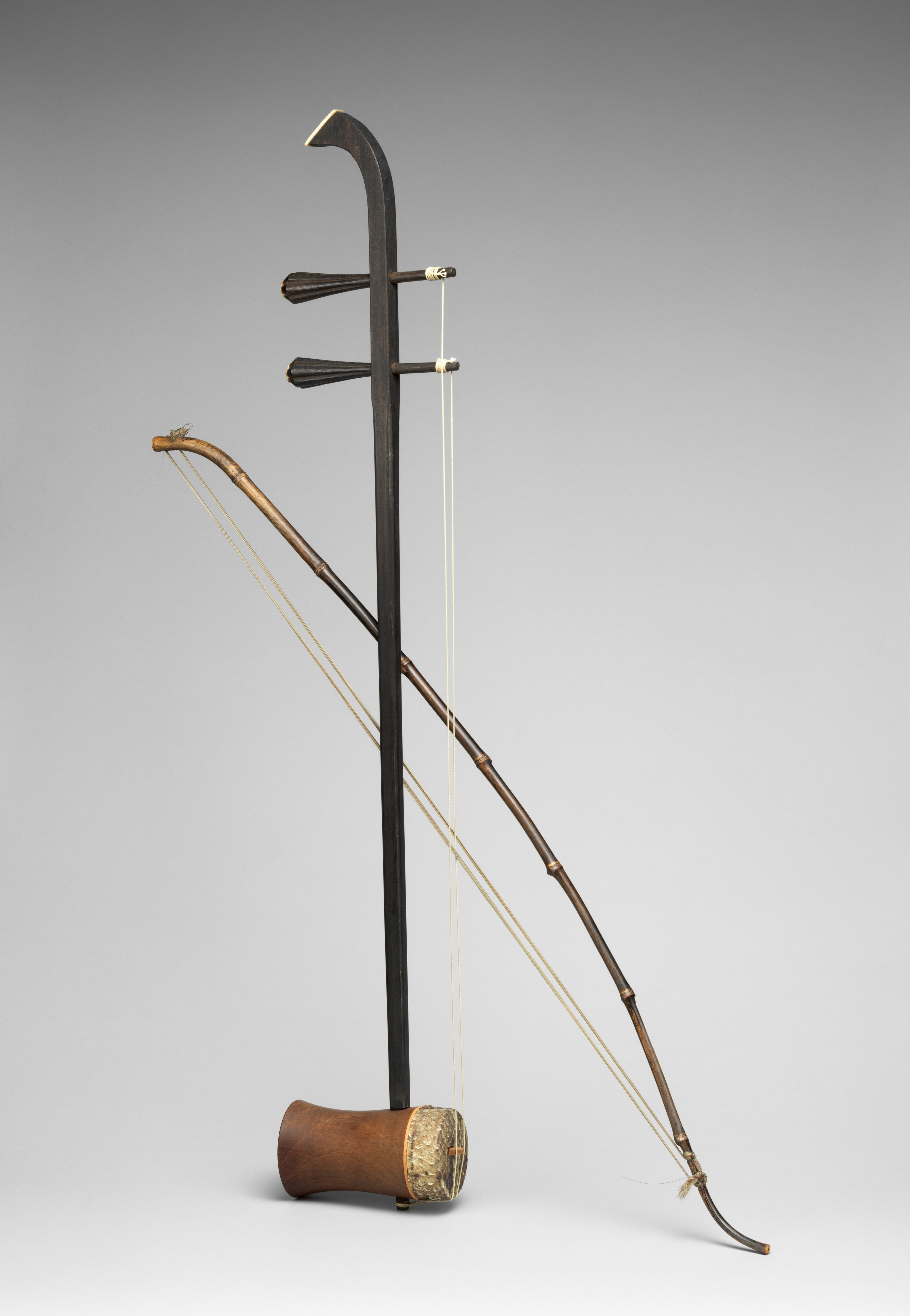
The erhu is a Chinese bowed fiddle with two strings, played upright on the lap. Its small hexagonal or octagonal hardwood resonator is faced with a stretched snake-skin membrane; rising from one end is a long, fingerboard-less neck; and a horsehair bow runs permanently between the two strings. Rather than lifting clear of the instrument, the bow stays threaded in place — the player pulls or pushes one string from underneath while pressing or releasing the other.
That single design choice gives the erhu its instantly recognisable voice: warm, breathy, vocally inflected, and almost always presented as a melodic solo voice rather than a chordal one. Among Chinese instruments heard internationally today, few rival the erhu in concert-hall and film-score visibility.
Origin & History
Within the broader huqin grouping of Chinese bowed strings, the erhu is the most familiar member by a wide margin. Huqin instruments entered China from Central Asia, with documented use under the Tang and Song dynasties and a steady evolution of regional types over the following centuries. The modern concert erhu — the high-tension steel-string instrument used today — was largely standardised in the early to mid-20th century, particularly through the work of the composer-performer Liu Tianhua and his successors at the Shanghai and Beijing conservatories.
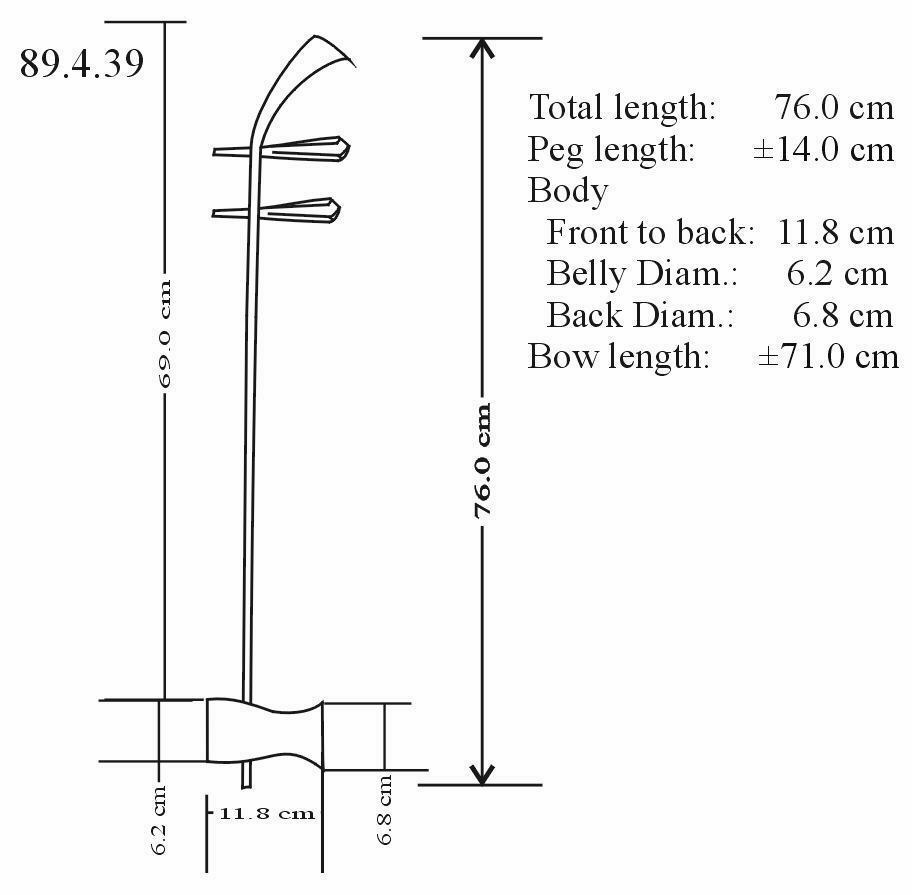
A nineteenth-century Chinese erhu held by the Metropolitan Museum of Art (object 500616) lists its materials as wood, python skin, cane, and ivory. The specimen is a useful reference point: by the time it was made, the instrument’s basic form was already in place, even if the silk strings of that period would later give way to steel.
Construction & Materials
A typical erhu is built around a small hexagonal hardwood resonator (often zitan red sandalwood or hong mu), with a long bamboo or hardwood neck rising from one side. The face of the resonator is covered with a stretched membrane traditionally made from python skin, which is the single most important factor in the instrument’s tone — and the source of significant ongoing debate around CITES regulation, sustainability, and synthetic substitutes.
Two metal strings (steel in modern instruments, silk historically) run from a tuning peg on the upper neck down through a small wooden bridge resting on the snake-skin face, and on to a fixed loop at the base. The bow, strung with horsehair, is permanently threaded between the two strings.
How It’s Played
When playing, the musician sits with the resonator balanced on the upper part of the left leg, with the long neck rising at an angle toward the left shoulder. The right hand draws or pushes the bow horizontally, alternating between bowing the inner string (by pulling the bow inward toward the body) and the outer string (by pushing the bow outward). Pressure on the horsehair against the chosen string produces the note.
There is no fingerboard for the left hand to work against; instead, the strings are stopped by finger pressure alone, with pitch determined entirely by where and how firmly the player presses. This places enormous demand on intonation, vibrato, and slide technique, all of which are central to the erhu’s vocal character. Skilled players can imitate the human voice, birdsong, and a wide range of emotional inflections, which is why the instrument is so widely used in film scoring.
Cultural Significance
Few Chinese instruments are as instantly identifiable to international listeners as the erhu, and within the modern Chinese orchestra it serves a role roughly equivalent to the violin section in a Western symphony. It is also a major solo concert instrument, with a 20th-century repertoire built largely around the compositions of Liu Tianhua, Hua Yanjun (Abing), and a steady output of new conservatory composers.
Beyond the concert hall, the erhu is widely heard in regional Chinese opera, in film and television scoring, and in cross-cultural projects with Western ensembles. It is also one of the most commonly busked instruments in Chinese cities, where it remains a familiar part of everyday street culture.
Notable Examples & Recordings
The Metropolitan Museum of Art’s 19th-century Chinese erhu (object 500616) is among the better-documented historical specimens available online. For listening, recordings of Hua Yanjun (Abing)’s Erquan Yingyue (“The Moon Reflected on the Second Spring”) are an essential starting point, as are interpretations of Liu Tianhua’s ten classic erhu pieces. Modern players including Min Huifen, Song Fei, and George Gao have brought the instrument to international audiences through recital tours and crossover recordings.
Related Instruments
- Gaohu – the higher-pitched cousin used in Cantonese music
- Zhonghu – the alto-register cousin within the broader huqin grouping
- – the wood-faced (rather than skin-faced) huqin used in northern Chinese opera
- Morin khuur – the Mongolian horsehead fiddle, a distant relative
- Rebab – the broader West and Central Asian bowed lute family from which the huqin tradition partly descends
Where to Hear It
Chinese conservatory concerts, modern Chinese orchestra performances, and film scores are the natural settings for the erhu. The instrument also appears in many global crossover projects and in everyday street music throughout the Chinese-speaking world.
Learning Resources
The erhu has a steep but well-mapped learning curve. Beginners typically start by learning to hold the bow correctly, to produce a clean tone on each open string, and to find the basic finger positions on the neck without a fingerboard to guide them. The Chinese conservatory grading system for erhu is well established, and structured online courses, video tutorials, and English-language method books are now widely available.
Frequently Asked Questions
Why does it have only two strings?
Tradition for this instrument prizes melody and vocal inflection above chordal harmony. Two strings, plus the special bow that runs between them, are enough to provide a wide melodic range and the slides and vibrato that are central to its sound.
Is the snake skin on the erhu real?
Traditionally, yes — the membrane is python skin, and that single material choice does more than almost anything else to shape the instrument’s distinctive tone. CITES regulation of python skins has made international travel with traditional erhus more complicated, and synthetic substitutes are increasingly used for export instruments.
How is the erhu different from a violin?
Both are bowed strings, but on the Chinese instrument there are just two strings, no fingerboard at all, and a bow threaded permanently between those strings. Its body is much smaller, its tone is more vocal and breathy, and it is held vertically on the lap rather than under the chin.
Are old erhus displayed in museums?
Yes. New York’s Metropolitan Museum of Art holds a 19th-century Chinese erhu (object 500616), part of the Crosby Brown Collection acquired in 1889.
Is the erhu difficult to learn?
Producing a basic tone is reasonably approachable, but stable intonation without a fingerboard is one of the harder challenges in any string family. Most students reach a comfortable amateur level after several years of consistent practice.


