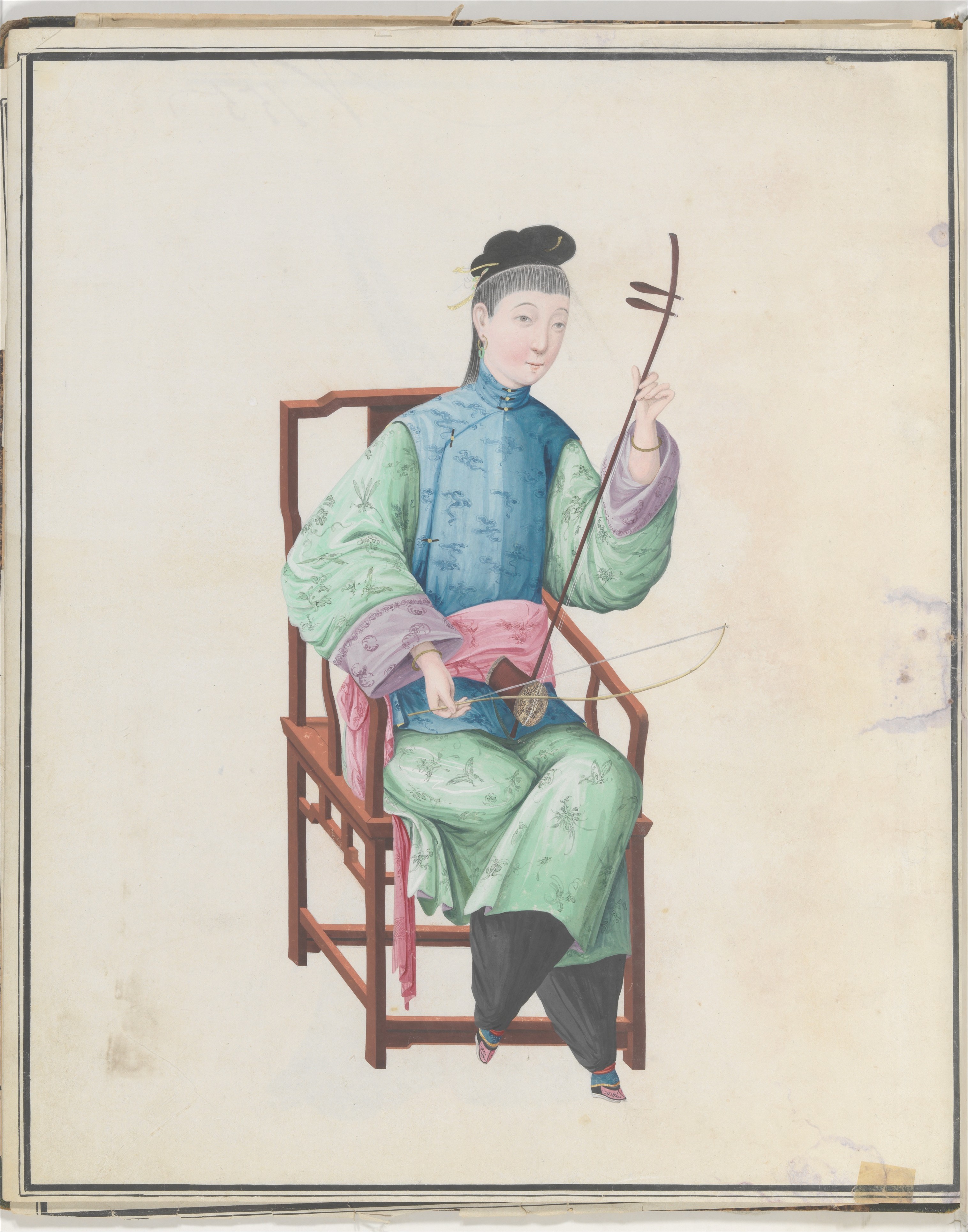

Gaohu
高胡 (gāohú)
| Category | Strings |
|---|---|
| Country of origin | Cantonese region of southern China |
| Wikipedia | en.wikipedia.org |
| Wikidata | Q579484 |
Overview
The gaohu (高胡, “high fiddle”) is a two-string bowed Chinese fiddle in the huqin family, pitched higher than the standard erhu and built with a slightly smaller body. Its name describes its function: a high-register version of the erhu, designed specifically for the brighter, faster, more melodically intricate music of the Cantonese tradition of southern China. In the modern Chinese orchestra it serves as the soprano voice of the bowed string section.
Wikidata classifies the gaohu as a “Chinese bowed string instrument,” within both the bowed-string family and the spike-box-lute category. Its construction places it firmly within the same huqin family as the erhu, the zhonghu and the banhu.
Origin & History
The gaohu has a precisely datable modern origin, which is unusual for traditional Chinese instruments. In the 1920s the musician Lui Tsun-Yuen (Lü Wencheng, 呂文成) of Guangzhou developed a higher-tuned and slightly smaller version of the erhu, with the body held between the knees rather than resting on the left thigh, specifically to play the new Cantonese music (Yueju, 粵樂) genre that was emerging in southern China during the same period.
Cantonese music emphasises fast, ornamented melodic lines with frequent slides, bends and grace notes — a style that asks for a brighter and more agile fiddle than the standard erhu. The gaohu provided exactly that. By the 1930s it had become the leading melodic instrument of the Cantonese ensemble, and as Cantonese music spread through Hong Kong, Singapore, Malaysia and the wider Chinese diaspora, the gaohu travelled with it.
In the 1950s the gaohu was incorporated into the standardised modern Chinese orchestra as the soprano voice of the bowed-string section, sitting above the erhu (alto), zhonghu (tenor) and bass instruments such as the gehu and bass gehu.
The Metropolitan Museum holds a late-18th-century Chinese watercolour on paper (object 506076) catalogued as “Watercolour of musician playing gaohu(?)” and held in the Works on Paper category. The question mark in the cataloguing is itself revealing: the documented modern gaohu post-dates this image by more than a century, and the catalogue note records the tentative identification of an instrument depicted in an earlier-period painting as a precursor to what we now call the gaohu.
Construction & Materials
The gaohu body is smaller than the erhu’s — typically around 12 centimetres long and 10 cm wide — with a hexagonal or rounded wooden frame covered on the playing face with python skin. The neck is around 60 centimetres long and carries two strings. Standard tuning is g-d (a fourth higher than the erhu’s d-a), although f-c and a-e are also used in different ensemble contexts.
The bow, like all huqin bows, is held between the two strings — meaning the same bow plays both strings without the player having to move it from string to string; pitch is changed entirely by left-hand finger placement. The bow hair, traditionally horsehair, is pressed against either string by adjusting the angle of the right hand.
The defining playing-position difference from the erhu is that the gaohu body is held between the player’s knees, which damps the body slightly and gives the instrument a more focused tone, particularly important when playing in the highest register.
How It’s Played
The player sits with the gaohu’s body held between the knees and the long neck angled upward to the left. The right hand draws the bow horizontally across one of the two strings (the bow hair always sits between the two strings). The left hand stops the strings against the bare neck — like the erhu, the gaohu has no fingerboard or frets.
The technique emphasises the fast slides, wide vibrato, grace notes and “scoop” attacks characteristic of Cantonese music. Major Cantonese music pieces such as Pingnu Bantian (《平湖秋月》) and Yu Da Bajiao (《雨打芭蕉》) are part of the standard gaohu repertoire, and the instrument has acquired a substantial body of solo concertos in the post-1980 conservatory tradition.
Cultural Significance
The gaohu is the central melodic instrument of Cantonese music — the wide regional tradition that includes both the older instrumental ensemble repertoire of Guangzhou and Hong Kong and the more recent Cantonese opera (粵劇) accompaniment. Cantonese music underpinned the early Hong Kong film and television score industry, and the bright, sliding sound of the gaohu is one of the most recognisable Chinese-instrument sounds in 20th-century film music from Hong Kong, Singapore and the wider Chinese diaspora.
In the modern Chinese orchestra the gaohu plays the role that the violin section plays in the Western orchestra: the principal melodic voice. Its standardisation in the 1950s as part of the Chinese orchestra reforms placed it permanently in the conservatory curriculum and on the international concert tour circuit.
Notable Examples & Recordings
For listening:
- Lü Wencheng (Lui Tsun-Yuen), historical recordings — the inventor of the modern gaohu and the founding figure of the modern Cantonese repertoire.
- Yu Qiwei, Cantonese Music — leading post-war gaohu player who carried the instrument into the conservatory tradition.
- Yu Lefu, gaohu recital recordings — modern player at the Hong Kong Academy for Performing Arts.
- Hong Kong Chinese Orchestra recordings — the gaohu as soprano voice of the modern Chinese orchestra.
Related Instruments
- Erhu – the alto Chinese fiddle that the gaohu was designed to play above.
- Zhonghu – the tenor Chinese fiddle in the same huqin family.
- Jinghu – the small high-pitched Beijing opera fiddle.
- – the wood-faced Chinese fiddle of northern theatre traditions.
- – the coconut-shell southern Chinese fiddle, related in repertoire and ensemble role.
Where to Hear It
The Hong Kong Chinese Orchestra, the Guangzhou Chinese Orchestra, the Singapore Chinese Orchestra and the Taipei Chinese Orchestra all feature the gaohu as soprano voice of the bowed-string section. Cantonese opera houses in Hong Kong, Guangzhou and the Chinese diaspora communities of Singapore and Malaysia continue to use the gaohu in nightly performances. The Hong Kong Academy for Performing Arts and the Star Hall venues regularly host gaohu recital programmes.
- Wikipedia: Gaohu
- The MET: Watercolour of musician playing gaohu (object 506076)
- Wikimedia Commons: Gaohu
Learning Resources
The Hong Kong Academy for Performing Arts, the Central Conservatory of Music in Beijing and the Shanghai Conservatory all offer the gaohu as a principal study. Most students approach the instrument either after some years on the erhu (in which case the transition is straightforward) or directly through the Cantonese music conservatory programme. Standard tutors include the Central Conservatory graded examination books for huqin instruments and Cantonese music method books published in Hong Kong and Guangzhou. New concert-grade instruments by Suzhou and Guangzhou makers run from approximately 300 to 2,000 USD.
Frequently Asked Questions
What is the difference between a gaohu and an erhu?
The gaohu is smaller, tuned a fourth higher, and held between the knees rather than resting on the left thigh. The two instruments share the same basic two-string fretless huqin construction.
Who invented the gaohu?
Lui Tsun-Yuen (Lü Wencheng), a musician based in Guangzhou, developed the modern gaohu in the 1920s specifically for the emerging Cantonese music genre. This precise dating and attribution is unusual for traditional Chinese instruments.
What is Cantonese music?
Cantonese music (Yueju, 粵樂) is the regional music of Guangdong province and Hong Kong, characterised by fast, highly ornamented melodic lines with extensive sliding and grace-note techniques. It became a major popular music style in 20th-century Hong Kong cinema.
Is the gaohu used in modern Chinese orchestras?
Yes. It is the soprano voice of the bowed-string section in all major modern Chinese orchestras and was standardised for this role in the 1950s.
How many strings does a gaohu have?
Two, the same as the erhu. Standard tuning is g-d, a fourth higher than the erhu.
Where is the gaohu played today?
The gaohu is played throughout the Chinese-speaking world but is particularly central to Hong Kong, Guangzhou, the Cantonese opera tradition, the modern Chinese orchestra programmes of Singapore and Malaysia, and the Cantonese diaspora communities worldwide.


