Jinghu
京胡
| Category | Strings |
|---|---|
| Country of origin | China (mid-19th century) |
| Classification | Wikimedia disambiguation page |
| Wikipedia | en.wikipedia.org |
| Wikidata | Q1689576 |
Overview
The jinghu is a small bamboo-bodied bowed string instrument, the smallest and highest-pitched member of the Chinese huqin (spike fiddle) family. It has two strings of silk or steel tuned a fifth apart and is bowed with a horsehair bow whose hair passes between the two strings, so the bow plays one string by upward pressure and the other by downward pressure rather than crossing over. The Wikidata entry treats jinghu as a category title (with a disambiguation page in Wikipedia) covering both the lead instrument of Beijing opera (the principal subject of this article) and a small Chinese drum of the same name; this article addresses the bowed-string jinghu.
The Hornbostel-Sachs system files the jinghu as a spike tube lute, alongside its larger relatives the erhu (alto), the zhonghu (tenor) and the gehu (cello-equivalent). Within the Beijing opera (jingju) orchestra it is the lead melodic instrument and shadows the singer’s vocal line throughout the performance.
Origin & History
The jinghu took shape together with Beijing opera itself in the early to mid-19th century. Beijing opera as a distinct stage form crystallised in the late 18th and early 19th centuries from the merging of regional opera styles brought to Beijing for the Qianlong emperor’s 80th birthday celebrations in 1790 (the famous “Four Great Anhui Troupes”) and subsequent decades of stylistic synthesis. The huqin instrument used to accompany singers in these emerging troupes was progressively shrunk and tightened to produce a brighter, higher voice that could cut through the singer’s high tessitura and the wind and percussion of the small theatre orchestra. By the 1840s and 1850s the recognisable jinghu was in place.
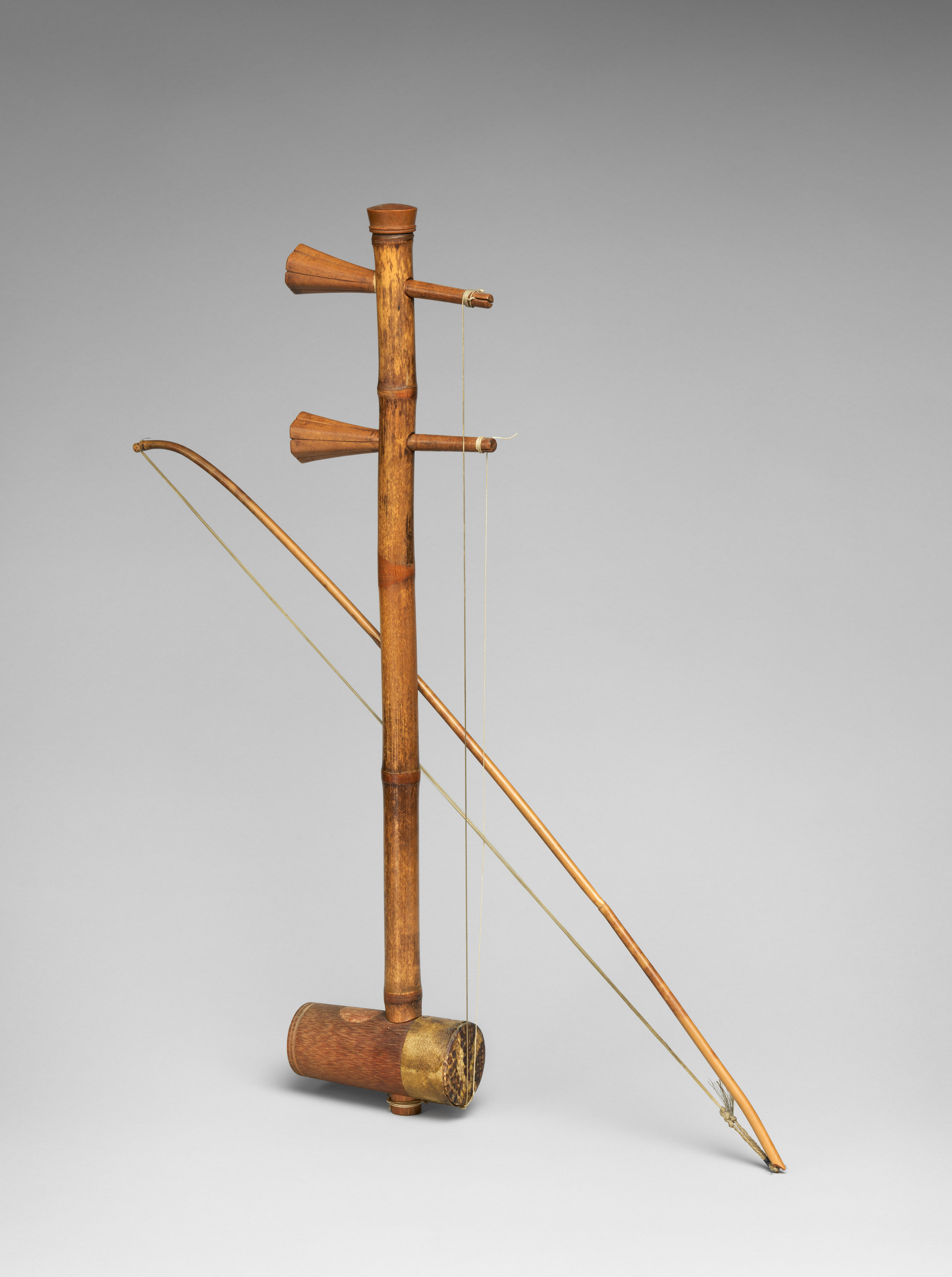
The Metropolitan Museum’s collection includes a 19th-century jinghu, object 500667, made of bamboo, snakeskin, parchment, silk and horsehair, and catalogued as Japanese/Chinese in cultural origin (the catalogue note reflects the difficulty of separating Chinese-origin instruments from Japanese-acquired examples in 19th-century collections). The MET also holds an erhu of the same period (object 500616), allowing direct visual comparison of the two huqin sizes.
Through the late Qing and Republican periods the jinghu remained the lead instrument of the Beijing opera orchestra and travelled with the genre wherever Beijing opera companies toured — first across China, then to Hong Kong, Taiwan, the Chinese diaspora cities of Southeast Asia and the West, and finally onto the international concert stage in the 20th century. The 1950s reforms of Chinese theatre did not displace the jinghu from its central role, although a parallel jinghu repertoire for solo concert work was developed by players such as Yang Baozhong and Shen Yuan during the same period.
Construction & Materials
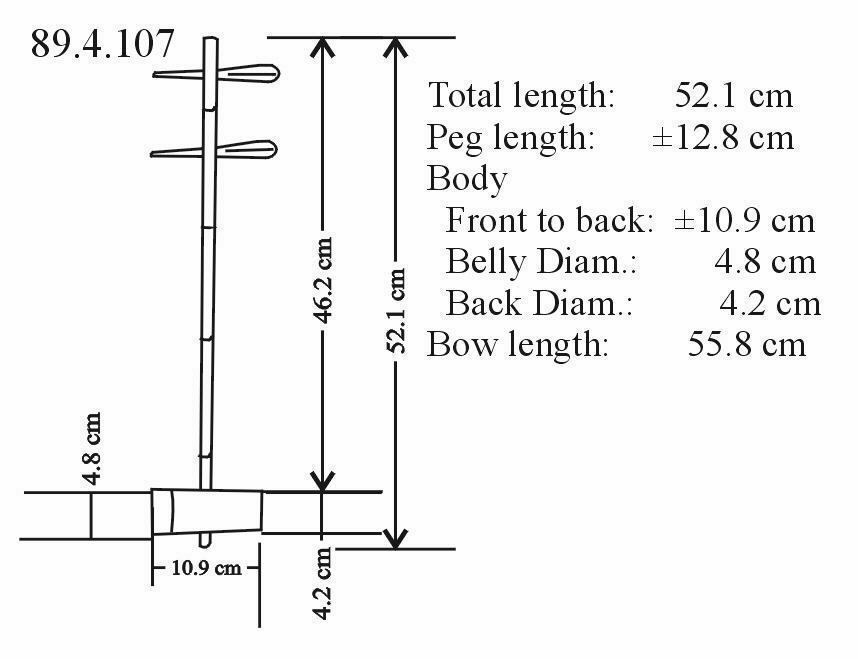
The jinghu’s resonator is a short cylinder of bamboo — typically 5 to 6 centimetres in diameter and 11 to 13 centimetres long — with one open end covered by a thin sheet of snake skin (traditionally Burmese python skin). The other end is open and projects sound. The neck is a slender length of bamboo or rosewood that passes through holes in the upper part of the resonator and projects below; two friction-fit wooden tuning pegs are fixed in the neck above the resonator, and the two strings are tied to a small loop at the bottom of the projecting neck.
Two strings of silk (older instruments) or steel (modern standard) are tuned a fifth apart — typically G4–D5 for the xipi mode and A4–E5 for the erhuang mode of Beijing opera (a player carries multiple instruments tuned to the different modes used in performance). The bow is short — around 60 to 65 centimetres — with horsehair tightened by the player’s fingers as needed during play, and the hair runs permanently between the two strings.
How It’s Played
The player sits with the jinghu held vertically on the left thigh, the resonator resting on the leg and the neck projecting upward. The left hand stops the strings against the unfretted neck — there are no frets — and the right hand draws the bow across one string at a time by adjusting pressure from above (sounding the inner string) or from below (sounding the outer string). A small skin pad on the player’s left thigh dampens the open end of the resonator.
Beijing opera technique calls for a vocal-imitative quality. The jinghu must shadow the singer’s melodic line throughout the performance, ornamenting around it, sliding into pitches in close imitation of the human voice, and in moments of vocal breath continuing the line on its own. The microtonal slides, rapid bow changes and high tessitura that result are unique to the jinghu among Chinese bowed strings.
Cultural Significance
The jinghu’s identity is fused with that of Beijing opera. Almost every jinghu player is primarily a jingju musician; the small concert solo repertoire that has developed since the 1950s is a relatively modern extension. Beijing opera was inscribed by UNESCO on the Representative List of the Intangible Cultural Heritage of Humanity in 2010, and the jinghu is named in the inscription as the lead melodic instrument of the form.
The jinghu’s playing style has had a wider influence on Chinese music. The tight high-pitched vocal-imitative bowing used in jingju was adopted by yueju (Cantonese opera) players for their lead bowed instrument, and the close coordination between jinghu player and lead singer has served as a model for the wider Chinese theatre tradition.
Notable Examples & Recordings
- Yan Shengmin, recordings as the lead jinghu of the China National Beijing Opera Company through the 1970s–1990s.
- Yang Baozhong, foundational concert-jinghu solos including arrangements of opera liu (instrumental interludes).
- Wang Caiyun and Liu Xunxia, leading mid-20th-century jinghu accompanists to the singers Mei Lanfang, Cheng Yanqiu and Ma Lianliang.
- The Mei Lanfang Memorial Museum in Beijing preserves jinghu used in landmark performances of the 1920s–1950s.
- The MET’s 19th-century specimen (object 500667) is one of the few well-documented jinghu in a major Western collection.
Related Instruments
- Erhu – the standard alto huqin and the most familiar member of the family in concert settings.
- Zhonghu – the tenor huqin developed in the 20th century for the modern Chinese orchestra.
- Gaohu – the high-pitched Cantonese huqin used in Cantonese music.
- – the wooden-faced huqin used in northern Chinese opera and folk music.
- – the slightly larger Beijing opera huqin used as a partner to the jinghu for erhuang mode passages.
Where to Hear It
Live jinghu is best heard at full Beijing opera performances. The Beijing Opera Theater and the China National Peking Opera Company in Beijing run regular performances at the Mei Lanfang Grand Theater and the Liyuan Theater. Major Chinese provincial opera companies in Tianjin, Shanghai and Wuhan also stage Beijing opera with full orchestra. International touring productions appear regularly at the Edinburgh Festival, the Lincoln Center and the BBC Proms. Recordings appear extensively on the China Record Corporation, ROI Productions and Wind Records catalogues.
- Wikipedia: Jinghu (instrument)
- Wikidata: Jinghu (Q1689576)
- The MET: Jinghu (object 500667)
- Wikimedia Commons: Jinghu
Learning Resources
The Central Conservatory of Music in Beijing and the China Conservatory of Music are the principal teaching institutions, both with full Beijing opera departments that train jinghu players. The China National Academy of Theatre Arts (the Xiqu Xueyuan) is the country’s specialised conservatory for traditional theatre and is the most concentrated source of jinghu training. Method materials in Chinese include Yang Baozhong’s Jinghu yanzou jiaocheng (Jinghu Performance Course); English-language pedagogical materials are limited. A serviceable student jinghu costs around 50 USD; concert-grade instruments by named Beijing or Suzhou makers run from 300 to 2,000 USD.
Frequently Asked Questions
What is the jinghu used for?
Almost exclusively as the lead melodic instrument of the Beijing opera (jingju) orchestra. A small modern solo concert repertoire also exists.
How is the jinghu different from the erhu?
The jinghu is smaller, made of bamboo (the erhu of wood), tuned a fifth or fourth higher, and produces a much brighter, more piercing tone. The jinghu’s role is operatic; the erhu’s role is broader and includes solo concert and folk music.
When was the jinghu invented?
The instrument took shape together with Beijing opera in the early to mid-19th century, becoming recognisable in roughly its modern form by the 1840s.
Is the jinghu hard to play?
Very. The combination of unfretted high-tessitura playing, vocal-imitative ornamentation, and the requirement to shadow a Beijing opera singer’s improvisational style makes the jinghu one of the most demanding traditional Chinese instruments. Most professional jinghu players come from full conservatory training and several years of orchestra apprenticeship.
Are there modern composers writing for jinghu?
Yes. Tan Dun, Bright Sheng, Chen Yi and Zhou Long have all written contemporary works featuring the jinghu, generally drawing on its operatic associations and high-tessitura voice.


