


Double Bass
double bass
| Category | Strings |
|---|---|
| Country of origin | Europe |
| Classification | bass, type of musical instrument |
| Wikipedia | en.wikipedia.org |
| Wikidata | Q80019 |
Listen
Audio: Ludwig van Beethoven, CC BY 3.0 / via Wikimedia Commons
Audio: PQ, CC BY / via Internet Archive
Overview
Among the standard bowed strings of the modern Western orchestra, the double bass stands as both the largest in physical size and the lowest in pitch. It is also the most stubbornly hybrid: its sloping shoulders and flat back are inherited from the viol family, while its f-holes and overall acoustics belong to the violin family. No other orchestral string instrument carries this divided ancestry so visibly.
Other names for the instrument include the upright bass, the contrabass, the string bass, and — in casual usage — just “the bass.” In jazz and bluegrass it is usually plucked; in classical music it is normally bowed. Both techniques are part of every working bassist’s toolkit.
Origin & History
The double bass took shape in late-16th- and 17th-century Europe alongside the violin family but never entirely abandoned the older viol family from which it borrowed many features. By the early 18th century the instrument had reached more or less its modern form, with three or four strings tuned in fourths (rather than the violin family’s fifths), a flat back, and sloping shoulders that allow the player to reach the upper neck.
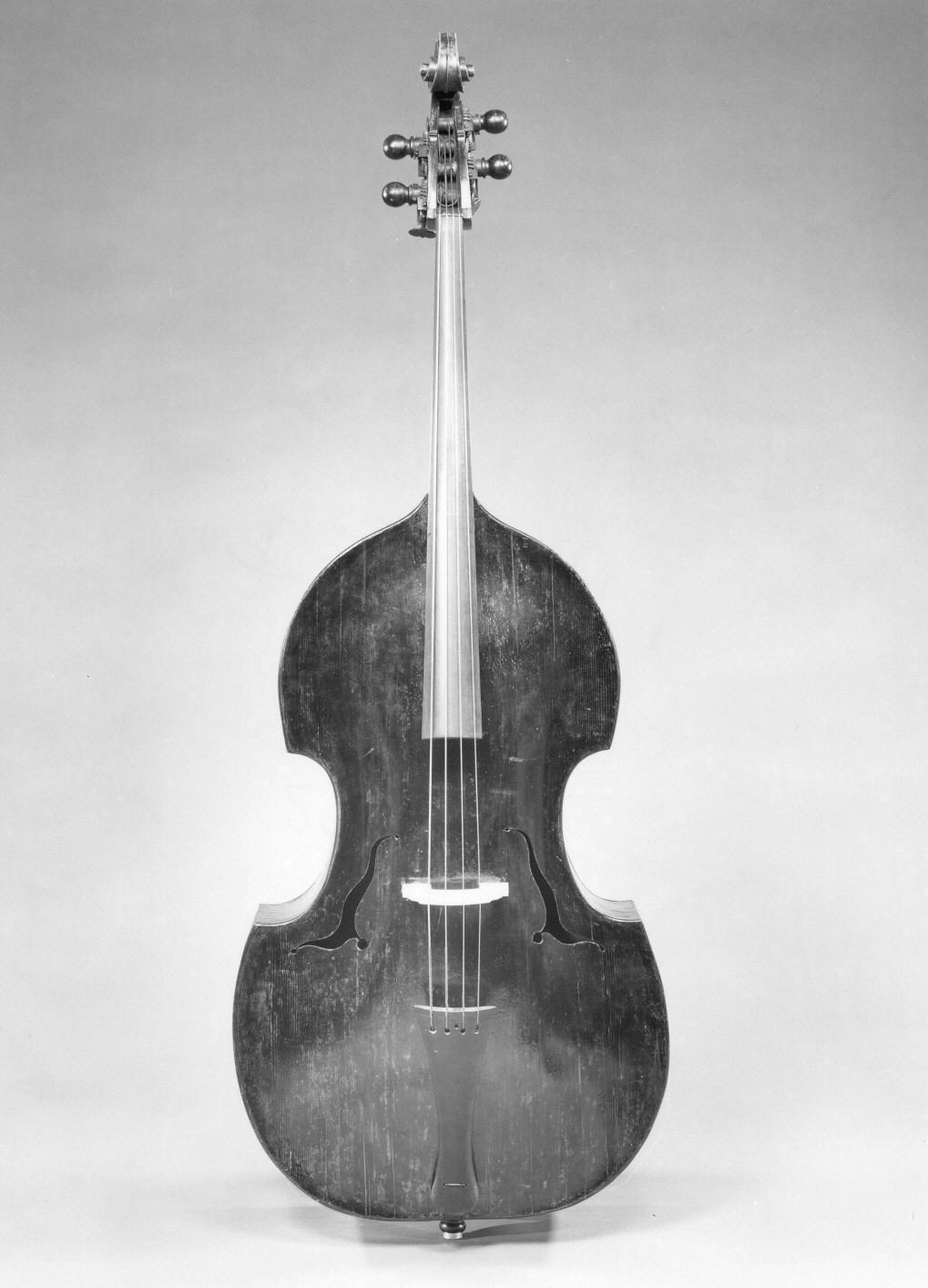
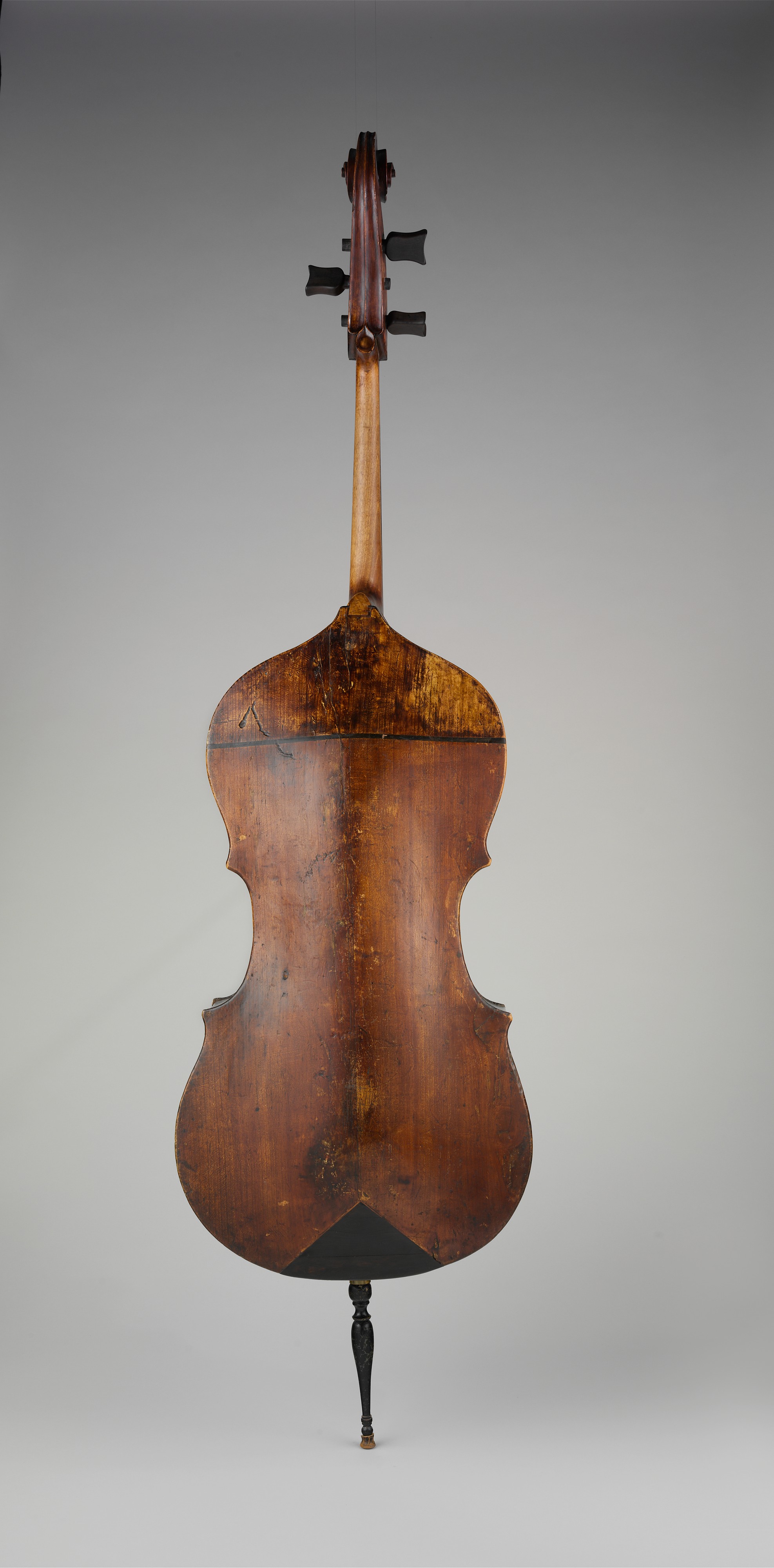
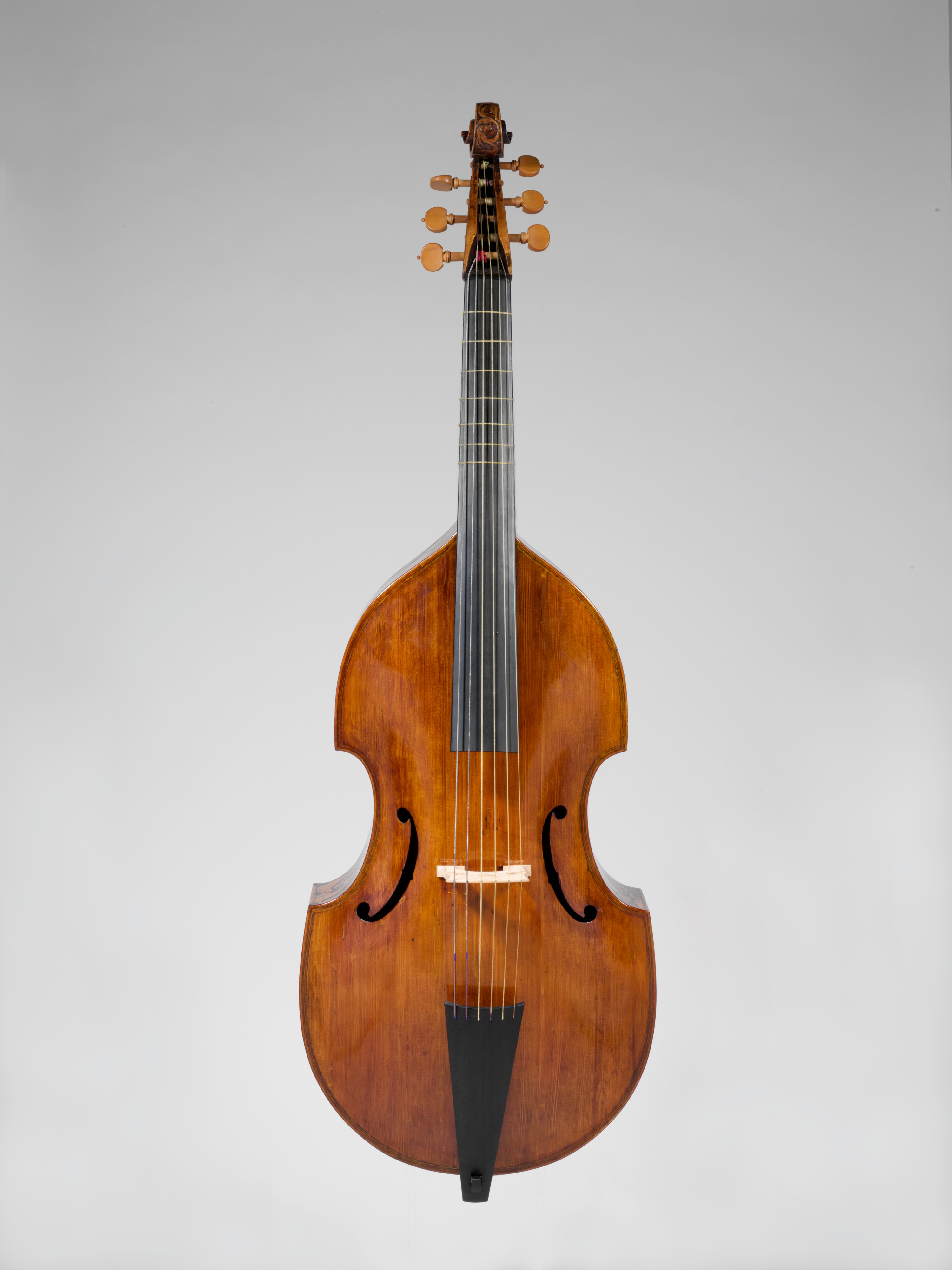
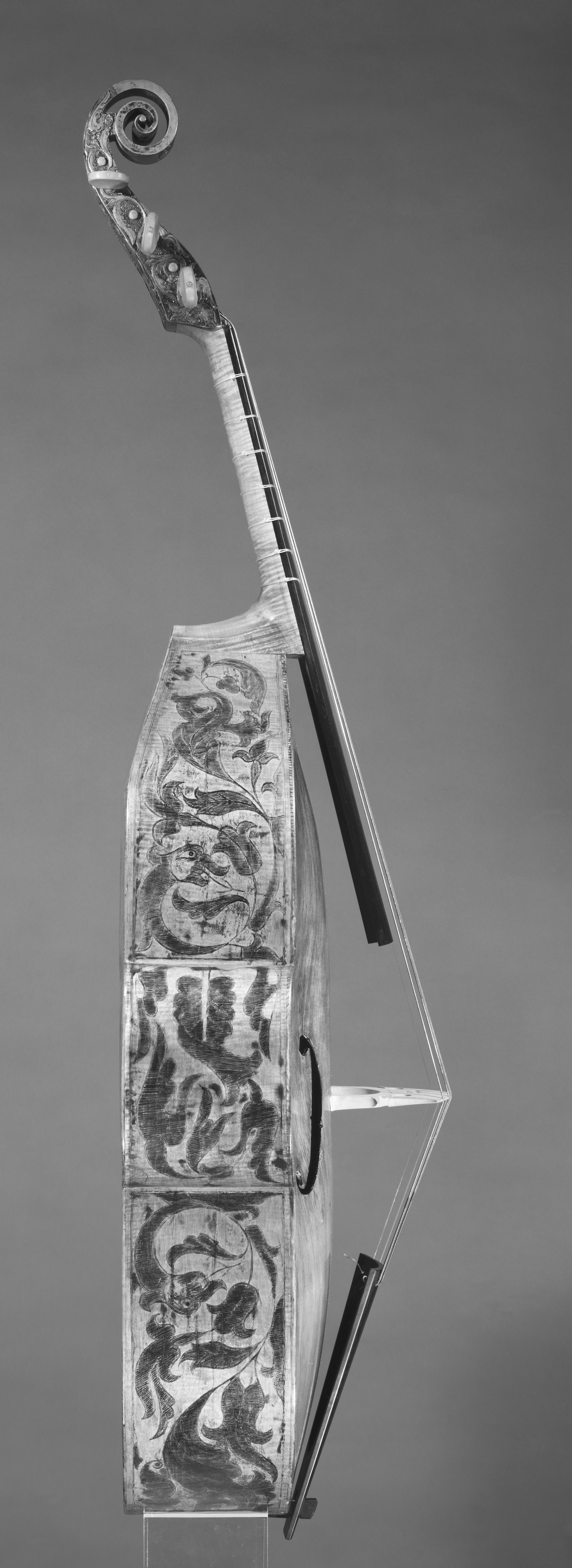
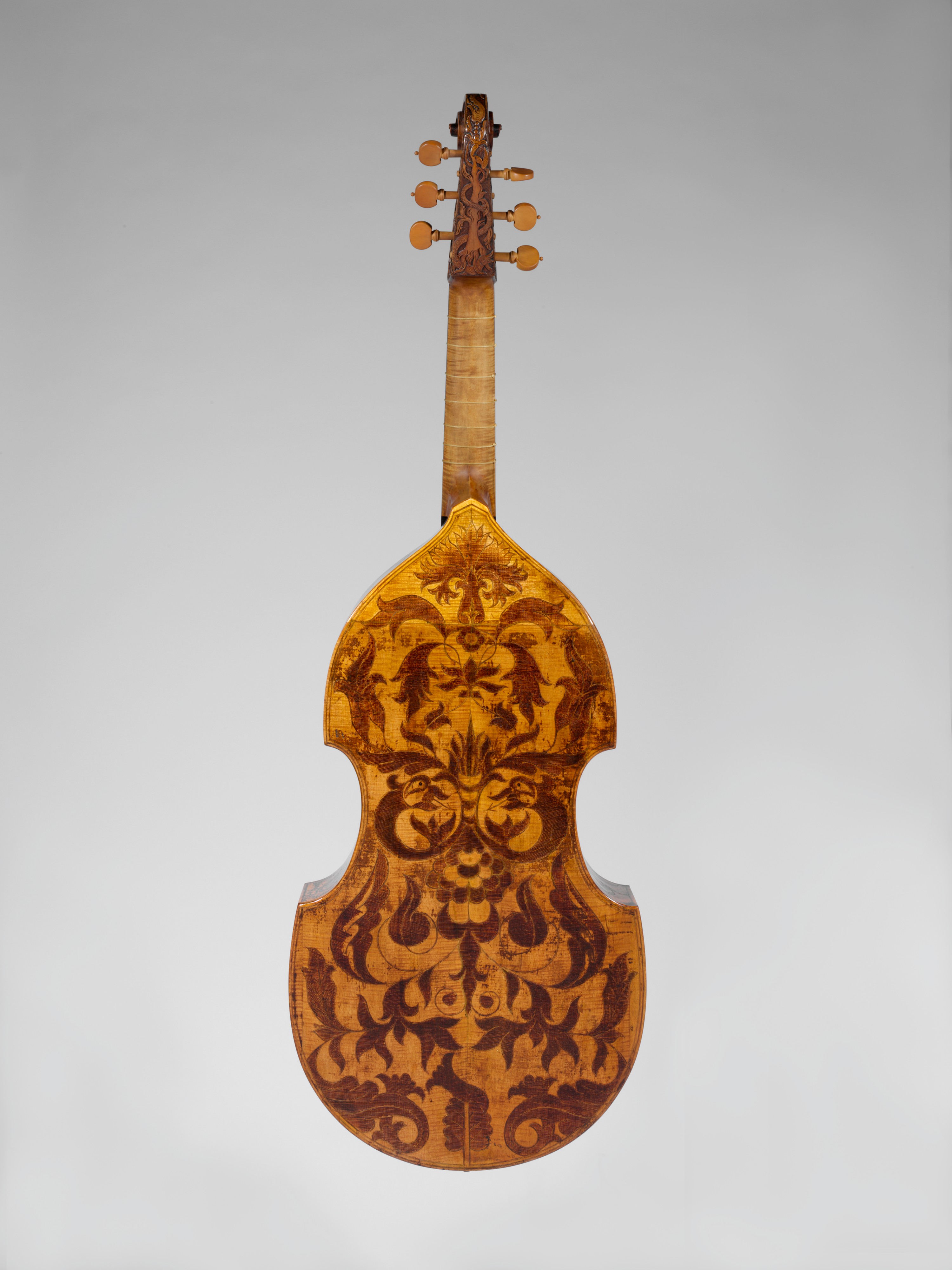
The Metropolitan Museum’s collection holds three instruments that document this hybrid history. A 1734 Czech double bass (MET object 504228) and an 18th-century Italian double bass (MET 503176), both wooden, sit at the centre of the family’s standardisation period. Beside them, a ca. 1600 British bass viola da gamba (MET 503359) shows the older viol-family instrument from which several construction features were carried over — including the flat back and the sloping upper bout.
Through the 19th century the double bass shifted to four strings as standard (with five-string instruments in some German orchestras), gut strings gradually gave way to steel after about 1900, and the modern adjustable bridge replaced earlier fixed bridges.
Construction & Materials
The Hornbostel-Sachs system places the double bass in 321.322 (necked box-lute, bowed). The body is built from spruce for the soundboard and maple for the back, ribs and neck. Two steel endpins — one at the base supporting the instrument upright, and one tuning peg at the top of each string — frame a flat back that distinguishes the instrument from the curved-back violin family.
The MET’s 1734 Czech instrument and 18th-century Italian instrument are typical of their period: simple wood throughout, gut stringing, and the more rounded body shape favoured in their respective regions. The British viola da gamba (object 503359) carries six strings and frets — features the modern double bass has shed but which mark its viol ancestry. Modern instruments are about 180 cm tall (6 ft) and weigh 8–11 kg.
How It’s Played
A player either stands or perches on a tall stool, with the instrument propped against the body with its endpin on the floor. The right hand either draws a bow across the strings (in classical playing) or plucks with the fingertips (in jazz and most popular styles). The left hand stops the strings against the unfretted fingerboard, with finger spacing far wider than on smaller bowed instruments — every position spans only a tone, not a fifth.
Two bow grips coexist: the underhand “German” or Dragonetti grip, and the overhand “French” or Bottesini grip. Choice is largely regional and a matter of school. Pizzicato playing in jazz typically uses one or two right-hand fingers slapping the string against the fingerboard for percussion, a technique sometimes called slap bass.
Cultural Significance
In the orchestra the double bass anchors the harmony from below. Eight to twelve players normally sit at the back of the string section in a full symphony orchestra. In opera and ballet the section’s role is similar. In chamber music the instrument is less common but appears in piano quintets such as Schubert’s Trout and in countless arrangements.
From the 1920s onward, in jazz, the instrument supplied the rhythmic and harmonic foundation of every classic ensemble. Bassists including Jimmy Blanton, Charles Mingus, Paul Chambers and Ray Brown shaped the vocabulary of jazz bass playing. In bluegrass and country music the slapped bass provides the same backbeat function.
Notable Examples & Recordings
The 1734 Czech double bass (MET 504228) and the 18th-century Italian double bass (MET 503176) sit together in the MET’s Musical Instruments department and document the hybrid construction tradition of the period. The accompanying ca. 1600 British bass viola da gamba (MET 503359) makes the family’s viol ancestry visible in the same collection.
For listening, classical recordings by Edgar Meyer, Gary Karr and François Rabbath show the modern instrument’s solo voice; jazz recordings by Charles Mingus (Mingus Ah Um), Paul Chambers (with Miles Davis on Kind of Blue) and Ron Carter cover the post-war jazz repertoire.
Related Instruments
- Cello – the smaller bowed bass instrument with violin-family construction
- Viola da Gamba – the fretted viol family that contributed to the double bass’s design
- Bass Guitar – the electric instrument that absorbed many of the double bass’s roles in popular music after 1950
- – the Baroque-era larger viol that is the closest direct ancestor
- – the rare 19th-century super-large variant pitched an octave below
Where to Hear It
Every symphony orchestra concert features the instrument, as does every traditional jazz ensemble. The International Society of Bassists holds a major convention every two years that gathers classical and jazz players from around the world. Recordings across both traditions are widely available. The Wikimedia Commons category for double basses includes performance video and historical photographs.
- Wikipedia: Double bass
- The MET: Double Bass, 1734 (object 504228)
- The MET: Double Bass, 18th c. (object 503176)
- The MET: Bass Viola da Gamba (object 503359)
- Wikimedia Commons: Double basses
Learning Resources
Beginners usually start on a 3/4-size instrument, which is the standard adult size — full 4/4 instruments are reserved for tall players or specialised solo work. The Simandl method remains the standard classical introduction; for jazz, Ray Brown’s Bass Method and the Ed Friedland books cover walking bass and ensemble fundamentals. School and community orchestras almost always need bassists, which makes finding playing opportunities relatively easy.
Frequently Asked Questions
What family is the double bass in?
It belongs to the bowed-string family but combines features from both the violin family (f-holes, body acoustics) and the viol family (flat back, sloping shoulders, fourths tuning).
How many strings does a double bass have?
Four strings tuned E–A–D–G is standard. Some orchestral instruments add a low B string or use a mechanical extension on the E string to reach down to low C.
Are old double basses in museums?
Yes. The Metropolitan Museum of Art holds an 18th-century Italian double bass (object 503176) and a 1734 Czech double bass (object 504228), along with a ca. 1600 British bass viola da gamba (object 503359) that documents the family’s viol ancestry.
Where did the double bass originate?
It developed in 16th- and 17th-century Europe out of the older viol family, with its modern form broadly settled by the early 18th century.
How is the double bass different from the cello?
The double bass is much larger, played standing or on a tall stool, tuned in fourths rather than fifths, and has a flat back and sloping shoulders inherited from the viol family.
Is the double bass difficult to learn?
Its size makes the early stages physically demanding, and the wide finger spacing requires careful left-hand technique. Beginners can play simple lines within months, but professional command takes many years.


