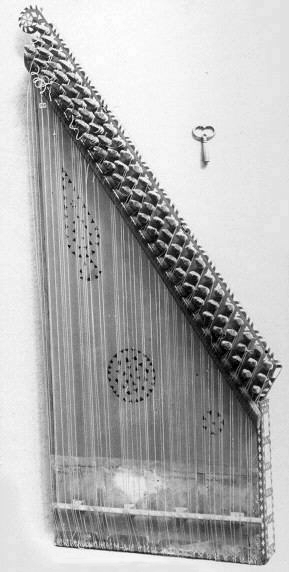

Qanun
قانون
| Category | Strings |
|---|---|
| Country of origin | Middle East |
| Classification | type of musical instrument |
| Wikipedia | en.wikipedia.org |
| Wikidata | Q904646 |
Listen
Audio: Ariel Qassis, CC BY-SA 2.5 / via Wikimedia Commons
Audio: Jeuwre, CC BY-SA 4.0 / via Wikimedia Commons
Audio: Benoît Prieur, CC0 / via Wikimedia Commons

Overview
The qanun (also written kanun) is a flat trapezoidal plucked box zither used across the Middle East, North Africa, the Eastern Mediterranean, and Central Asia. It carries between 70 and 80 strings, organised in groups of three per pitch, played with two finger picks worn on the index fingers of both hands. Along the left edge of the soundboard, a row of small metal levers (the mandal in Turkish; urab in Arabic) sit under the strings and can be flipped during a performance to raise or lower individual notes by micro-tonal amounts.
That small lever system is what makes the qanun unusual among the world’s zithers. Unlike the Chinese guzheng or Japanese koto, where pitch can only be changed by repositioning bridges before playing, the qanun’s mandal allow live retuning between sections of a piece — essential for the maqam and makam traditions, which use micro-tonal intervals that change from one mode to the next.
Origin & History
The qanun has been in continuous use across the Middle East for many centuries; DBpedia’s structured entry places its origins in antiquity. Pictorial evidence and surviving treatises document its presence in Persian and Arab court music well before the medieval period, and by the time of the great Andalusian and Abbasid courts it was already a well-established instrument.
The Hornbostel-Sachs system classifies the qanun as a box zither, and it sits within a broader regional family of zithers documented in DBpedia: the Vietnamese đàn tranh, Korean gayageum, Chinese guzheng, Japanese koto, Mongolian yatga, the European psaltery, and the Baltic kantele and kankles. The qanun is therefore one expression of an extremely wide zither tradition that stretches across most of Eurasia.
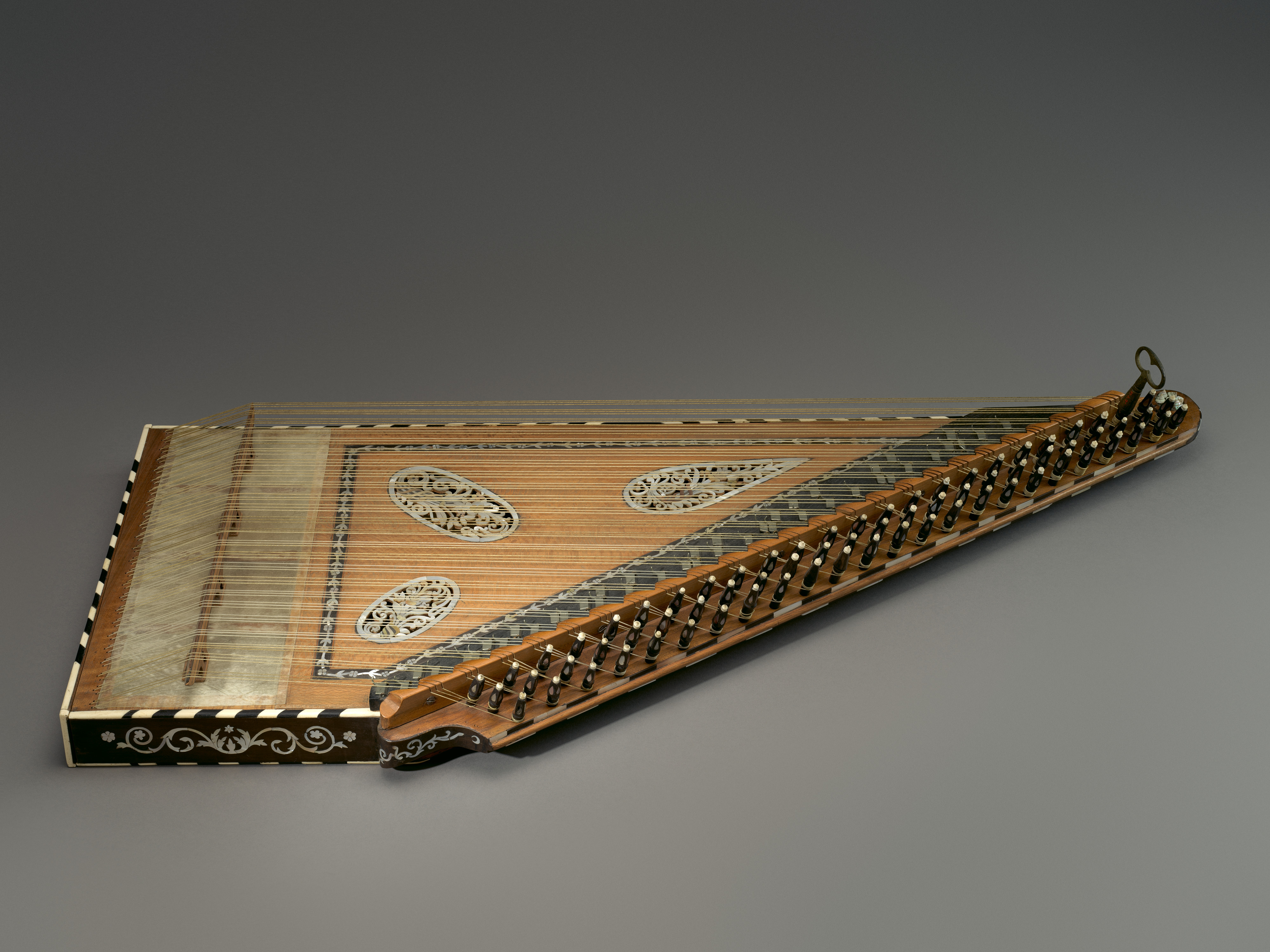
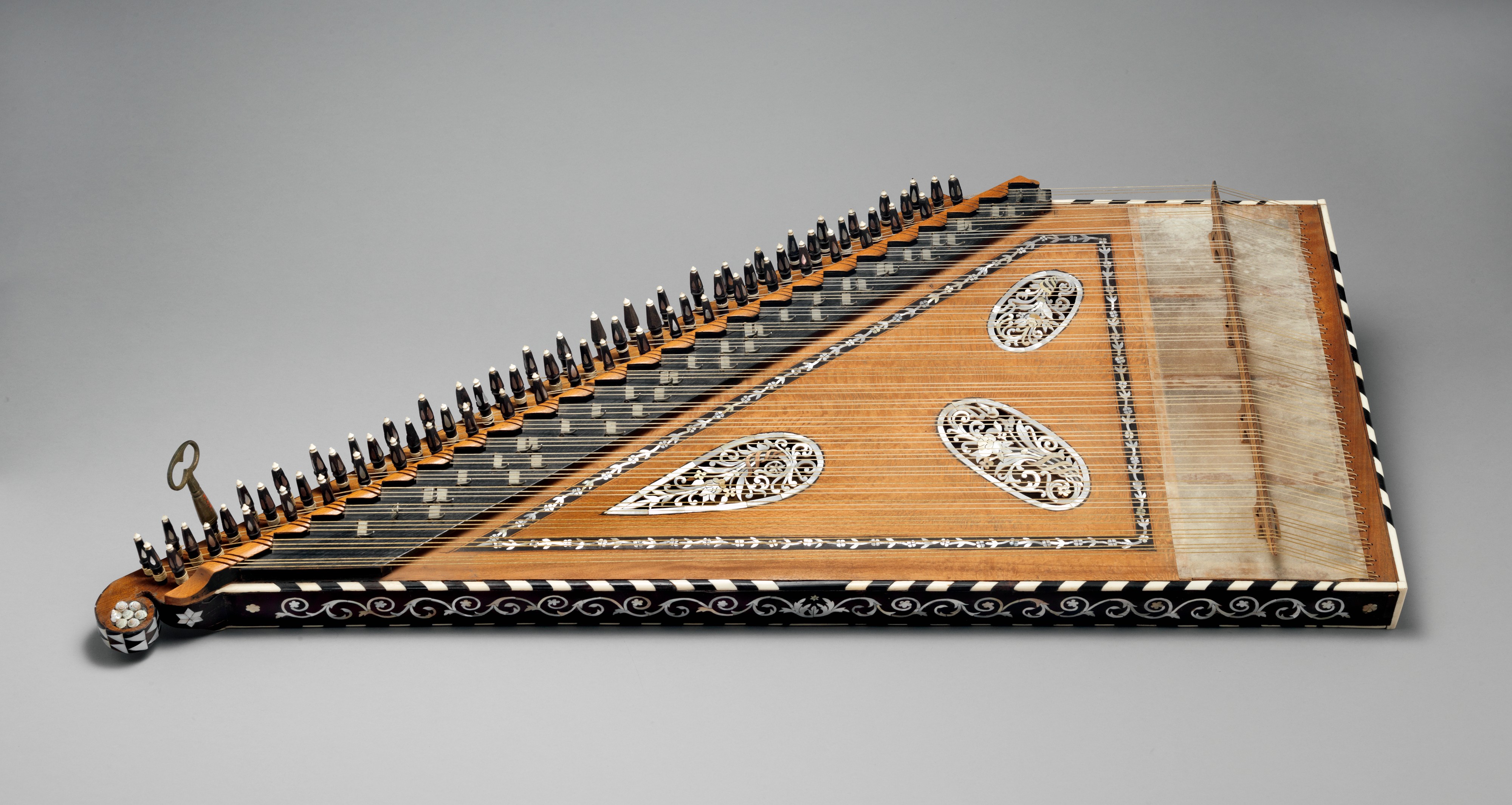
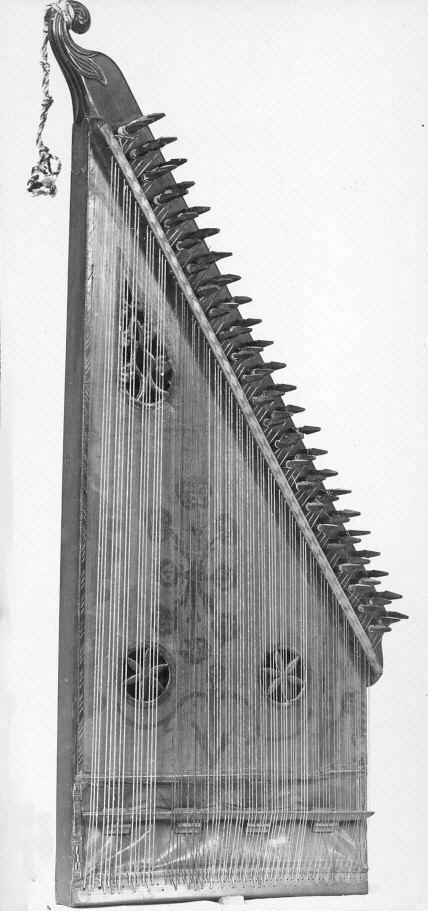
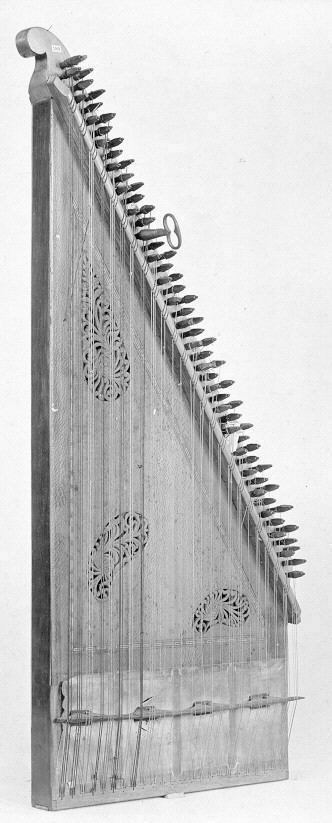
The Metropolitan Museum of Art holds two well-documented 19th-century Turkish qanuns. Object 500957 is built from wood, parchment, gut strings, and decorated with mother-of-pearl, ivory, bone, and ebony inlay; object 501814 is a more austere late-19th-century example of wood and metal. Together they show the variety of decorative practice on the instrument while documenting the basic form clearly.
Construction & Materials
A modern qanun is built around a flat trapezoidal wooden body, typically of walnut or beech, with a soundboard pierced by carved sound-roses. A section of the soundboard nearest the player is often a stretched fish or sheep parchment rather than wood, supporting the bridge directly and giving the instrument much of its characteristic warm tone — a feature documented in the MET’s parchment-and-wood Turkish qanun (object 500957).
Strings are nylon or fluorocarbon in modern instruments and were traditionally gut. They run from a fixed bridge over the parchment section to tuning pegs along the diagonal left edge of the body. The Turkish qanun typically carries 26 courses of three strings each (78 strings total); the Arabic and Egyptian qanuns vary slightly in count and tuning.
The mandal lever system runs along the left edge of the soundboard, with each lever positioned underneath a single course of three strings. Flipping a lever shortens or lengthens the speaking part of those strings by a precise amount, raising or lowering the pitch in micro-tonal increments. Turkish qanuns typically have a denser mandal layout than Arabic qanuns, reflecting the larger number of distinct micro-tones used in the Turkish makam system.
How It’s Played
The player sits with the qanun flat on the lap or on a low stand, with the longest strings closest to the body. The two index fingers each wear a small metal pick (the risha); the other fingers are free to manipulate the mandal levers as the music progresses. Both hands pluck — the right hand typically takes the melody and the left hand provides counterpoint or doubles in octaves — but the precise division varies by region and player.
Skilled qanun players often flip mandal levers mid-phrase to retune specific notes for the upcoming section, allowing them to move smoothly between maqam or makam without stopping. This live re-tuning is one of the most distinctive features of the instrument and one of the harder skills to master.
Cultural Significance
The qanun is a foundation instrument in Arabic, Turkish, Greek, Armenian, and broader Eastern Mediterranean classical music. It is a standard member of the Arabic takht ensemble, the Turkish ince saz ensemble, and many of the broader regional orchestras of the 20th and 21st centuries. It appears prominently in muwashshah song forms, in taqsim improvisation, and in the standard maqam repertoire.
In recent decades the qanun has also gained a steady international presence through the recordings of players such as Julien Jalâl Eddine Weiss, Maya Youssef, Göksel Baktagir, and the Lebanese composer-performer Abdullah Chhadeh, who have brought the instrument into cross-cultural projects with chamber and orchestral musicians.
Notable Examples & Recordings
The Metropolitan Museum of Art’s two surviving 19th-century Turkish qanuns (objects 500957 and 501814) are particularly useful because they bracket the late Ottoman era, when the instrument took close to its modern form. For listening, recordings by Julien Jalâl Eddine Weiss, Maya Youssef, Göksel Baktagir, and the Egyptian master Abdul Fattah Sabri offer a strong introduction across the Arabic, Turkish, and contemporary global traditions.
Related Instruments
- Santur – the hammered Persian dulcimer, the qanun’s struck cousin
- – an alternative spelling for the same instrument used in Turkish contexts
- – the medieval European plucked zither, descended from the same family
- Guzheng – the Chinese long zither cousin in the broader Asian family
- – the Finnish plucked zither in the broader Eurasian family
Where to Hear It
Arabic, Turkish, Armenian, and Greek classical concerts are the natural settings for the qanun. The instrument is also widely heard in modern Middle Eastern orchestras, in cross-cultural collaborations with Western chamber and orchestral musicians, and in the soundtracks of many regional films.
- Wikipedia: Qanun
- The MET: Qānūn (object 500957)
- The MET: Qānūn (object 501814)
- Wikimedia Commons: Qanun
Learning Resources
Beginners typically start by learning to attach the two risha picks securely and to produce a clean tone on the open courses before moving on to scales and short taqsim improvisations. The mandal lever system is usually introduced in stages, beginning with the most common micro-tonal alterations of the basic maqam. Several senior players now offer structured online tuition in Arabic, Turkish, and English, and a growing literature on maqam theory is accessible to non-Arabic-speaking students.
Frequently Asked Questions
What is the qanun?
The qanun is a flat trapezoidal plucked box zither used across the Middle East, North Africa, the Eastern Mediterranean, and Central Asia. It typically carries 70 to 80 strings and is played with two finger picks worn on the index fingers of both hands.
What are the small levers on a qanun?
The levers are called mandal in Turkish and urab in Arabic. They sit under the strings along the left edge of the soundboard and can be flipped during a performance to raise or lower individual notes by micro-tonal amounts — essential for moving between maqam or makam.
How is the qanun different from a guzheng or koto?
All three are box zithers in the broader Eurasian family. The qanun differs in carrying many more strings (around 70-80 versus 21 or 13), in being played with finger picks on both hands rather than primarily on the right, and in having the mandal lever system that allows live micro-tonal retuning.
Are old qanuns displayed in museums?
Yes. The Metropolitan Museum of Art in New York holds at least two well-documented 19th-century Turkish qanuns (objects 500957 and 501814).
Is the qanun difficult to learn?
The basics of producing a clean tone and playing simple scales are reasonably approachable. Coordinating the two hands, learning the mandal lever system, and developing fluency in the regional maqam repertoire typically takes several years of structured study.


