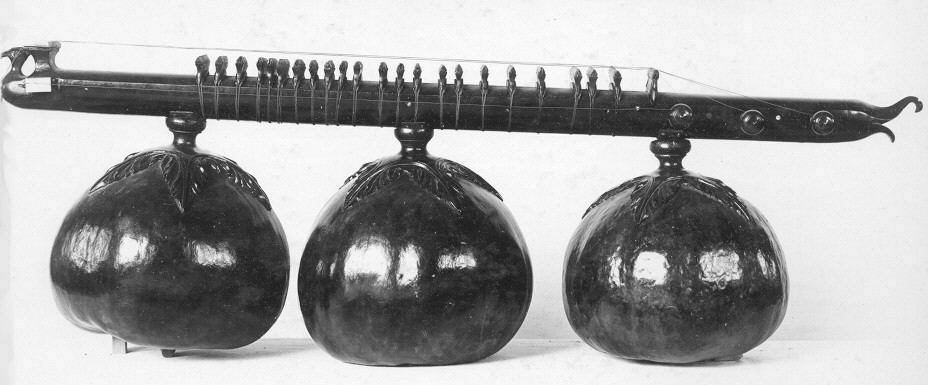

Kinnari Vina
किन्नरी वीणा / Kinnari Veena
| Category | Strings |
|---|---|
| Country of origin | Medieval India |
| Classification | chordophone, tube zither, type of musical instrument |
| Wikipedia | en.wikipedia.org |
| Wikidata | Q106782089 |
Overview
The kinnari vina (also spelled kinnari veena) is a medieval and early modern stick-zither veena of South Asia. Wikidata characterises it as a gourd-fitted stick-zither-form veena spanning the medieval period through to modern times, kin to both the alapini and the eka-tantri varieties — together the wider family of single-stick veenas of medieval India. The Wikipedia article documents the instrument’s continuous presence in Indian iconography from medieval temple sculpture to surviving early-modern specimens.
The kinnari vina belongs to the wider veena family — the umbrella term for South Asian plucked-string instruments of considerable diversity. Unlike the modern Saraswati vina (which has a large carved wooden body), the kinnari vina is built around a long wooden stick or tube neck with two or three small gourd resonators attached at points along its length, giving it the distinctive multi-resonator appearance familiar from medieval Indian stone carving and palm-leaf manuscript illustration.
Origin & History
The kinnari vina is one of the older members of the South Asian veena family. Wikidata’s description places its history from the medieval period into the modern era. The instrument and its relatives — the alapini vina (with one resonator) and the eka-tantri vina (single-string) — are documented in medieval Indian musicological literature including Sarngadeva’s 13th-century Sangita Ratnakara, which provides detailed construction descriptions and playing technique for the wider family.
Medieval South Indian temple sculpture provides extensive visual documentation. The Hoysala temples of Karnataka (12th–13th centuries), the Chola temples of Tamil Nadu (10th–13th centuries), and the Vijayanagara temple complexes of the 14th–16th centuries all include numerous depictions of musicians and celestial figures playing stick-zither veenas of the kinnari type. The instrument is closely associated in iconography with the kinnara — celestial musicians of Hindu and Buddhist mythology — and the name kinnari vina is widely understood to derive from this association.
During the 19th century the modern Saraswati vina (with its single large carved wooden body) displaced the kinnari vina in mainstream Karnatak classical performance, while the older stick-zither form lingered in regional folk and chamber settings across Karnataka, Andhra Pradesh and Tamil Nadu. The Metropolitan Museum’s collection holds a 19th-century kinnari vina (object 500774, of wood and gourds) — one of very few surviving museum specimens of the older form — and the William Gibb illustration of the instrument used in major 19th-century musicological encyclopedias was based on this or a similar specimen.
In the 21st century there has been a small but deliberate revival of the kinnari vina by performers including the Karnatak musicians G. Vijayalakshmi and the late Karaikudi S. Subramanian, who have built modern reproductions and developed concert performance practice based on medieval iconographic and textual sources.
Construction & Materials
A kinnari vina consists of a long straight wooden stick or hollow bamboo tube — typically 90 to 110 centimetres long — that serves as both the neck and the principal sound-producing element. Two or three small dried gourd resonators are attached to the underside of the stick at calculated points along its length, increasing the body’s acoustic surface area and adding resonant chambers that enhance specific frequency ranges. Frets — typically of metal wire or bamboo — are tied to the upper face of the stick to allow precise pitch stopping.
The MET’s specimen is described as wood and gourds, the canonical traditional construction. Strings vary by regional tradition and historical period; the medieval eka-tantri vina used a single string (eka = one), the kinnari vina typically uses three or four melody strings plus a separate set of small drone (sympathetic) strings that pass through small holes drilled in the frets and resonate with the played notes.
Construction techniques follow the wider South Asian luthier tradition. The wooden stick is typically jackfruit, jackwood or local hardwood; the gourds are dried bottle-gourds (Lagenaria) hollowed and seasoned for resonance; the strings are historically of silk and gut, in modern instruments of metal wire.
How It’s Played
The kinnari vina is held horizontally across the player’s lap, with one gourd resonator resting on the player’s right thigh and the other (or the second and third) on the floor or on a small support beside the player. The right hand plucks the strings — historically with a small wooden plectrum, in modern revival practice often with the fingers — and the left hand stops the strings against the frets to select pitches.
Idiomatic technique reflects the wider South Asian raga tradition. The player uses careful pitch-bending and ornamental glides (gamakas) on the melody strings, allowing the instrument to articulate the microtonal inflections central to South Asian classical music. The sympathetic drone strings sound continuously throughout the performance, providing a continuous pitch-reference and a characteristic shimmering background texture.
Cultural Significance
The kinnari vina’s cultural significance is primarily historical and iconographic rather than active performance. The instrument is one of the most widely depicted musical objects in medieval South Indian temple sculpture and provides essential evidence for our understanding of the wider history of the South Asian veena family. The Hoysala, Chola and Vijayanagara temple sculptures of musicians playing kinnari-type vinas — often accompanying images of the deities Saraswati, Sarasvati, Narada and various celestial musicians — together form one of the largest visual archives of any medieval Asian musical tradition.
The instrument’s name derives from the kinnara — celestial musicians of Hindu and Buddhist mythology depicted as half-human, half-bird figures — and the kinnari vina is therefore implicitly associated with divine and otherworldly music in South Asian iconographic tradition. Modern revival of the instrument by Karnatak musicians has explicitly drawn on these iconographic associations.
Notable Examples & Recordings
- G. Vijayalakshmi, contemporary Karnatak music recordings featuring revived kinnari vina.
- The MET’s 19th-century specimen (object 500774) is one of very few surviving museum kinnari vinas in any major Western collection.
- Hoysala and Chola temple iconography — the temple sculptures of Belur, Halebidu, Thanjavur and Madurai provide extensive medieval depictions of kinnari-type vinas.
- Sarngadeva’s 13th-century Sangita Ratnakara provides the principal medieval textual documentation of the construction and playing technique.
Related Instruments
- Veena – the wider South Asian plucked-string family that includes the kinnari vina.
- – the modern South Indian classical veena that displaced the kinnari vina in formal performance.
- – the North Indian stick-zither veena of the dhrupad tradition, the closest surviving relative.
- – the modern fretless stick-zither veena.
- Eka tantri vina – the single-string medieval veena documented in Sangita Ratnakara.
Where to Hear It
The kinnari vina is rarely heard in live performance because of its near-disappearance as a continuous tradition. The annual Margazhi (Madras) Music Festival in Chennai occasionally features revival performances by G. Vijayalakshmi and others. International appearances are very rare. The instrument can be seen as a museum object at the Metropolitan Museum of Art in New York (object 500774), at the Government Museum in Chennai, at the National Museum in New Delhi, and at the Indira Gandhi National Centre for the Arts. Recordings of the modern revival appear on the Karnatak music labels Carnatica and Kalpita Classics.
- Wikipedia: Kinnari veena
- Wikidata: Kinnari vina (Q106782089)
- The MET: Kinnari Vina (object 500774)
- Wikimedia Commons: Kinnari vina
Learning Resources
Active teaching of the kinnari vina is essentially limited to the small revival circle around G. Vijayalakshmi in Chennai. Scholarly study is supported by the Indira Gandhi National Centre for the Arts in New Delhi and the South Asian music programmes at SOAS London, the University of California at Santa Barbara, and Wesleyan University. Method materials in English include the relevant chapters of the Sangita Ratnakara (Mukund Lath’s translation), Bonnie C. Wade’s Music in India: The Classical Traditions and Lalita Ramakrishna’s writings on the medieval veena tradition. Modern reproduction kinnari vinas built by Karnataka luthiers run from approximately 800 to 3,000 USD.
Frequently Asked Questions
What is the kinnari vina?
A medieval and early-modern South Indian stick-zither veena, with a long wooden stick or bamboo neck and two or three small gourd resonators attached to the underside. The instrument is the older form that predated the modern Saraswati vina.
Is the kinnari vina still played?
Rarely. The instrument was largely displaced by the modern Saraswati vina in formal Karnatak music by the late 19th century. A small modern revival by performers including G. Vijayalakshmi has reanimated the tradition for chamber and academic performance.
Where can the kinnari vina be seen?
The Metropolitan Museum of Art in New York holds a 19th-century specimen (object 500774). The Government Museum in Chennai, the National Museum in New Delhi and the Indira Gandhi National Centre for the Arts also hold kinnari vinas. The instrument is also extensively depicted in medieval South Indian temple sculpture, especially at Belur, Halebidu, Thanjavur and Madurai.
How is the kinnari vina related to the modern Saraswati vina?
Both belong to the wider South Asian veena family, but the kinnari vina is the older stick-zither form and the Saraswati vina is the modern carved-wooden-body form that replaced it. The two instruments share repertoire (raga-based classical music) but differ entirely in construction.
Why is the instrument called kinnari?
The name derives from the kinnara — celestial musicians of Hindu and Buddhist mythology depicted as half-human half-bird figures — implying a divine or otherworldly association for the instrument’s voice. The name is widely used in medieval Indian musicological literature.


