.jpg)

Yueqin
月琴 (yuèqín)
| Category | Strings |
|---|---|
| Country of origin | China |
| Classification | type of musical instrument |
| Wikipedia | en.wikipedia.org |
| Wikidata | Q1370147 |
Overview
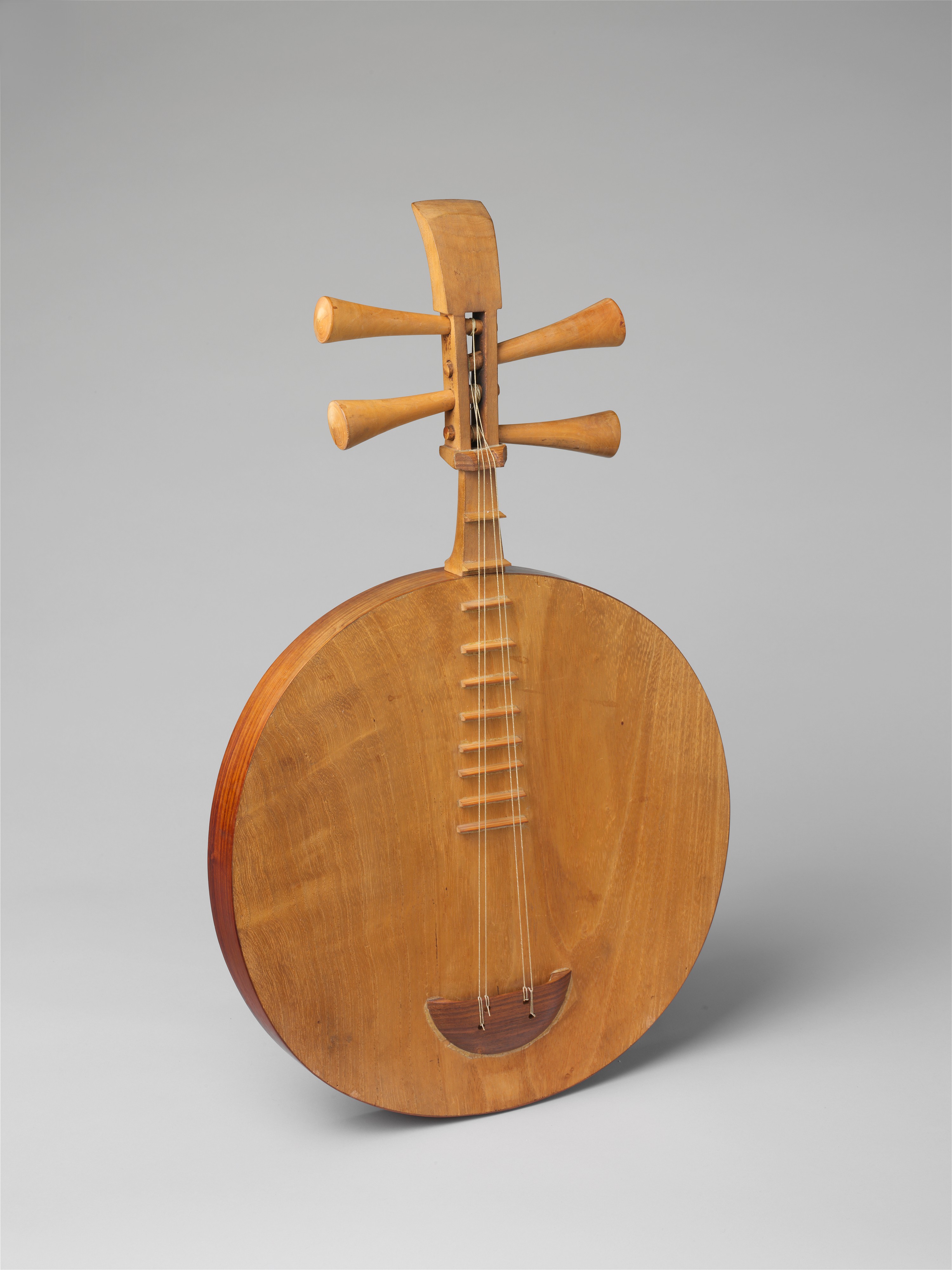
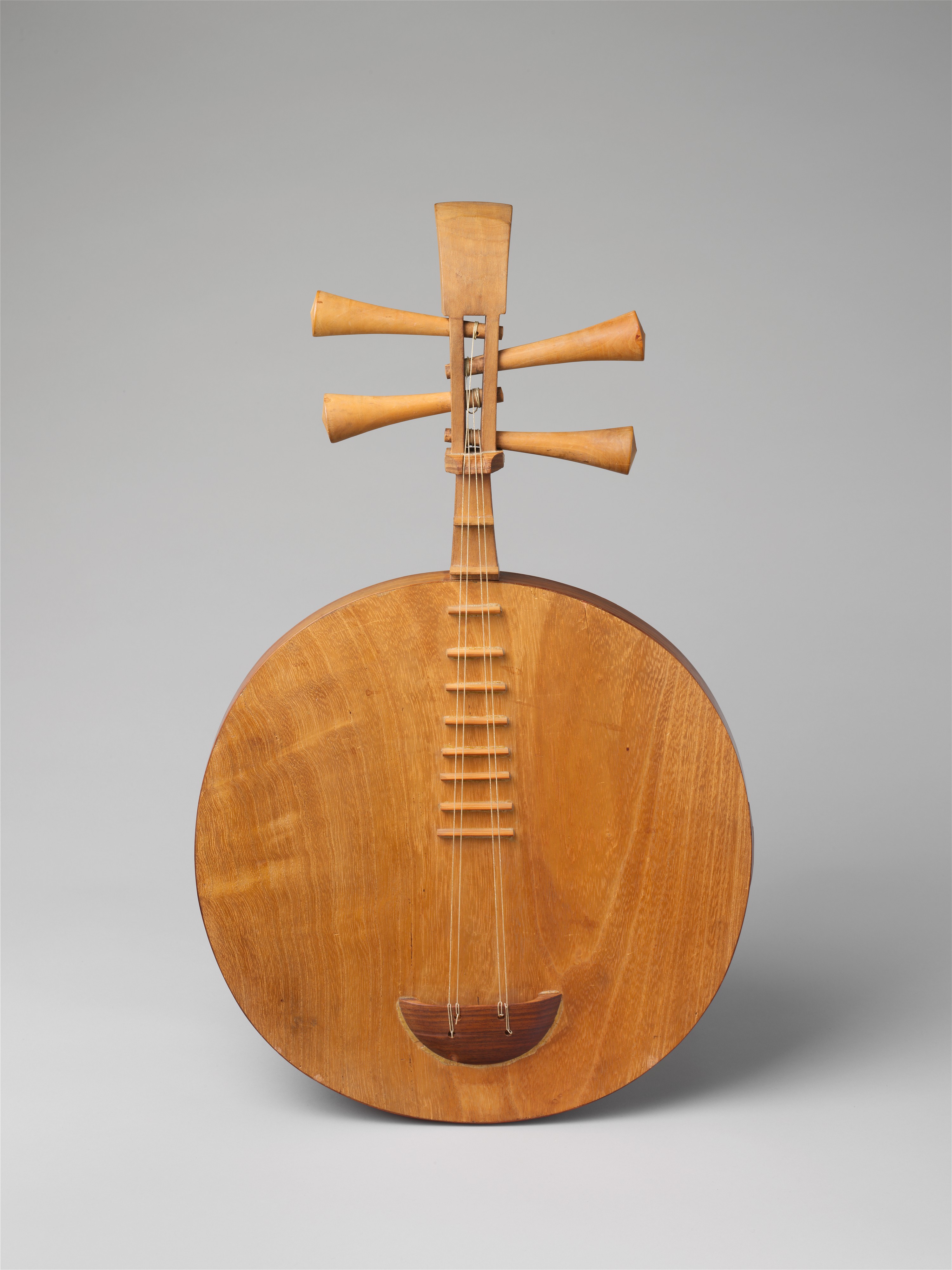
The yueqin (月琴, “moon zither”) is a Chinese plucked lute with a perfectly circular wooden body, a short neck and four strings tuned in two pairs. Its body shape — fully round, like the full moon — gives the instrument its name, and the round-and-short profile distinguishes it sharply from the pear-shaped pipa, the round-and-long ruan, and the long-necked sanxian. Its sound is bright, clipped and rhythmic, well suited to fast accompaniment patterns under sung melodic lines.
Wikidata describes the yueqin as a “traditional Chinese string instrument” within the necked-lute family. The English nickname “moon guitar” is widely used in modern descriptions but obscures the older lute lineage of the instrument.
Origin & History
The yueqin developed during the Han dynasty (3rd century BCE–3rd century CE) and reached an essentially modern form by the Tang and Song dynasties. Its closest relative is the larger ruan, with which it shares the round body and flat back; the yueqin can be thought of as the short-necked, smaller form of the same instrumental idea. The two instruments evolved in parallel — the ruan as a melodic-line and ensemble instrument, the yueqin as a primarily rhythmic accompaniment instrument.
By the late Ming and Qing dynasties the yueqin had become indispensable to Beijing opera and to several other regional Chinese theatre traditions. In the standard Beijing opera jinghu ensemble the yueqin sits alongside the jinghu fiddle and the sanxian as one of the three main accompaniment instruments — the sanjianzi trio that supports the singers.
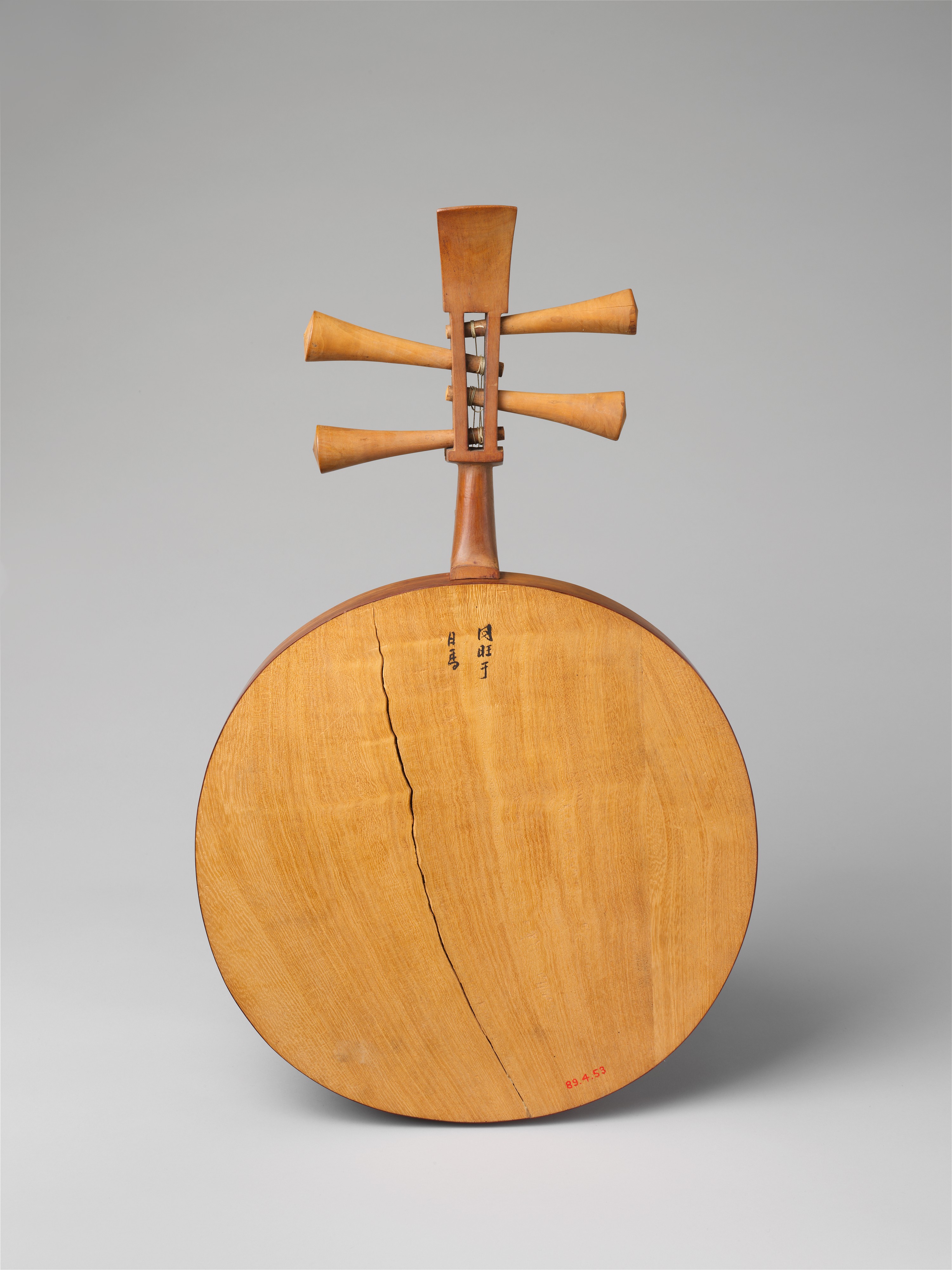
The Metropolitan Museum holds a 19th-century Chinese yueqin (object 500626), built of rosewood, paulownia (wu-tong) wood and gut, donated through the Crosby Brown Collection in 1889. Catalogued together with it is a Thai seung (object 500927), a late-19th-century instrument related to the yueqin in body shape and construction. Together they document the South-East Asian spread of the round-bodied short-necked plucked lute.
Construction & Materials
The yueqin body is a fully circular wooden box, around 36 centimetres in diameter and around four to five centimetres deep, with a flat soundboard of paulownia and a flat back of harder wood. The neck is short — around 18 centimetres — and carries between eight and twelve frets on the fingerboard, plus additional frets on the soundboard for the higher positions.
The four strings (originally silk, today nylon-wound steel) are arranged in two double courses, each course tuned in unison. Standard tuning is two pairs a fifth apart, most commonly d-d-a-a or g-g-d-d. A small bridge sits on the soundboard near the bottom of the body.
The MET’s 19th-century specimen, with its rosewood body, paulownia top and gut strings, represents standard high-quality late-Qing construction.
How It’s Played
The player holds the yueqin diagonally across the body, with the round body resting against the right thigh and the neck angled upward to the left. The right hand plucks the strings with a small plectrum (formerly tortoiseshell, now usually plastic), and the left hand stops the strings against the frets.
In Beijing opera accompaniment the yueqin plays a continuous accompaniment pattern — repeated single-note runs, tremolo, and rhythmic chord strokes — that supports the singer over the slower melodic line of the jinghu fiddle. In silk-and-bamboo ensemble work the role is similar, providing a bright rhythmic layer above the lower-pitched instruments.
Cultural Significance
The yueqin is one of the three signature instruments of Beijing opera, and any visual representation of a Beijing opera ensemble — in television, film or tourist marketing — almost always includes the round body of the yueqin. The instrument also features prominently in Sichuan opera, Yueju (Cantonese) opera, Min opera (Fujian) and several other regional theatre traditions, each with its own slight variant of construction and tuning.
In Taiwan and southern China the yueqin appears in nanguan and liyuan classical chamber music. In Vietnam the closely related đàn nguyệt (also called đàn kìm) is a central instrument of cải lương southern theatre and nhạc tài tử chamber music — another example of the round-body short-neck lute spreading from China through the cultural networks of southeast Asia.
Notable Examples & Recordings
For listening:
- Beijing Opera Ensemble archival recordings — yueqin in its primary functional role as theatre accompaniment.
- The Twelve Girls Band, Eastern Energy — modern crossover featuring the yueqin in popular arrangement.
- Chinese Music Research Institute historical recordings of regional theatre traditions including Sichuan and Cantonese opera.
- Đặng Thị Hồng Thư, Đàn Nguyệt Việt Nam — Vietnamese moon-lute recordings, the southeast-Asian descendant of the yueqin.
Related Instruments
- – the larger round-bodied long-necked Chinese lute family that the yueqin is the short-necked counterpart of.
- Pipa – the pear-shaped Chinese lute, the principal solo plucked instrument of Chinese music.
- Sanxian – the long-necked snake-skin-covered Chinese lute that joins the yueqin in Beijing opera accompaniment.
- – the Vietnamese descendant used in southern theatre and chamber music.
- Liuqin – the small soprano member of the modern Chinese plucked-lute family.
Where to Hear It
The National Centre for the Performing Arts in Beijing, the Shanghai Grand Theatre and the major opera houses of Sichuan, Cantonese and Min opera all program regular performances in which the yueqin features as part of the standard ensemble. Conservatory recitals at the Central Conservatory of Music in Beijing and the Shanghai Conservatory feature the yueqin both as a Beijing-opera accompaniment instrument and as an emerging solo instrument. In Vietnam, the cải lương theatres of Ho Chi Minh City and the An Giang region feature the related đàn nguyệt in continuous nightly use.
- Wikipedia: Yueqin
- The MET: Yueqin, 19th c. (object 500626)
- The MET: Seung, Thai (object 500927)
- Wikimedia Commons: Yueqin
Learning Resources
The yueqin is most often studied in the context of Beijing opera or other regional theatre traditions, and most teachers come from a working theatre-orchestra background. Conservatory programmes in Beijing, Shanghai, Tianjin and Wuhan offer the yueqin both as a principal study and as a secondary study for opera-orchestra students. Standard tutor material includes the central conservatory’s graded examination books for plucked strings and the Beijing Opera Academy’s accompaniment manuals. New instruments by Beijing makers run from approximately 200 to 1,500 USD; high-quality concert-grade yueqin from leading workshops can reach 2,500 USD.
Frequently Asked Questions
Why is the yueqin called the moon lute?
Its perfectly circular body shape resembles a full moon, and the Chinese name yueqin (月琴) means “moon zither” or “moon lute.” The English nickname “moon guitar” is widely used today.
How many strings does a yueqin have?
Four strings arranged in two double courses, each tuned in unison. The two courses are typically tuned a fifth apart.
What is the difference between a yueqin and a ruan?
The yueqin is shorter, with a smaller round body and a much shorter neck. The ruan family covers a wider range of sizes (gao, xiao, zhong and da), all with longer necks and used as the central plucked-string section of the modern Chinese orchestra.
Is the yueqin used in Beijing opera?
Yes. It is one of the three main accompaniment instruments in Beijing opera, alongside the jinghu fiddle and the sanxian. This trio supports the singers in nearly all Beijing opera ensembles.
Are old yueqin in museums?
Yes. The Metropolitan Museum holds a 19th-century Chinese yueqin (object 500626) and a related Thai seung (object 500927), both in the Musical Instruments department.
Where is the yueqin played outside China?
The closely related đàn nguyệt is widely played in Vietnam in southern theatre and chamber music. Yueqin players also work in the Chinese diaspora communities of Singapore, Malaysia, Hong Kong and Taiwan.


