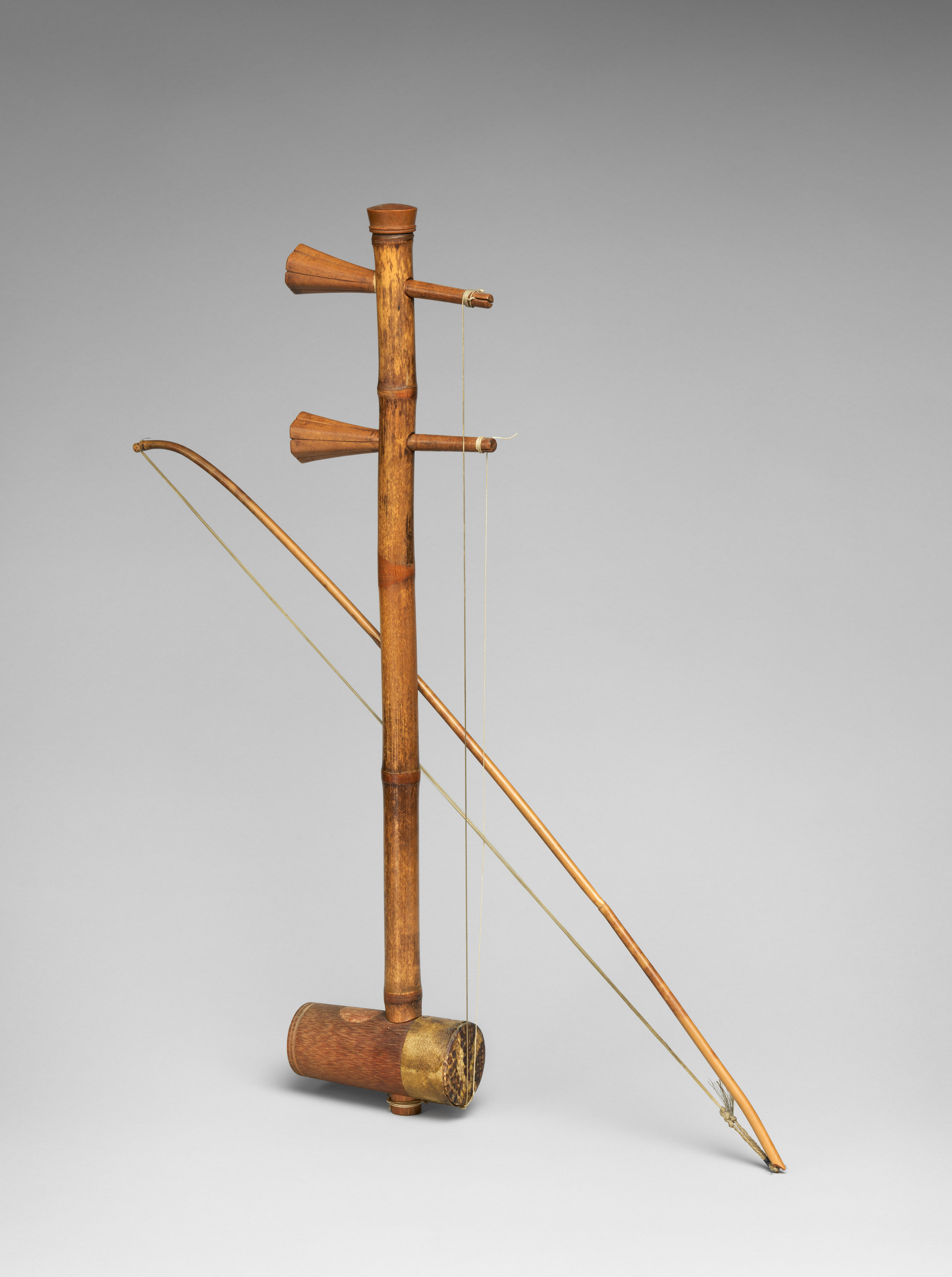
Tanpura
तानपूरा
| Category | Strings |
|---|---|
| Country of origin | India |
| Classification | type of musical instrument |
| Wikipedia | en.wikipedia.org |
| Wikidata | Q1164636 |
Listen
Audio: Arunasank, CC BY-SA 4.0 / via Wikimedia Commons
Audio: Ramakrishnamurthy, CC BY 3.0 / via Wikimedia Commons

Overview
The tanpura — also written tambura — is a long-necked plucked drone instrument used across Indian classical music, both Hindustani and Carnatic. It has no frets and no melody role. Its purpose is to provide a continuous, harmonically rich background drone against which a soloist sings or plays. Listeners who only notice the tanpura subliminally are still being deeply shaped by it: every note of an Indian classical performance is heard against its sustained tonic.
The instrument is unusual among long-necked lutes precisely because of this restricted role. It does only one job, and it does it in a way that has shaped the harmonic sensibility of an entire musical tradition.
Origin & History
The tanpura developed on the Indian subcontinent as part of the same broad family of long-necked lutes that produced the sitar, surbahar, and a number of regional drone instruments. It exists in two main regional variants: the Miraj style typically used in Hindustani classical music and the Tanjore style preferred in Carnatic music. A smaller fretless instrument, the tamburi, is sometimes used by vocalists who travel.
Detailed dates for the tanpura’s standardisation are less well documented than for the sitar, and our most reliable evidence comes from related instruments. The Metropolitan Museum of Art’s 19th-century Indian Sarangi specimens (objects 503204 and 500752) give a sense of the instrument-making tradition the tanpura belongs to: hand-built, heavily ornamented in the higher-end examples, and stable in form by the late 19th century. By that point the modern tanpura was clearly being built and played in roughly its present form.
Construction & Materials
A tanpura is built around a hollow gourd resonator, a long hollow wooden neck, and four (sometimes five or six) metal strings stretched over a wide flat bridge. There are no frets. The bridge is the secret to the instrument’s sound: it is curved on top and slightly raised, so each string vibrates against the bridge edge in a controlled buzz, generating a complex set of overtones that can sustain for many seconds after each pluck.
A small thread, the jivari or “life-giving” thread, is placed under each string between the string and the bridge. Sliding this thread by a fraction of a millimetre changes the timbre of the drone dramatically and is a central skill in setting the instrument up. Bodies are usually made from a dried bottle gourd; necks are typically tun, teak, or jackwood; bridges are bone, ivory, or — in modern instruments — synthetic substitutes.
How It’s Played
The tanpura is played by a seated accompanist, often a student of the soloist. The strings are plucked one at a time in a slow, continuous cycle from lowest to highest. The result is a steady, breathing drone in which one tonic note dominates and the others fill in upper-octave and fifth (or sometimes fourth) harmonics depending on the raga.
Tuning is the heart of tanpura practice. The standard tuning is Pa – Sa – Sa – Sa (fifth, tonic, tonic, lower octave), but it changes for ragas that emphasise the fourth instead. The drone is not “set and forget”: small jivari adjustments throughout a performance keep the harmonic colour aligned with the music developing above it.
Cultural Significance
In both Hindustani and Carnatic concerts the tanpura is the harmonic ground from which the raga is built. A soloist tunes their voice or instrument against the tanpura’s sustained tonic and gradually unfolds the raga in relation to that fixed reference. Without the tanpura, the precise micro-tonal intervals that define each raga would be much harder to hear and to teach.
The instrument also plays a quiet but real role in the social structure of Indian classical performance. Sitting tanpura for one’s teacher is a traditional part of a student’s training; it is how generations of musicians have spent their early years on the concert stage before stepping forward as soloists themselves. Electronic shruti boxes and tanpura apps have replaced live tanpura players in some settings, but most senior soloists still prefer an acoustic instrument when they can have one.
Notable Examples & Recordings
The Metropolitan Museum of Art’s collection contains several closely related instruments from the broader tradition, including 19th-century sarangis (objects 503204 and 500752) that document the kind of finely built drone-and-bow lutes the tanpura belongs alongside. For listening, almost any Hindustani or Carnatic vocal recording places the tanpura at the centre of the sound — singers such as Bhimsen Joshi, Kishori Amonkar, M.S. Subbulakshmi, and T.M. Krishna offer especially clear examples of how performer and drone interact.
Related Instruments
- Sitar – the melodic lute most often paired with tanpura accompaniment
- Sarod – another Hindustani lead instrument that requires a tanpura background
- Tabla – the rhythmic counterpart in most Hindustani concerts
- Sarangi – the bowed accompaniment instrument frequently heard alongside tanpura in vocal concerts
- Veena – the older South Indian lute family related to the tanpura’s design lineage
Where to Hear It
Any Hindustani or Carnatic classical recording is a tanpura recording. Listening with headphones makes it especially clear how much the harmonic field of an Indian classical performance owes to the four strings of the drone instrument behind the soloist.
Learning Resources
Tanpura technique is straightforward to start — slow, even plucking with a relaxed hand — but tuning is harder than it looks and is usually taught in person. A few short lessons with an experienced teacher are far more valuable than weeks of self-study. Many Indian music institutions also publish tuning guides aimed at vocal and instrumental students.
Frequently Asked Questions
What is a tanpura used for?
The tanpura provides a continuous, harmonically rich drone that anchors Indian classical music. It does not play melodies; instead, it gives the soloist a fixed tonic against which raga is unfolded.
How is a tanpura different from a sitar?
The tanpura is fretless and used only as a drone, while the sitar has frets and sympathetic strings and plays melodies. They share the same general lute-family ancestry but serve completely different roles in performance.
What is the buzzing sound of the tanpura?
That buzz is created by a small thread (the jivari) placed under each string at the bridge, controlling how the string vibrates against the curved bridge edge. Adjusting the jivari is how a tanpura is shaped to a particular raga.
Can a tanpura be replaced by an app or shruti box?
In casual practice, yes. Many students and even professionals use electronic drones for convenience. In serious performance contexts, however, an acoustic tanpura is still preferred for the warmth and small fluctuations a real instrument provides.
Are there different sizes?
Yes. Larger tanpuras with deeper resonance are typically used by male vocalists, smaller ones by female vocalists or instrumentalists, and the small tamburi is sometimes used by travelling musicians.