

Shamisen
三味線
| Category | Strings |
|---|---|
| Country of origin | Japan |
| Classification | type of musical instrument |
| Wikipedia | en.wikipedia.org |
| Wikidata | Q241337 |
Listen
Audio: Nesnad, CC BY 3.0 / via Wikimedia Commons
Audio: Jeffrey A. Brick, PD / via Internet Archive

Overview
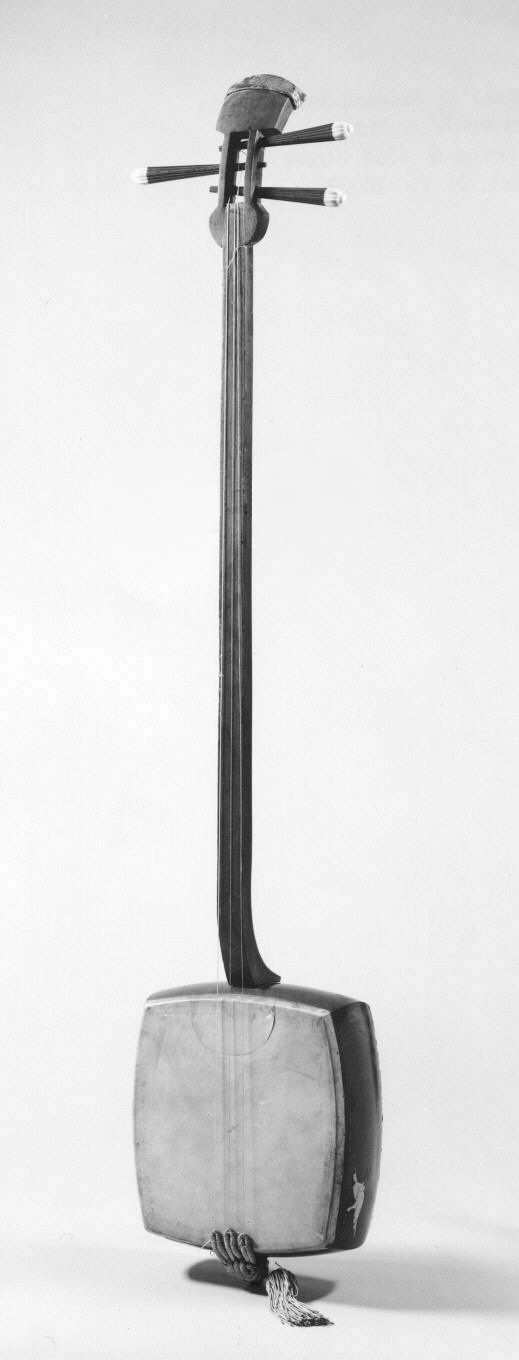
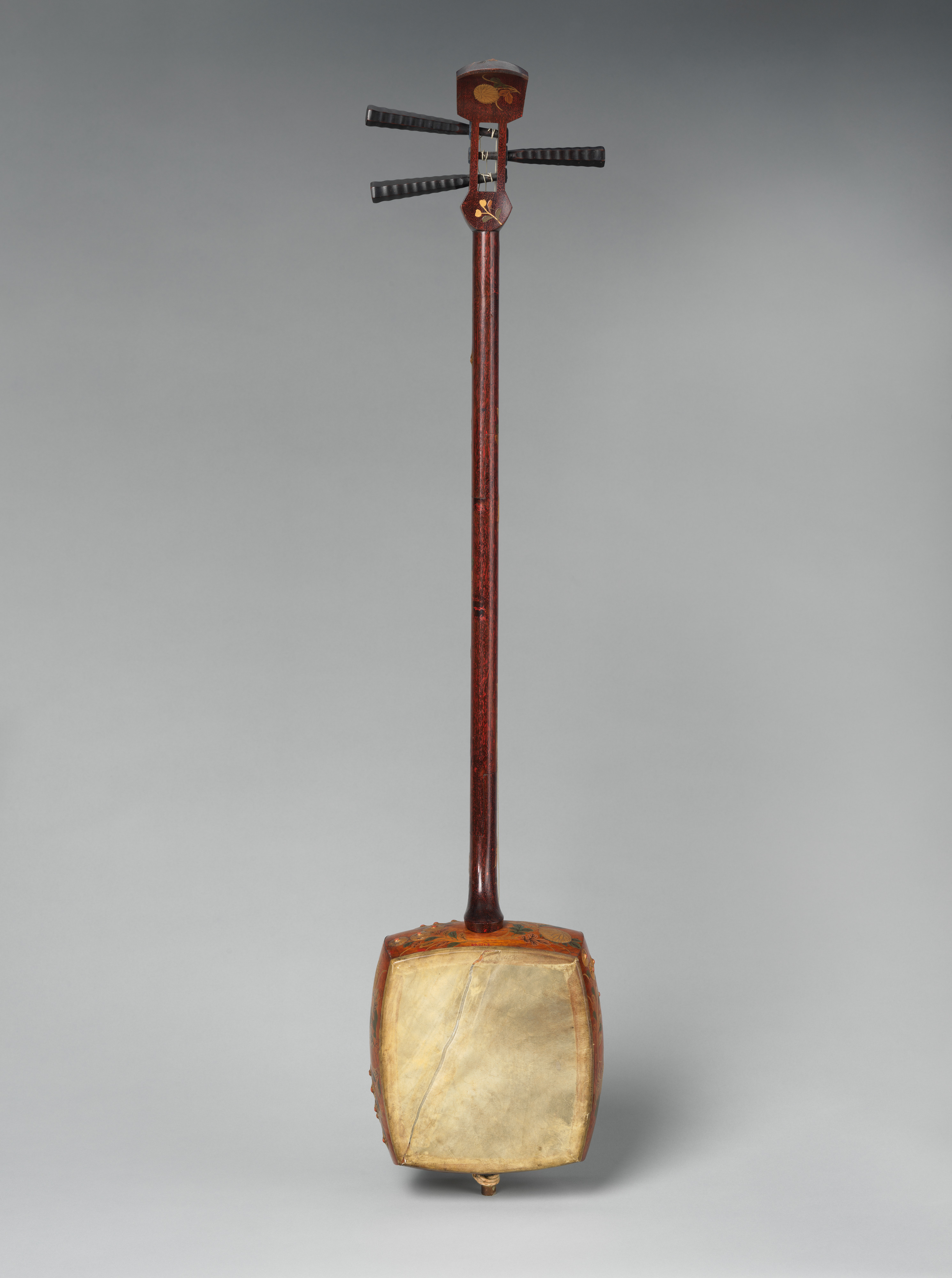
The shamisen is a three-string plucked lute used across Japanese music, from the chamber repertoire associated with kabuki theatre to the high-energy solo style developed in the Tsugaru region of northern Japan. Its body is a small wooden box, typically square or slightly trapezoidal, with both faces covered by a stretched skin head. A long fretless neck carries three strings of twisted silk or, increasingly, of synthetic substitutes.
Despite its compact size, the shamisen has an unusually wide expressive range — from the quiet, ornamented accompaniment of jiuta chamber music to the percussive, rhythmically driven attack of Tsugaru solo playing. It is one of the most widely recognised Japanese instruments worldwide today.
Origin & History
The shamisen reached Japan in the second half of the 16th century, generally dated to around 1560–1570. Its immediate ancestor is the Okinawan sanshin, which itself came from the Chinese sanxian by way of the Ryukyu trade. Within a few decades of arriving on the main Japanese islands, the instrument had been adapted in three important ways: the snake-skin face of the sanshin was replaced with cat or dog skin, the body became larger and more rectangular, and a distinctive playing technique using a large flat plectrum (the bachi) developed.
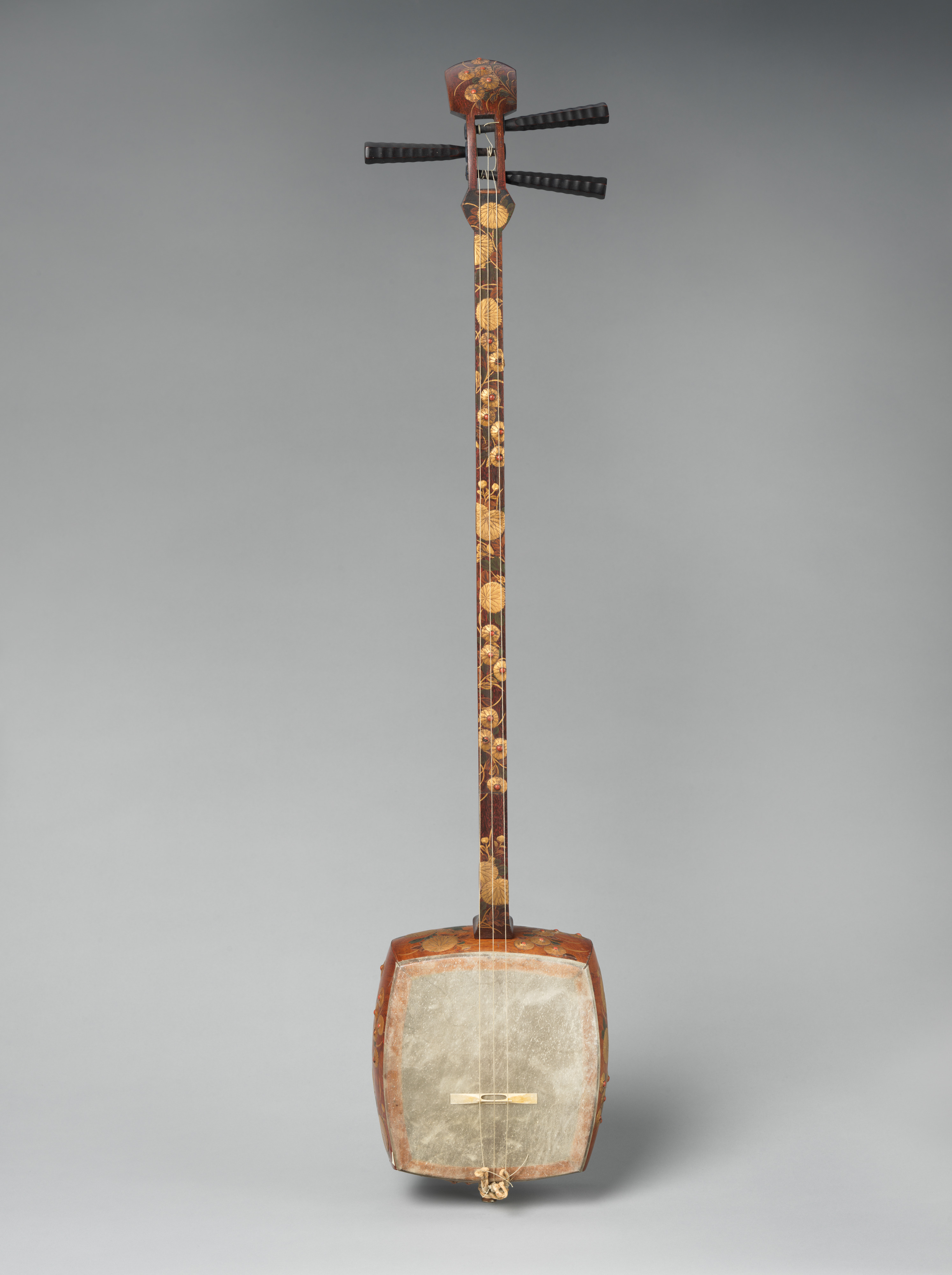
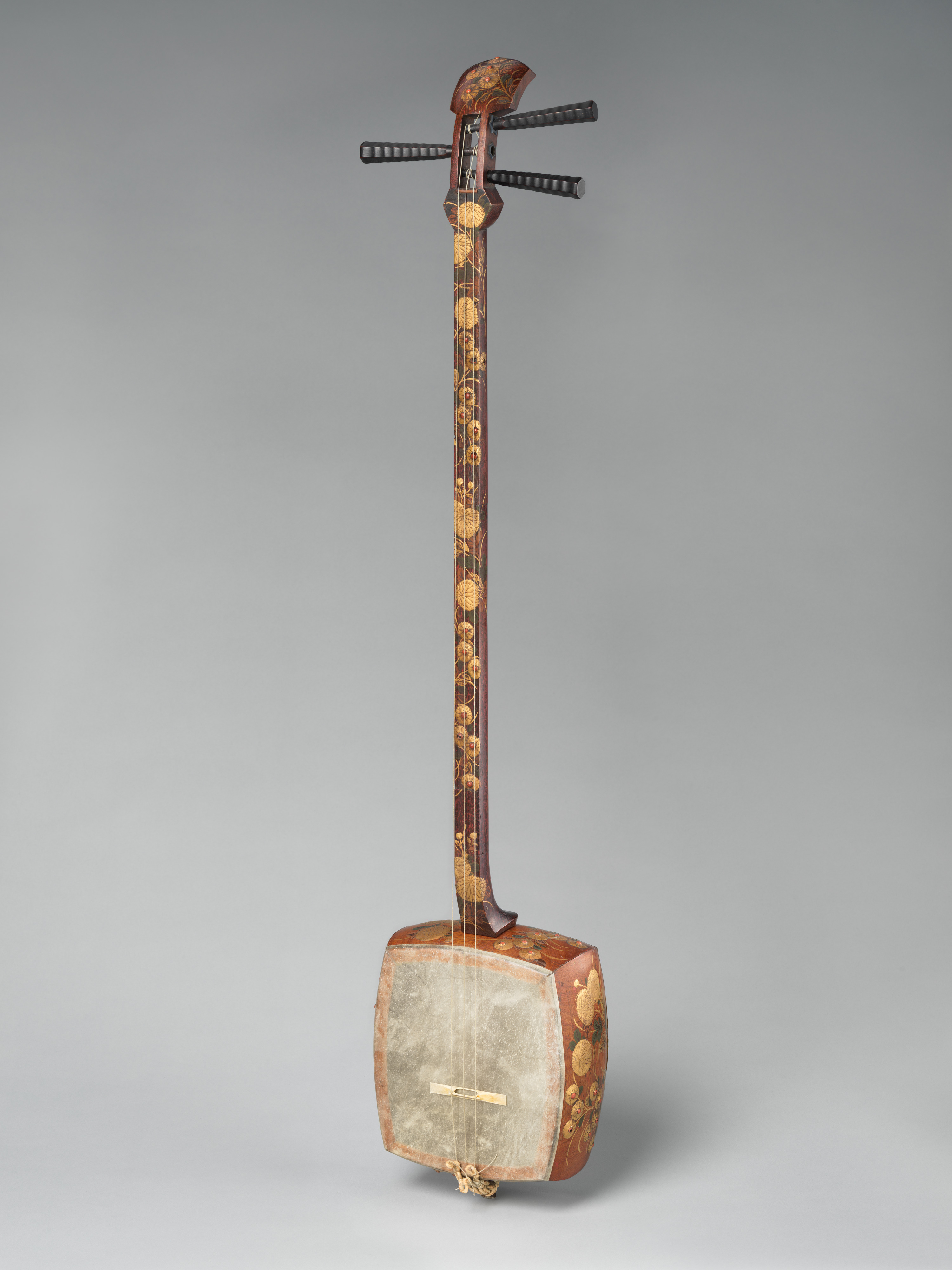
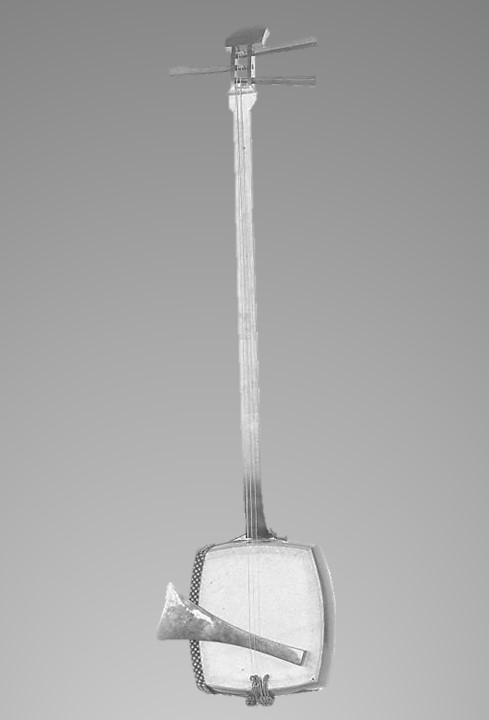
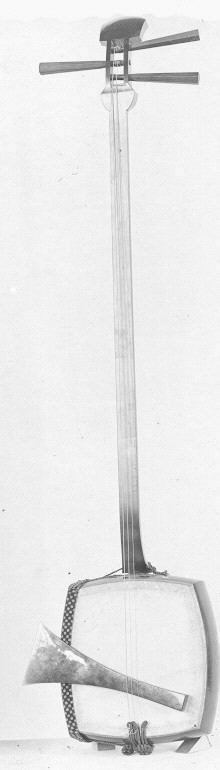
By the Edo period the shamisen was already deeply embedded in urban Japanese culture, accompanying kabuki and bunraku theatre as well as a wide range of chamber genres. The Metropolitan Museum of Art holds two well-documented late-Edo / early-Meiji examples: a 19th-century shamisen (object 503799) made of wood, cloth, and skin, and an instrument dated 1891 (object 503054) with cat-skin head, silk strings, lacquer body, and red coral fittings. Together they show how stable the design was across the transition from the Edo to the Meiji eras.
Construction & Materials
A shamisen is built around three main parts: the body (dō), the neck (sao), and the strings. The body is a small hollow wooden box, typically of karin or mulberry, with skin heads stretched and glued across both the front and back faces. The neck is a long, fretless rod of the same hardwood, often built in three detachable sections so that the entire instrument can be dismantled for transport.
Three different body sizes define the three major branches of shamisen practice: hosozao (slim neck) for chamber and theatre genres such as nagauta, chuzao (medium neck) for jiuta and minyo folk repertoire, and futozao (thick neck) for the powerful Tsugaru style. Heads have traditionally been made from cat or dog skin, although ethical and supply concerns have driven a steady move toward synthetic substitutes such as nylon-based “kawalon” and other modern membranes. Strings are silk in the most traditional setups, though most professional players today use a mix of silk and tetron.
How It’s Played
The player sits on the floor or on a low chair, holding the shamisen across the lap with the body resting against the right thigh and the neck angled up and to the left. The right hand grips a large flat bachi, made of wood, plastic, or — in high-end instruments — bekko (tortoise shell). The bachi strikes both the strings and the skin head simultaneously, giving the shamisen its characteristic combination of pitched and percussive sound.
The left hand presses the strings against the bare neck — there is no fingerboard. Different styles use the bachi very differently: nagauta and jiuta playing tend toward fluid, controlled strokes, while Tsugaru style includes rapid downstrokes and percussive slaps that can sound almost like a drum.
Cultural Significance
The shamisen has been one of the central instruments of Japanese popular and theatrical music for more than four hundred years. It accompanies almost every major form of Edo-period theatre — kabuki, bunraku, joruri narrative singing — and a wide range of folk traditions across the country. In the 20th century, the Tsugaru style associated with players such as Takahashi Chikuzan introduced a much more soloistic and improvisatory practice, which has since become the most internationally visible face of the instrument.
Today the shamisen is taught in conservatories, in lineage-based traditional schools, and increasingly through online tuition by performers such as the Yoshida Brothers and Hiromitsu Agatsuma. It is widely heard in film and game scoring as well as in cross-genre collaborations with rock, jazz, and electronic musicians.
Notable Examples & Recordings
The Metropolitan Museum of Art’s two 19th-century shamisens (objects 503799 and 503054) are particularly useful because they bracket the late Edo and early Meiji eras and document the design just before mass-produced instruments became common. For listening, recordings by Takahashi Chikuzan (Tsugaru), Hiromitsu Agatsuma (modern Tsugaru), the Yoshida Brothers, and the great nagauta and jiuta soloists of the 20th century together cover the instrument’s expressive range.
Related Instruments
- Sanshin – the Okinawan three-string lute and direct ancestor of the shamisen
- Sanxian – the Chinese long-necked three-string lute from which the sanshin derives
- Koto – the Japanese long zither frequently paired with shamisen in chamber music
- Shakuhachi – the end-blown bamboo flute often heard alongside shamisen in sankyoku trios
- Biwa – the Japanese pear-shaped lute used in narrative singing traditions
Where to Hear It
Kabuki and bunraku theatre, traditional chamber concerts (jiuta, nagauta, sankyoku), Tsugaru solo recitals, and folk minyo performances are all natural settings for the shamisen. The instrument is also widely heard in Japanese film and game scores and in cross-cultural projects with Western musicians.
- Wikipedia: Shamisen
- The MET: Shamisen, 19th century (object 503799)
- The MET: Shamisen, 1891 (object 503054)
- Wikimedia Commons: Shamisen
Learning Resources
Beginners usually start with the chuzao or hosozao size, learning to hold the bachi correctly and to produce a clean stroke that combines string and skin contact. Most traditional schools (ryūha) maintain their own tablature systems and graded curricula. For Tsugaru style, structured online tuition by senior performers has become widely available in English and Japanese.
Frequently Asked Questions
How is the shamisen different from a guitar?
The shamisen has only three strings, no frets, a skin-covered wooden body, and is played with a large flat plectrum that strikes both the strings and the skin. Its body is much smaller than a guitar’s, and its tone is sharply percussive rather than sustained.
What are the three sizes of shamisen?
The hosozao (slim neck) is used for nagauta and other chamber genres, the chuzao (medium neck) for jiuta and minyo folk repertoire, and the futozao (thick neck) for the powerful Tsugaru solo style.
Is the shamisen really made with cat skin?
Traditionally, yes — cat or dog skin has been the standard membrane for centuries. Ethical concerns and supply issues have driven a steady move toward synthetic substitutes such as nylon-based “kawalon”, which most professional players now use for at least some of their instruments.
Are old shamisens displayed in museums?
Yes. The Metropolitan Museum of Art in New York holds at least two well-documented 19th-century examples (objects 503799 and 503054), part of the Crosby Brown Collection acquired in 1889.
Is the shamisen difficult to learn?
Producing a basic stroke and finding the main left-hand positions is fairly approachable. The Tsugaru style, with its rapid down-strokes and percussive technique, is significantly more demanding and typically takes several years of consistent practice.