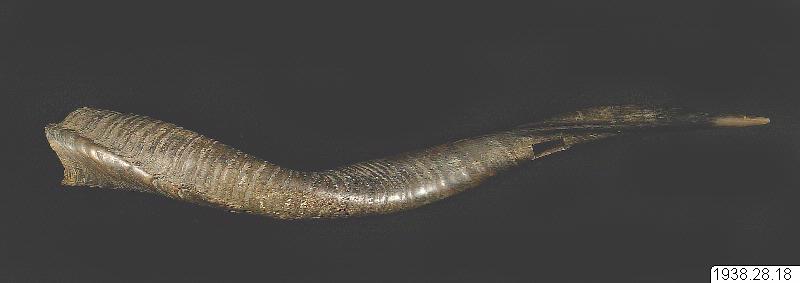
Image: Museum of World Culture, CC0 — via Wikimedia Commons
Hungu
hungu / humbo
| Category | Strings |
|---|---|
| Country of origin | Angola |
| Classification | Wikimedia disambiguation page |
| Wikipedia | en.wikipedia.org |
| Wikidata | Q20999122 |
Overview
The hungu (also called humbo in some regions) is a single-stringed musical bow from Angola, with a wooden bow stave, a single wire or fibre string, and a hollowed gourd attached to the stave as a resonator. It is widely considered the direct African ancestor of the Brazilian berimbau, carried across the Atlantic during the centuries of the trans-Atlantic slave trade and reborn in Bahia as the central instrument of capoeira.
Origin & History
Musical bows of the hungu type are believed to be among the oldest instruments of the Bantu-speaking peoples of central and southern Africa, with broadly similar bows found from Angola south through the Congo basin to the Kalahari and east to Mozambique. The hungu is most closely associated with the Kimbundu and Ovimbundu peoples of present-day Angola.
During the sixteenth to nineteenth centuries enormous numbers of Bantu-speaking people from the Angola-Kongo region were taken to Brazil; their musical bows survived the crossing and are widely believed to be the parents of the modern Brazilian berimbau, which preserves the hungu’s general design with only minor changes. The hungu itself is still played in Angola today, both in folk and in revival contexts.
How It’s Played
The player holds the bow vertically with the gourd resonator pressed against the chest or stomach. A small stick struck against the string produces the basic note. A coin or small stone, held lightly against the string with the other hand, can be brought into contact to raise the pitch by a small interval, giving the instrument its characteristic two-tone melodic vocabulary.
Moving the gourd toward and away from the body opens and closes the resonating chamber against the player’s torso, modulating the overtones and producing a wah-wah-like effect very similar to the modern berimbau. A small rattle (the caxixi in Brazil, with various local equivalents in Angola) is sometimes held in the same hand as the stick.
Cultural Significance
In Angola the hungu is associated with both secular entertainment and ceremonial occasions, including healing rituals in some communities. Its repeated rhythmic and melodic patterns make it well suited to the call-and-response singing traditions of the region.
The hungu’s Brazilian descendant, the berimbau, has become a global emblem of capoeira and of the African contribution to Brazilian music. The Angolan revival of the hungu in recent decades, including its inclusion in projects by artists such as Victor Gama, has helped re-emphasise the African origins of the wider musical-bow tradition.
Related Instruments
- Berimbau – the Brazilian descendant of the hungu
- Mouth bow – the broader family of single-string bows resonated by the player’s body
- Kora – the larger Mande harp from a different but related African string tradition
- Bolon – the West African three-string hunter’s harp
- Mbira – the Zimbabwean lamellophone from the broader southern African sound world
Where to Hear It
Recordings by Victor Gama, the Kafala Brothers, and various Angolan field-recording compilations feature the hungu. Many berimbau recordings from Brazil are now paired in educational releases with their Angolan counterpart, drawing the historical connection explicitly.
Learning Resources
The hungu is taught informally within Angolan communities and through the educational outreach of musicians such as Victor Gama. International workshops on capoeira occasionally include sessions on the Angolan ancestor of the berimbau as part of the broader cultural background.
Frequently Asked Questions
Is the hungu the same as a berimbau?
They are very closely related; the berimbau is the Brazilian descendant of the hungu and other related Angolan musical bows, with only minor changes in materials and playing context.
How many notes does the hungu produce?
Two main pitches — open string and stopped string — together with a wide range of overtone colours produced by moving the gourd against the body.
Is the hungu associated with capoeira?
Capoeira is Brazilian and uses the berimbau, not the hungu directly, but the link between the two instruments is part of the deep African heritage of the practice.
Are there other African musical bows like the hungu?
Yes — many: the uhadi and umrhubhe of southern Africa, the xitende of Mozambique, and the wider mouth-bow family across central and southern Africa.


