

Mbira
mbira / kalimba / sanza
| Category | Percussion |
|---|---|
| Country of origin | Zimbabwe |
| Classification | type of musical instrument |
| Wikipedia | en.wikipedia.org |
| Wikidata | Q1467960 |
Overview
The mbira is a lamellophone — a plucked instrument with a row of thin metal tongues fixed at one end and free to vibrate at the other. The most internationally familiar form is the mbira dzavadzimu used by the Shona of Zimbabwe; closely related lamellophones, however, can be found across most of sub-Saharan Africa under names such as kalimba, sanza, likembe, karimba, nyonganyonga, and many others.
The Hornbostel-Sachs system classifies the mbira as 122.1: a plucked idiophone. That sparse description sits behind one of the most acoustically distinctive instruments in the world — a layered, interlocking sound built from short repeating phrases that overlap and shift against each other to create complex auditory patterns that no single line of notes captures on the page.
Origin & History
Lamellophones of the mbira family have a long history in Africa, with archaeological precursors going back well over a thousand years and a continuous tradition documented across the centuries. One particular form — the mbira dzavadzimu, a name commonly translated as the mbira used to address the ancestors — developed within Shona communities of present-day Zimbabwe and northern Mozambique, and is closely associated with the bira ceremony, in which mbira music helps the community communicate with ancestral spirits.
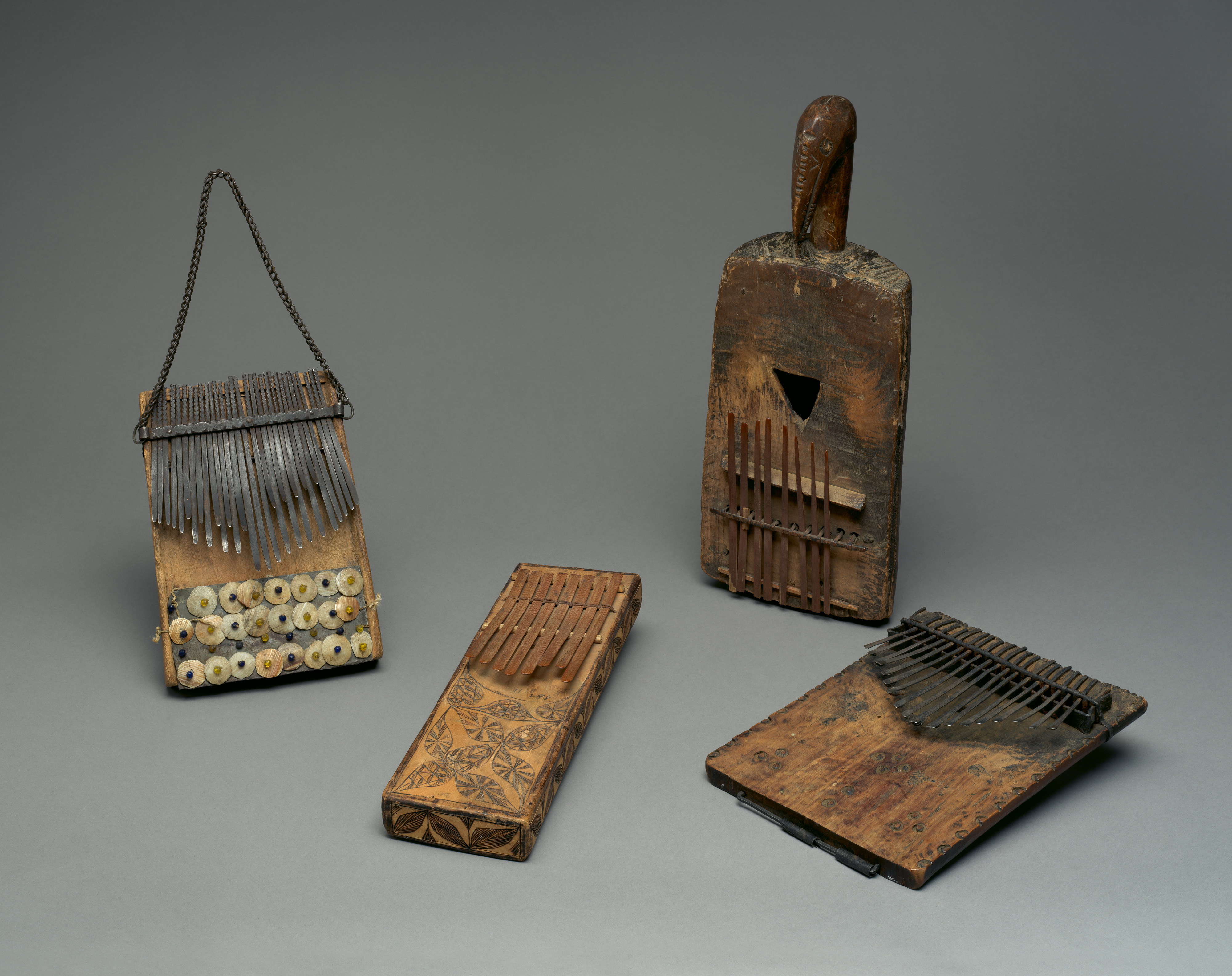
A nineteenth-century mbira of the Efik people of Nigeria sits in the collection of the Metropolitan Museum of Art (object 501100), made from kapok wood, alongside a closely related Barwe Nyonganyonga dated around 1900 (object 503679) and built from wood, shell, metal, and beads. Together they show that what we call “mbira” sits within a much wider regional family of lamellophones whose forms vary significantly from one community to another.
Construction & Materials
A typical mbira dzavadzimu has 22 to 28 thin metal keys (originally hand-forged from iron, today often made from car-spring steel) mounted on a hardwood soundboard, with the keys arranged in three roughly nested ranks. The whole instrument is usually played inside a large hollow gourd resonator (deze), which amplifies the sound and gives it the deep buzz characteristic of the Zimbabwean tradition.
The buzz is intentional and important. Small metal beads, shells, or bottle caps (machachara in Shona) are attached to the soundboard or resonator to vibrate sympathetically with the keys. To Western ears tuned to clean, pitched tones, this can sound at first like noise; in the Shona tradition the buzz is essential to the music’s meaning, providing a textural haze that helps blur the boundary between individual notes and the larger interlocking pattern.
How It’s Played
The player holds the mbira in both hands inside the gourd resonator, with both thumbs and the right index finger free to pluck the metal keys. The two thumbs play the lower-pitched left and middle ranks; the right index finger plucks the high right rank from underneath, giving an upward stroke. This three-finger combination produces the characteristic interlocking sound of Shona mbira music.
Most pieces are organised as cyclical patterns of around 48 pulses, repeated continuously with subtle variations. As the music continues, the listener begins to hear secondary melodic lines emerging from the interaction of the left, middle, and right voices — patterns that no single hand is actually playing, but that arise from how the brain organises the overlap.
Cultural Significance
At the heart of the bira — an all-night Shona ritual in which the gathered community calls upon ancestral spirits for guidance, healing, or blessing — sits the mbira dzavadzimu. Specific pieces are associated with specific spirits and occasions, and the music’s slow, hypnotic cyclical structure is meant to support trance and possession by the spirits being invited.
International awareness of the mbira owes much to the work of Paul Berliner, whose 1978 book The Soul of Mbira introduced many readers outside Africa to the music and the bira tradition, and to senior Zimbabwean players such as Mbuya Stella Chiweshe, Forward Kwenda, and Cosmas Magaya, who have toured and taught extensively abroad. The smaller, simpler “kalimba” sold worldwide as a beginner instrument is a related but distinct member of the broader family — a design developed for educational use during the mid-twentieth century by the ethnomusicologist Hugh Tracey.
Notable Examples & Recordings
The Metropolitan Museum of Art’s two surviving 19th- and early-20th-century lamellophones (objects 501100 and 503679) usefully document the wider regional family. For listening, recordings by Mbuya Stella Chiweshe, Forward Kwenda, Cosmas Magaya, Dumisani Maraire, and Ephat Mujuru offer the strongest introduction to traditional Shona mbira music. Paul Berliner’s field recordings, originally released alongside The Soul of Mbira, also remain valuable.
Related Instruments
- – the smaller, simpler lamellophone designed for international educational use
- – the Central African lamellophone tradition
- – the broader regional name for several West and Central African lamellophones
- – the smaller Zimbabwean lamellophone often used as a teaching instrument
- – the Barwe regional lamellophone documented in MET object 503679
Where to Hear It
The bira ceremony remains the deepest cultural setting for mbira music. Outside that context, public concerts by senior Zimbabwean players, dedicated mbira festivals in Zimbabwe and abroad, and a substantial catalogue of recordings together provide the strongest entry points.
- Wikipedia: Mbira
- The MET: Mbira (object 501100)
- The MET: Nyonganyonga (object 503679)
- Wikimedia Commons: Mbira
Learning Resources
Beginners often start with a smaller karimba or with a kalimba designed for educational use, learning to pluck the keys cleanly with the thumbs before progressing to the full mbira dzavadzimu. Several senior Zimbabwean players, including Cosmas Magaya and the late Dumisani Maraire’s family, have produced structured tuition materials in English. Cultural context matters: most senior teachers prefer that students learn pieces with their proper names and ceremonial associations, not as abstract exercises.
Frequently Asked Questions
Is the mbira the same as a kalimba?
No. The Shona mbira dzavadzimu is a specific instrument with twenty-two to twenty-eight keys, played from inside a large gourd resonator and used in bira ceremonies. The smaller “kalimba” sold worldwide as a beginner instrument is a related but distinct design — developed for educational use in the mid-twentieth century by the ethnomusicologist Hugh Tracey.
Why does the mbira buzz?
The buzz comes from small metal beads, shells, or bottle caps attached to the soundboard or gourd resonator. In the Shona tradition this buzz is essential to the music’s meaning, providing the textural haze that helps blur individual notes into the larger interlocking pattern.
How many keys does a mbira have?
A typical mbira dzavadzimu has 22 to 28 keys arranged in three roughly nested ranks. Other regional lamellophones in the broader mbira family vary widely in key count.
Are old mbiras displayed in museums?
Yes. New York’s Metropolitan Museum of Art holds at least two related 19th- and early-20th-century lamellophones (objects 501100 and 503679), part of the Crosby Brown Collection.
Is the mbira difficult to learn?
Plucking the keys cleanly is reasonably approachable. The deeper challenge is internalising the cyclical interlocking patterns of traditional Shona repertoire and learning to hear the secondary melodic lines that emerge from the overlap — a skill that typically takes several years of focused listening and practice.


