.jpg)
.jpg)

.jpg)

Saz / Bağlama
bağlama / saz
| Category | Strings |
|---|---|
| Country of origin | Turkey / Central Asia |
| Classification | type of musical instrument |
| Wikipedia | en.wikipedia.org |
| Wikidata | Q717773 |
Listen
Audio: Poniol, CC BY-SA 3.0 / via Wikimedia Commons
Overview
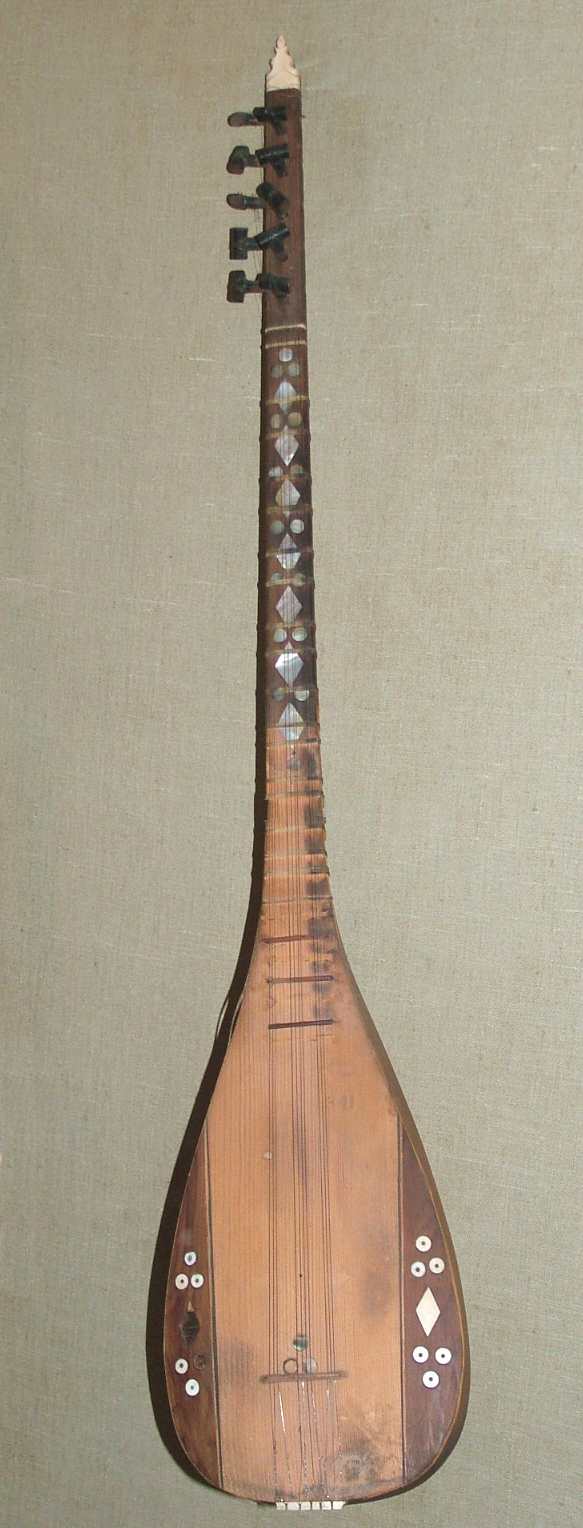
The saz, also called bağlama, is a long-necked plucked lute from Turkey, with a deeply curved pear-shaped body, an unusually long fretted neck, and three double or triple courses of metal strings. It is the most widely played folk instrument in Turkey and one of the central instruments of the aşık tradition — the wandering minstrel-poets whose sung verse has carried Turkish vernacular literature for centuries.
Several closely related instruments — the cura saz (smaller and higher pitched), the divan saz (larger and lower pitched), and the meydan saz (largest of all) — together form a family that covers the full vocal range. The instrument is also widespread across the Turkish-speaking world beyond Anatolia, including Azerbaijan, Iran, the Caucasus and Central Asia.
Origin & History
The saz family belongs to the broader long-necked lute tradition that has been documented across Central Asia and the Middle East for over a thousand years. Related instruments — the dombra of Kazakhstan, the dotar of Iran, the Azerbaijani saz — share a common ancestry with the Anatolian instrument. The form took its modern Turkish shape during the Ottoman period and has continued to evolve in the Turkish Republic.
The Metropolitan Museum’s collection holds two relevant late-19th-century Turkish specimens. A Saz (MET object 500968) in wood inlaid with ivory and pearl shows the high-finish workshop tradition. A smaller Jōra Sāz (MET 500997), in plain wood, represents the more portable folk instrument used by the aşık and by household musicians. Both sit in the museum’s Musical Instruments department and document the family at scales suitable for concert and folk use respectively.
The 20th century has seen several waves of saz revival in Turkey, particularly tied to the leftist folk-music movements of the 1960s and 70s and to the long-running cultural recognition of Alevi religious tradition (in which the saz plays a central role). Contemporary players such as Arif Sağ and Erdal Erzincan have brought the instrument to international concert audiences.
Construction & Materials
The Hornbostel-Sachs system places the saz family in 321.321 (composite chordophones, plucked, necked bowl-lutes). The body is built from many thin curved staves of mulberry, juniper, walnut or other local hardwoods, glued edge-to-edge over a mould — a construction technique closely related to that of the European lute. The soundboard is thin spruce or fir.
The neck is unusually long for a lute — typically more than twice the body length — and carries movable nylon-tied frets. The fret positions reflect Turkish microtonal practice, with fret intervals smaller than the Western tempered semitone in places. Strings are arranged in three courses (one triple-string course at the top, two double-string courses below) and tuned in fourths and fifths.
The MET’s larger Saz (object 500968), with its ivory and pearl inlay, exemplifies the late-Ottoman luxury workshop production. The smaller Jōra Sāz (500997) is plain wood — the everyday working instrument.
How It’s Played
The player sits with the instrument held diagonally across the body, the body resting on the right thigh and the long neck angled upward to the left. The right hand strikes the strings with a thin flexible plectrum (tezene) of plastic or cherry bark. The left hand stops the strings against the moveable frets along the long neck.
A distinctive saz technique is şelpe — playing without a plectrum, using the fingertips and nails of the right hand for percussive strumming and rapid arpeggios. Şelpe is associated particularly with the Alevi religious repertoire and gives the instrument a softer, more intimate tone than plectrum playing.
Cultural Significance
In Turkey the saz is the instrument most strongly associated with the aşık tradition — the wandering folk poets whose sung verses, often improvised on traditional themes of love, social commentary and religious reflection, have been a central form of Turkish vernacular literature for centuries. The 16th-century poet Pir Sultan Abdal and the 17th-century Karacaoğlan are among the most celebrated historical aşıks; their poems are still sung to saz accompaniment today.
The instrument is also central to the Alevi religious tradition, where the saz is referred to as the telli Kur’an (“stringed Quran”) and accompanies the cem religious ceremony. This sacred role gives the saz a cultural weight in Alevi communities that goes well beyond folk music.
Notable Examples & Recordings
The two MET specimens (objects 500968 and 500997) document the instrument family at two different scales in late-Ottoman Turkey. For listening, recordings by Arif Sağ, Erdal Erzincan, Erkan Oğur (often with cura saz) and Neşet Ertaş cover the central modern repertoire. The Alevi religious recordings of Sabahat Akkiraz document the sacred dimension of the instrument’s use. International touring by Aynur Doğan and Erdal Erzincan has brought the saz to European and North American concert audiences.
Related Instruments
- Bouzouki – the Greek long-necked lute from a closely related Anatolian root
- – the Kazakh long-necked lute, sister instrument
- – the Iranian and Central Asian two-string long-necked lute
- Tar – the Persian and Azerbaijani figure-eight-bodied lute
- Setar – the Persian small long-necked lute used in classical performance
Where to Hear It
Aşık festivals in Turkey — particularly at Sivas, Kars and Konya — feature the saz in nearly every performance. Alevi cem ceremonies (which welcome respectful visitors in many communities) feature the instrument in religious context. International concert touring by leading Turkish folk musicians brings the saz to European and North American audiences. The Wikimedia Commons category collects images and audio.
- Wikipedia: Bağlama
- The MET: Saz (object 500968)
- The MET: Jōra Sāz (object 500997)
- Wikimedia Commons: Bağlama
Learning Resources
Most students start on a medium-sized bağlama because its range covers most folk repertoire. Method books are widely published in Turkish; English-language instruction has been growing through online lessons by Erdal Erzincan and others. The Istanbul Technical University Conservatory and the Ankara State Conservatory both offer formal saz training. Outside Turkey, instruction is offered through Turkish cultural centres in Berlin, Cologne, Amsterdam and other diaspora cities with established Turkish populations.
Frequently Asked Questions
What family is the saz in?
It is a composite chordophone, plucked, in the necked bowl-lute subgroup, classed as 321.321 in the Hornbostel-Sachs system.
Are saz and bağlama the same instrument?
Yes. Saz is the older general Turkish word for the family; bağlama is the more specific modern term, particularly for the medium-sized instrument that is the most widely played form. The terms are largely interchangeable in everyday use.
How many strings does a saz have?
Seven strings arranged in three courses: one triple course at the top, two double courses below. The triple course is typically tuned in unison or in octaves.
Are old sazes in museums?
Yes. The Metropolitan Museum of Art holds a late-19th-century inlaid Saz (object 500968) and a smaller late-19th-century Jōra Sāz (object 500997) in its Musical Instruments department.
What is the aşık tradition?
The aşık are wandering folk poets and singer-musicians whose sung improvised and traditional verse has been a central form of Turkish vernacular literature for centuries. The saz is their characteristic instrument.
Is the saz difficult to learn?
Basic strumming and simple folk tunes can be acquired within a few months. The microtonal fret intervals, the long neck position changes, and the şelpe fingertip technique all add complexity for serious students.


