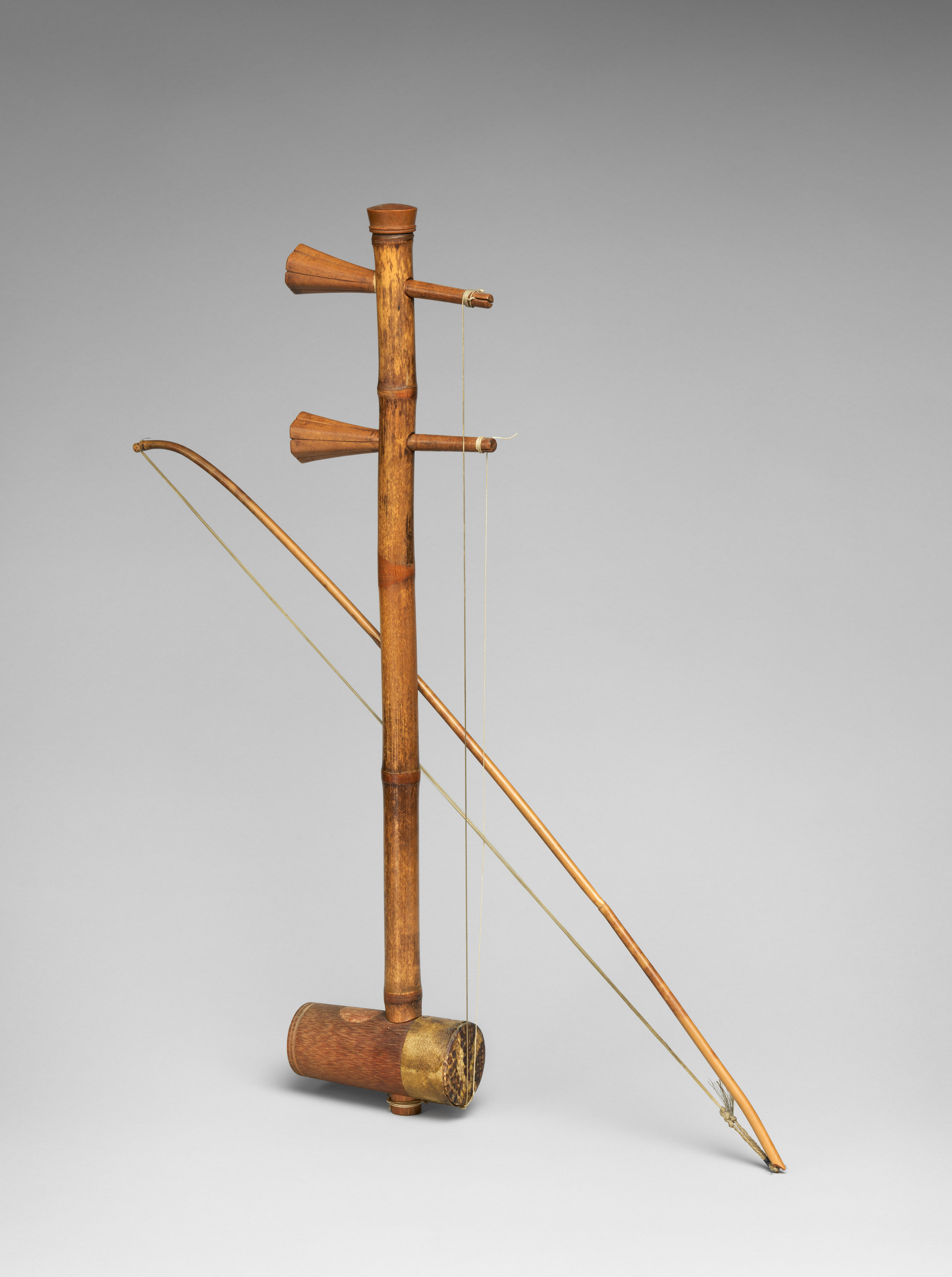
Image: Unknown photographer, CC BY-SA 3.0 — via Wikimedia Commons
Sapeh
sapè / sape
| Category | Strings |
|---|---|
| Country of origin | Borneo (Dayak peoples) |
| Classification | musical instrument |
| Wikipedia | en.wikipedia.org |
| Wikidata | Q7420932 |
Overview
The sapeh (also spelled sape, sampek or sape’) is a long-necked plucked lute of the Dayak peoples of Borneo. The instrument has a long, narrow, boat-shaped body hewn from one wooden block, a long unfretted or sparsely fretted neck, and three or four strings (originally of split rattan, now usually of nylon or wire). It is played by the Kenyah, Kayan and related Dayak groups in the interior of Sarawak (Malaysia) and East Kalimantan (Indonesia) for ritual, healing, social dance and personal expression.
Wikidata describes the sapeh as a “Dayak instrument of Borneo origin,” classed as a musical instrument originating in Indonesia. The Wikipedia and Commons references use Sapeh as the principal English-language name, although sape and sampek are equally valid.
Origin & History
The sapeh’s exact origin is undocumented in surviving written sources, but the instrument is part of the wider Austronesian boat-lute tradition that extends from the Philippines through Borneo into the Malay peninsula. Closely related instruments include the Philippine kudyapi, the Sundanese kacapi (also spelled kachapi), and the various gambus lutes of the Malay world. The body shape — long, narrow, carved from a single piece of softwood — is one of the distinguishing markers of the Bornean branch of the family.
In traditional Dayak culture the sapeh was associated with specific shamanic and ritual contexts. Kenyah and Kayan players were said to learn their tunes through dreams, with the spirits of ancestors and forest beings communicating individual melodies to the player in sleep. The repertoire is structured around named tunes (each with a specific function — healing, dance accompaniment, courtship, mourning) rather than around abstract melodic patterns, and the music’s rhythmic and melodic structure was historically closely tied to the Datun Julud and other Kenyah dance traditions.
In the 20th century the sapeh underwent significant changes. Wire and nylon strings replaced the older split-rattan strings; small frets were added on some instruments to enable fully chromatic playing; pickup systems and amplification became standard for festival performance. Today the instrument has both a strong traditional core in the longhouse communities of inland Sarawak and Kalimantan and a substantial modern presence in Malaysian and Indonesian world-music ensembles.
The Metropolitan Museum does not currently hold a documented sapeh in its Musical Instruments department; the instrument is documented here primarily through Wikipedia, DBpedia and the Wikimedia Commons photograph.
Construction & Materials
A traditional sapeh is between 100 and 140 centimetres long, with a long narrow boat-shaped body cut from one piece of softwood — jelutong, meranti and adau are all used in Sarawak. The neck is integral with the body and is typically as long as the soundbox. The whole instrument is often decorated with intricate Dayak carved designs along the sides and back, and modern instruments frequently feature traditional motifs (the aso dragon, the hornbill, geometric Dayak patterns) carved or painted onto the soundboard.
Originally the sapeh had two or three strings of split rattan; modern instruments have three or four strings of nylon or wire. The frets, when present, are made of soft material such as beeswax or rubber and can be moved along the neck to retune the instrument for different scales — a flexible-fret system shared with several other Southeast Asian boat-lutes.
How It’s Played
The player sits cross-legged on the floor or on a low stool with the sapeh held diagonally across the body, with the boat-shaped body resting on the right thigh and the long neck angled upward to the left. The right hand plucks the strings with the fingertips or with finger-picks; the left hand stops the melody string against the neck (or against the movable frets, if present).
The technique uses a small vocabulary of strumming, tremolo and single-string melodic patterns. The lower strings function as drones — they sound continuously while the upper string carries the melody — and the resulting sound is a continuous quiet drone with a single sliding melodic line above it. This drone-and-melody structure fits the trance-induction function of the traditional repertoire particularly well, and modern players note that the steady drone is essential to the meditative quality of the music.
Cultural Significance
In its traditional setting the sapeh is the central musical instrument of the Kenyah, Kayan and related Dayak peoples of inland Borneo. Its repertoire is closely tied to specific cultural practices — the Datun Julud longhouse dance, healing ceremonies, courtship songs, and personal expression of emotion — and the instrument has historically been considered a spiritual rather than merely musical object in many Dayak communities.
In modern Malaysia and Indonesia the sapeh has become one of the principal cultural symbols of indigenous Borneo, featured prominently in Sarawak’s annual Rainforest World Music Festival in Kuching, in tourist promotion materials, and in cultural-policy publications. The instrument’s distinctive sound — sliding, droning, meditative — has also entered Malaysian and Indonesian world-music ensembles and contemporary composition.
Notable Examples & Recordings
For listening:
- Tusau Padan, Sape: The Dayak Lute of Sarawak — recordings of the leading 20th-century traditional Kenyah player.
- Matthew Ngau Jau, Sape Music of the Borneo Rainforest — central modern Sarawak player and teacher.
- Alena Murang, Flight — contemporary Kenyah-language singer-songwriter who plays sapeh herself.
- Asmara Borneo, Sound of Borneo — Sarawak ensemble work integrating sapeh with other traditional and modern instruments.
Related Instruments
- – the Philippine boat-lute in the same wider Austronesian family.
- Kacapi – the Sundanese box zither that shares the kacapi/sapeh name root.
- – the Malay short-necked lute of Arab origin, used in different Malay traditions.
- – the Toba Batak lute of northern Sumatra, related in design.
- – the Vietnamese long-necked lute used in ca trù sung poetry.
Where to Hear It
The yearly Rainforest World Music gathering held at Kuching in Sarawak (every July) is the largest international showcase for the sapeh and brings traditional Dayak players together with international world-music acts. The Sarawak Cultural Village in Damai gives daily demonstrations of traditional Dayak music. In East Kalimantan, the Erau festival in Tenggarong every September features traditional sapeh performances. International tours by Matthew Ngau Jau, Alena Murang and other modern players bring the instrument to audiences in Asia, Europe and North America.
Learning Resources
Traditional sapeh learning takes place through long apprenticeship with a senior player in a Dayak longhouse community. Modern instruction is increasingly available through cultural centres in Kuching (Sarawak Cultural Village), Bandung and Jakarta, and through online lessons by leading players such as Matthew Ngau Jau and Salomon Gau. New instruments by Sarawak makers run from approximately 200 to 800 USD; high-end traditional instruments with full carved decoration can reach 2,000 USD.
Frequently Asked Questions
Where is the sapeh played?
The sapeh is played by the Kenyah, Kayan and related Dayak peoples of inland Borneo, particularly in the upper rivers of Sarawak (Malaysian Borneo) and East Kalimantan (Indonesian Borneo). It is also increasingly played in Malaysian and Indonesian world-music ensembles outside the traditional cultural area.
Why is the sapeh associated with trance?
In traditional Kenyah and Kayan culture the sapeh’s repertoire was learned through dreams from ancestral and forest spirits, and the music’s structure (a continuous drone with a sliding melodic line above) is well suited to inducing meditative or trance states. Specific named tunes accompanied healing ceremonies and ritual dances.
How many strings does a sapeh have?
Traditional instruments have two or three strings of split rattan; modern instruments have three or four strings of nylon or wire. The lower strings function as drones; the upper string carries the melody.
Are the frets fixed or movable?
On instruments with frets, the frets are made of soft material (beeswax or rubber) and can be moved along the neck to retune the instrument for different scales. Many traditional instruments have no frets at all.
Who are the leading modern sapeh players?
Matthew Ngau Jau in Sarawak, Salomon Gau in East Kalimantan, and the contemporary singer-songwriter Alena Murang are among the most internationally recognised modern players. Tusau Padan was the leading 20th-century traditional player and was inscribed as a Sarawakian Living Heritage figure.
What is the difference between sapeh, sape and sampek?
All three are different romanisations of the same Dayak instrument name. Sapeh is the standard English-language Wikipedia spelling, sape is widely used in Malaysian and academic publications, and sampek is the Indonesian-language form used in Kalimantan.