
Sarod
सरोद
| Category | Strings |
|---|---|
| Country of origin | India |
| Wikipedia | en.wikipedia.org |
| Wikidata | Q687406 |
Listen

Overview
The sarod is a fretless plucked lute used in Hindustani classical music. Where the sitar’s signature is a shimmering, sustained ring, the sarod’s is a percussive, slightly nasal attack that decays quickly into a sliding, vocal pitch. The instrument has a rounded wooden body, a polished metal fingerboard with no frets, and a skin-covered resonator at its base.
The combination of metal fingerboard and skin head is what gives the sarod its distinctive voice. It is one of the more recently standardised of the major Hindustani solo instruments and remains tightly bound to a small number of musical lineages, most famously the Maihar and Shahjahanpur gharanas.
Origin & History
The sarod is generally traced back to Central Asian and Afghan plucked lutes — most often the rabab — that were brought into northern India and reshaped over the eighteenth and nineteenth centuries by court musicians in places such as Lucknow, Rampur, Gwalior, and Maihar. The exact lineage is debated, with different gharanas offering different accounts of who introduced the metal fingerboard and the steel strings that distinguish the sarod from its rabab ancestors.
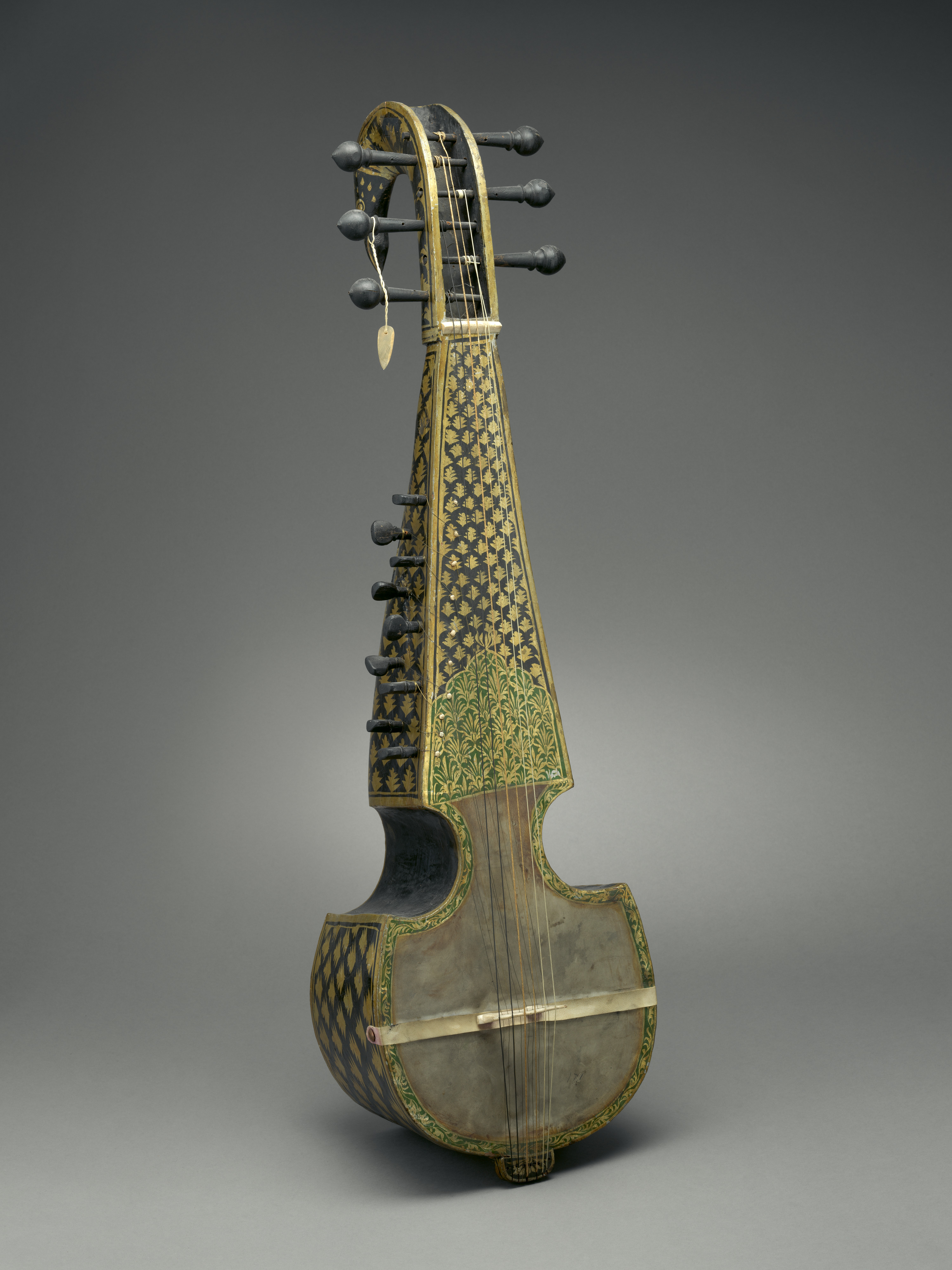
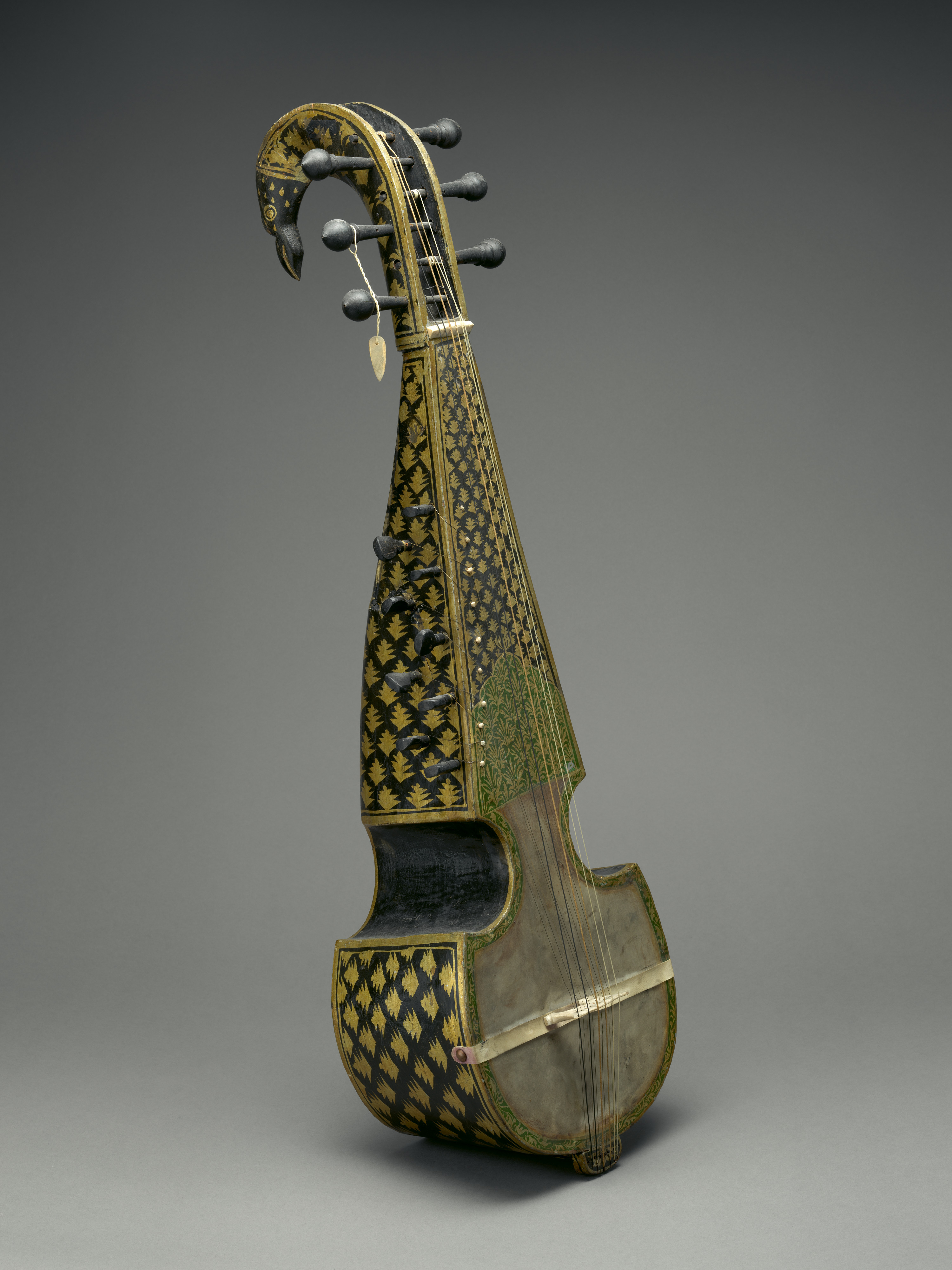
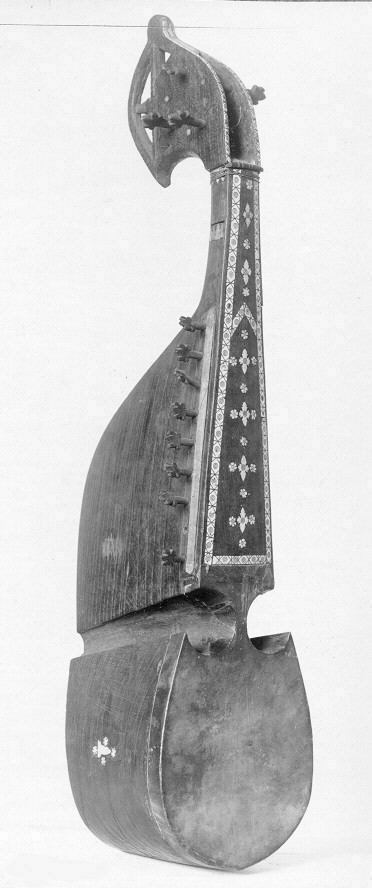
Surviving museum specimens help anchor the chronology. The Metropolitan Museum of Art holds a sarod made around 1885 in northwestern India (object 500717) with a body of dun wood, parchment head, and wire and gut strings, and a separate late-19th-century north Indian sarod (object 502322) with wood, skin, and ivory components. Both confirm that the modern sarod’s signature design — wooden body, skin head, metal fingerboard, and a mix of metal playing strings and resonating sympathetic strings — was already in place by the late 1880s.
Construction & Materials
A sarod is carved from a single block of teak or a similar dense hardwood, with a body roughly shaped like a rounded shovel. The lower face of the body is covered in stretched goat skin, which acts as the soundboard. The neck carries a smooth, polished metal fingerboard — usually steel — with no frets. Strings are pulled across this fingerboard at relatively high tension.
A modern sarod typically carries between 18 and 25 strings: four to five main playing strings, two chikari (drone) strings struck rhythmically with the plectrum, and a bank of sympathetic strings that vibrate freely. The plectrum, called the jawa, is traditionally cut from coconut shell. The most influential modern variants of the design are associated with the families of Allauddin Khan (Maihar) and Hafiz Ali Khan (Shahjahanpur), whose adjustments to string count and bridge layout effectively defined the 20th-century concert sarod.
How It’s Played
The player sits cross-legged with the sarod resting flat across the lap, body to the right and neck to the left. The right hand strikes the strings with the jawa, while the left hand uses the side of the fingernails — not the fingertips — to slide along the polished metal fingerboard. Because there are no frets, every note involves placing a fingernail at exactly the right point and gliding smoothly between pitches.
This makes the sarod technically demanding. Intonation is unforgiving. The reward is a fluid, vocal phrasing — one of the closest instrumental approximations of Hindustani vocal technique — and the rapid percussive attacks that have become a sarod trademark in fast jhala sections.
Cultural Significance
The sarod sits at the heart of the Hindustani solo concert tradition alongside the sitar. It is closely associated with a small number of musical lineages, particularly the Maihar gharana of Allauddin Khan and his descendants (most famously Ali Akbar Khan), and the Shahjahanpur gharana of Hafiz Ali Khan and his son Amjad Ali Khan. These lineages have shaped not just playing styles but the design of the instrument itself.
International audiences first encountered the sarod through Ali Akbar Khan’s mid-20th-century tours and recordings, and it has since become a regular presence on global concert stages. Within India, however, its meaning remains strongly tied to the guru-shishya transmission system and the long apprenticeship that mastery requires.
Notable Examples & Recordings
The Metropolitan Museum of Art’s two surviving 19th-century sarods (objects 500717 and 502322) are among the better-documented historical examples available online. Both date to within a decade or two of when Allauddin Khan and Hafiz Ali Khan were establishing the modern concert sarod, and they confirm that the standardisation happened earlier than is sometimes assumed.
For listening, recordings by Ali Akbar Khan, Amjad Ali Khan, Buddhadev Dasgupta, and Tejendra Narayan Majumdar offer a strong introduction to the instrument’s range. The sarod also features in many crossover and film recordings, although its concert repertoire remains the clearest place to hear it.
Related Instruments
- Sitar – the fretted long-necked lute most often paired with sarod in concert circuits
- Tabla – the rhythmic partner in nearly all sarod performances
- Tanpura – the drone instrument that anchors any sarod recital
- Sarangi – the bowed Hindustani lute that shares many phrasing ideals with sarod
- Rabab – the Afghan and Central Asian lute family from which the sarod is generally said to descend
Where to Hear It
Hindustani classical concerts remain the natural setting for the sarod, and many are streamed by Indian cultural institutions and university music departments. The instrument has also recorded extensively for film, jazz crossover projects, and global-fusion ensembles.
- Wikipedia: Sarod
- The MET: Sarod (object 500717)
- The MET: Sarod (object 502322)
- Wikimedia Commons: Sarod
Learning Resources
The sarod is generally considered one of the most demanding Hindustani instruments to learn, largely because of the fretless metal fingerboard and the unforgiving intonation it requires. Beginners typically start with basic sa-re-ga-ma exercises played extremely slowly, working on tone production with the jawa and on stable left-hand contact. Working with a teacher in the guru-shishya tradition remains the standard route, but several institutions in India and abroad now offer structured online courses.
Frequently Asked Questions
How is the sarod different from the sitar?
The sarod is fretless, with a polished metal fingerboard and a skin-covered resonator, and produces a percussive, sliding sound. The sitar has frets and sympathetic strings and produces a shimmering, sustained tone. They are both Hindustani concert lutes but with very different voices.
Where does the sarod come from?
The instrument is generally traced back to Central Asian and Afghan rabab-family lutes, reshaped in northern India over the 18th and 19th centuries by court musicians. The modern concert sarod was largely standardised by the late 1880s, as 19th-century specimens in major museums confirm.
How many strings does a sarod have?
A typical modern sarod carries between 18 and 25 strings, including four to five main melody strings, two chikari drone strings, and a bank of sympathetic strings.
What is the sarod plectrum made of?
The plectrum, called the jawa, is traditionally cut from a piece of coconut shell. Modern players sometimes use plastic substitutes for everyday practice.
Are old sarods displayed in museums?
Yes. The Metropolitan Museum of Art in New York holds at least two 19th-century Indian sarods (objects 500717 and 502322), part of the Crosby Brown Collection assembled in 1889.
Is the sarod difficult to learn?
It is widely considered one of the most demanding Hindustani instruments because of the fretless metal fingerboard. Tone and intonation generally take longer to develop than on a fretted lute.


