
Sitar
सितार
| Category | Strings |
|---|---|
| Country of origin | India |
| Classification | type of musical instrument |
| Wikipedia | en.wikipedia.org |
| Wikidata | Q229205 |
Listen
Audio: TheRealRanjitMakkuni, CC BY-SA 3.0 / via Wikimedia Commons
Audio: TheRealRanjitMakkuni, CC BY-SA 3.0 / via Wikimedia Commons
Audio: TheRealRanjitMakkuni, CC BY-SA 3.0 / via Wikimedia Commons

Overview
The sitar is a long-necked plucked lute most closely associated with Hindustani classical music in the northern half of the Indian subcontinent. It is built around a hollow gourd resonator, a wide hardwood neck carrying movable arched frets, and a second tier of sympathetic strings that vibrate untouched beneath the playing strings to give the instrument its shimmering halo of sound.
For many listeners worldwide, the sitar is the first sound they associate with Indian music. That recognition is a recent phenomenon — barely sixty years old — but the instrument it points to is older, more standardised, and more technically demanding than its pop-culture image suggests. Understanding the sitar means looking past the 1960s and into the long Mughal-era refinement that produced its modern form.
Origin & History
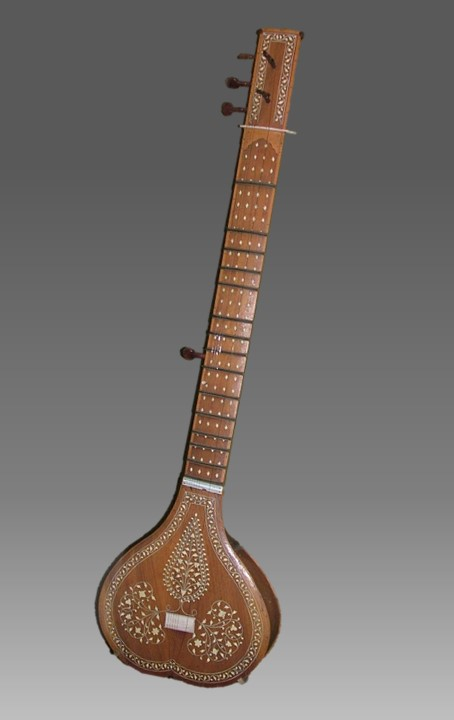
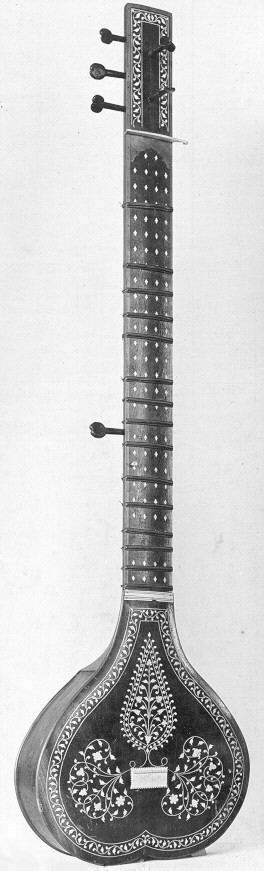
The sitar took shape on the Indian subcontinent over several centuries, with its modern body, fret arrangement, and tuning conventions broadly settled by the eighteenth century. DBpedia’s structured entry places the instrument’s standardised form in the 18th century, which aligns with the dates of most surviving museum specimens. The Metropolitan Museum of Art’s collection, for instance, includes a mid-19th-century Indian sitar (object 500759) whose construction is already recognisable to a modern player.
The instrument is generally understood to have grown out of two parallel traditions: long-necked Persian lutes such as the setar, and older Indian plucked instruments in the veena family. Wikidata records the setar explicitly as a precursor instrument to the sitar, and the shared etymological root (“se-tar” meaning “three strings” in Persian) supports a Central Asian influence on the name even where the physical descent is debated.
By the eighteenth and nineteenth centuries, court musicians in northern India had refined the instrument into the larger, deeper-resonating form recognised today. Two principal playing styles, or gharanas, eventually emerged: the lighter Maihar tradition associated with Ravi Shankar, and the heavier, more ornamented style of Vilayat Khan. Both shaped how the sitar is built, tuned, and taught into the present. The mid-twentieth century then carried the instrument far beyond South Asia through recordings, world tours, and a brief but influential moment in Western popular music.
Construction & Materials
The Hornbostel-Sachs system classifies the sitar as a composite chordophone sounded with a plectrum (321.321). In practice that translates into a recognisable assembly: a hollowed gourd body (the tumba), a long neck of teak or tun wood, and around eighteen to twenty strings of which only six or seven are played directly. The remaining sympathetic strings, called taraf, run beneath the curved frets and resonate freely.
Museum-documented specimens add useful detail to the textbook description. The MET’s mid-19th-century sitar lists its medium simply as “wood”, which is consistent with the typical use of seasoned tun or teak for the neck and dried bottle gourd for the body. Higher-grade instruments add bone or ivory inlay around the bridge and pegs, and the larger surviving 19th-century examples confirm that the instrument’s full size — closer to a metre and a quarter long — was already standard well before modern professional concert touring made it familiar abroad.
How It’s Played
Players sit cross-legged on the floor, balancing the gourd against the left foot and the upper arm. The right hand wears a wire plectrum called a mizrab, which strikes the main melody and rhythm strings. The left hand presses the strings sideways across the curved frets to bend pitch, allowing the long, gliding ornaments known as meend that give the sitar its expressive, vocal quality.
A skilled performer moves smoothly between meditative slow passages and rapid rhythmic flourishes. The sound is unmistakable: bright, metallic, and full of overtones that seem to hang in the air after each note thanks to the sympathetic strings. Most concert performances pair the sitar with a tabla for rhythm and a tanpura for sustained drone.
Cultural Significance
In India, the sitar is closely tied to the performance of raga, the melodic framework at the heart of Hindustani classical music. A typical concert unfolds slowly, beginning with an unmetered alap exploration of the raga and gradually moving into rhythmic interplay with the tabla. Beyond the concert stage, the instrument carries strong associations with contemplation and devotional traditions.
It is worth being precise about the international story. The sitar’s global recognition in the 1960s and 1970s genuinely widened its audience, but that wave introduced the instrument largely as a sonic colour. The deeper meaning of the sitar lies in centuries of disciplined teacher-to-student transmission — the guru-shishya relationship — that shaped both the repertoire and the playing styles still taught today.
Notable Examples & Recordings
The Metropolitan Museum of Art holds a mid-19th-century Indian sitar (object 500759) in its Musical Instruments department, part of the foundational Crosby Brown Collection assembled in 1889. Surviving instruments from this period are useful reference points because they show that the modern fret count and resonator shape were already in place well before the recording era.
For listening, recordings by Ravi Shankar, Vilayat Khan, Nikhil Banerjee, and Anoushka Shankar offer a strong introduction to the instrument’s range. Live concerts of Hindustani classical music — frequently archived by public radio and by institutions such as the Sangeet Natak Akademi — give the clearest sense of how the sitar interacts with tabla and tanpura in real time.
Related Instruments
- Sarod – a fretless plucked lute with a brighter, more percussive attack
- Tanpura – the four-string drone instrument that accompanies most sitar performances
- Tabla – the pair of hand drums that provides rhythmic dialogue
- – a larger, lower-pitched cousin developed for slow alap sections
- Setar – the Persian long-necked lute that shares an etymological root
Where to Hear It
Hindustani classical concerts remain the natural setting for the sitar, and many are now livestreamed by Indian cultural institutions and university music departments. Outside that tradition, the instrument turns up in film scores, jazz crossover projects, and electronic music. The Wikimedia Commons category for sitars also includes performance clips and high-resolution images of historical instruments.
Learning Resources
Beginners usually start by learning to sit comfortably with the instrument and to produce a clean stroke with the mizrab before moving on to fingering. Studying with a teacher in the guru-shishya tradition remains the most respected route, but many introductory videos, structured online courses, and method books are now available for self-study. Foundational texts on raga theory by Ravi Shankar and Deepak Raja are useful companions.
Frequently Asked Questions
What family of instruments does the sitar belong to?
The sitar is a composite chordophone in the necked bowl-lute group, classified as 321.321 in the Hornbostel-Sachs system and played with a wire plectrum.
Where did the sitar originate?
It developed in the Indian subcontinent over several centuries. Its modern form is generally credited to the late Mughal period and reflects a blend of Indian veena traditions and Persian long-necked lutes such as the setar.
How is the sitar different from the sarod?
The sitar has frets and sympathetic strings and produces a shimmering, sustained tone, while the sarod is fretless with a metal fingerboard and produces a more percussive, sliding sound.
How many strings does a sitar have?
Most modern sitars have around 18 to 20 strings in total, including six or seven main strings and a set of sympathetic strings that resonate beneath the frets.
Are old sitars displayed in museums?
Yes. The Metropolitan Museum of Art in New York holds a mid-19th-century Indian sitar (object 500759) acquired in 1889 as part of the Crosby Brown Collection of Musical Instruments.
Is the sitar difficult to learn?
It is considered demanding for beginners because of its size, posture requirements, and the depth of raga theory involved, but early progress on basic patterns is possible within a few months of consistent practice.