

Appalachian Dulcimer
mountain dulcimer
| Category | Strings |
|---|---|
| Country of origin | United States (Appalachian region) |
| Wikipedia | en.wikipedia.org |
| Wikidata | Q2145031 |
Listen
Audio: Wikith, CC BY-SA 3.0 / via Wikimedia Commons
Audio: Julie M Elman, CC BY-SA / via Internet Archive

Overview
This Appalachian instrument is a fretted plucked zither developed in the highland counties of the eastern United States. Three or four strings — usually a melody string, a middle drone, and one or two bass drones — run the length of a slim wooden body, most often shaped as an hourglass, a teardrop, or an elongated lozenge. The instrument is laid flat across the lap and the melody is fretted with a noter rod or with the fingers, while the drones sound continuously underneath. Its sound is quiet, modal and immediately recognisable.
Wikidata describes it as a zither-family instrument with frets and strings, classified within the broader dulcimer category and originating in the United States. Despite its English name, the Appalachian dulcimer is not a relative of the hammered dulcimer; the two share only the word.
Origin & History
The instrument took shape in the late 18th and early 19th centuries among Scotch-Irish, English and German settlers in the southern Appalachian Mountains, from western North Carolina through eastern Kentucky into West Virginia. Its closest ancestors are the German Scheitholt and the Pennsylvania-Dutch zitter, both fretted box zithers carried to North America by Palatine settlers in the 18th century. The DBpedia article on this family is in fact filed under Scheitholt, an indication of how directly scholars trace the lineage.
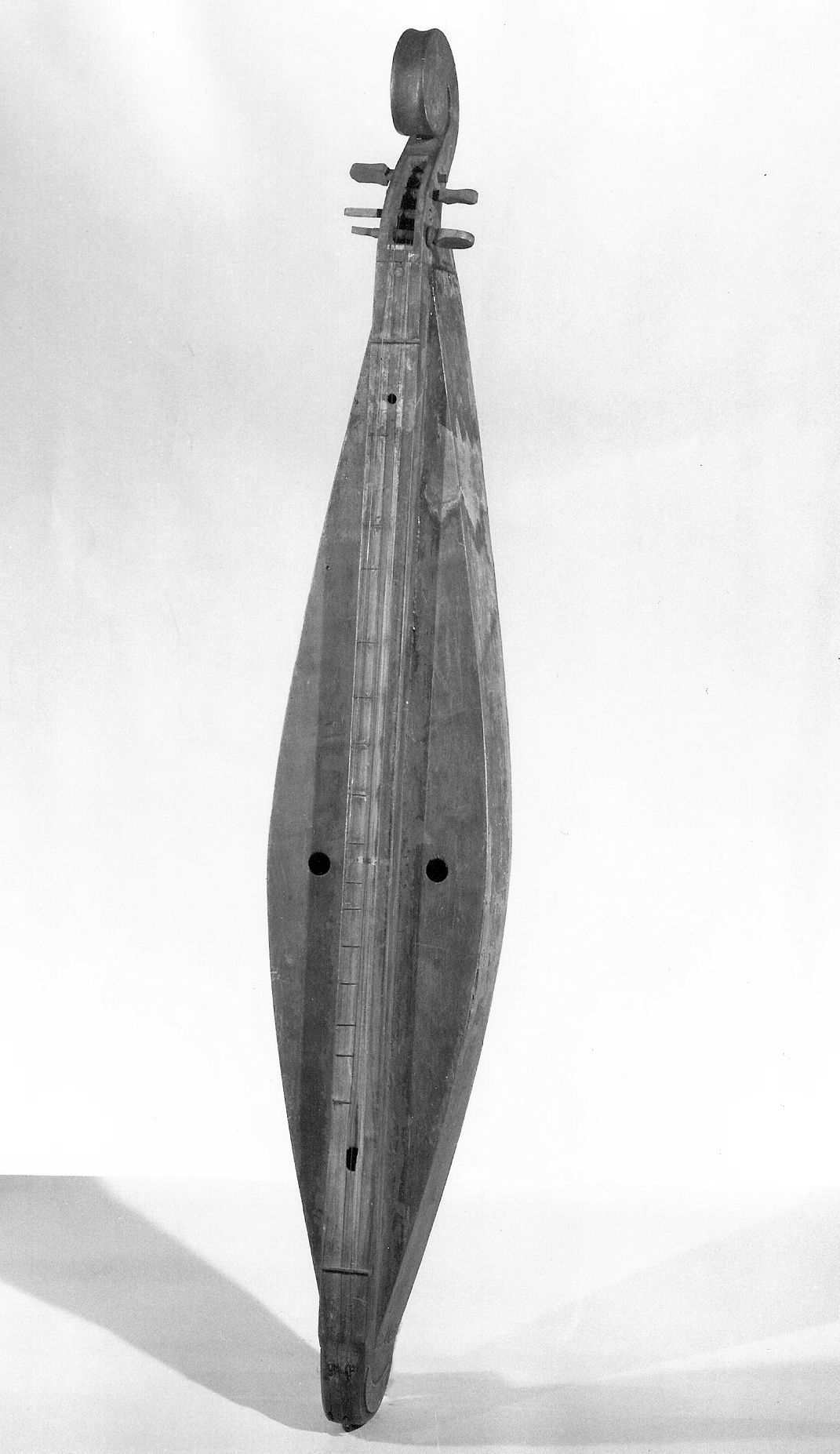
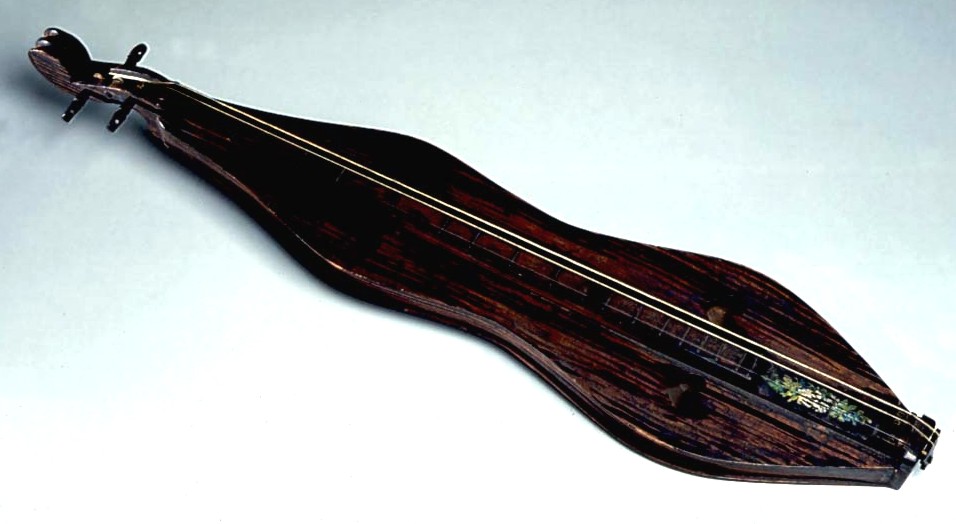
For most of its first century the Appalachian dulcimer was a strictly home-made and home-played instrument. It rarely appeared in commercial sheet music or in vaudeville, and it travelled by word of mouth between rural makers. The Metropolitan Museum’s collection holds two American specimens from this quiet era, both from the late 19th century, both made of wood and metal, and both donated through the Crosby Brown Collection of Musical Instruments in 1889. Object 500912 is built of cherry wood with metal frets; object 501598 is a similar mountain-made instrument from the same period. Both are catalogued as Chordophone-Zither-plucked.
The dulcimer entered the wider American consciousness only in the mid-20th century. Jean Ritchie of Viper, Kentucky, brought it to New York audiences in the 1940s and 50s, and the post-war folk revival turned it into one of the symbols of Appalachian music. Joni Mitchell played a dulcimer on her 1971 album Blue, and from then onward it has held a small but durable place in American songwriting.
Construction & Materials
A standard Appalachian dulcimer is between roughly 80 and 100 centimetres long. The body is a slim wooden box, two to three centimetres deep, with a hollow soundboard and back. Tonewoods vary by region and maker — cherry, walnut, butternut, poplar and spruce all appear in old instruments — and the MET specimens are typical of late-19th-century mountain construction in their use of hardwoods.
The fretboard runs the length of the soundboard down the centre line, and the frets are diatonic rather than chromatic: they reproduce the major scale (or, with a 6½ fret, the modal scales) along the melody string. The drones are tuned to a tonic and a fifth, and the most common tunings — DAD and DAA — give the instrument its characteristic open, harp-like sound.
How It’s Played
The player sits with the dulcimer resting flat on the lap, soundholes upward. The melody is fretted with a noter (a short hardwood stick held in the left hand) on the highest string, while the right hand strums or picks across all strings with a quill, plectrum or fingertips. Each strum sounds the melody plus the drones together, producing a continuous open chord under every note.
A more recent fingerstyle technique replaces the noter with the left-hand fingers and treats the dulcimer almost like a small lap guitar, allowing chord shapes and counter-melodies. Both styles coexist in the modern repertoire.
Cultural Significance
Within Appalachian culture the dulcimer represents a domestic, family-scale music — instruments built by a father or grandfather, played in a kitchen or on a porch, transmitting English and Scottish ballads that had themselves crossed the Atlantic generations earlier. It is one of the few American instruments with a strong claim to local invention, and it sits at the centre of the modal, drone-based sound that distinguishes much of the southern mountain repertoire.
In the post-war folk revival the dulcimer became a symbol of authenticity for urban audiences: an instrument with no electric ancestor, no commercial origin, and a direct line to colonial-era folk practice.
Notable Examples & Recordings
The MET’s two late-19th-century mountain specimens (objects 500912 and 501598) are useful reference photographs of the instrument before any standardised commercial production existed.
For listening:
- Jean Ritchie, The Most Dulcimer — the foundational mid-20th-century recordings.
- Joni Mitchell, Blue — Appalachian dulcimer in a singer-songwriter context.
- David Schnaufer, Dulcimer Player Deluxe — virtuoso fingerstyle work in old-time and contemporary repertoire.
- Stephen Seifert, Dulcimer Player — modern playing across folk, classical and original material.
Related Instruments
- Scheitholt – the German fretted box zither that the Appalachian dulcimer most directly descends from.
- Epinette des Vosges – the closely related French regional zither.
- Langeleik – the Norwegian fretted zither in the same wider family.
- Hammered Dulcimer – unrelated by construction but linked by the shared name in English.
- Banjo – the other instrument central to old-time Appalachian music.
Where to Hear It
The Cosby Dulcimer Convention in Tennessee, the Kentucky Music Week in Bardstown, and the Mountain Dulcimer Music Festival in Ashtabula draw players from across the United States every year. In the British Isles, the Nonsuch Dulcimer Club and similar groups keep the instrument’s English-speaking community connected. The Smithsonian Folkways catalogue holds a deep set of mid-20th-century field recordings on which mountain dulcimer features prominently.
- Wikipedia: Appalachian dulcimer
- The MET: Appalachian Dulcimer (object 500912)
- The MET: Appalachian Dulcimer (object 501598)
- Wikimedia Commons: Appalachian dulcimers
Learning Resources
The Appalachian dulcimer is widely considered one of the easiest stringed instruments for beginners. Its diatonic fretboard means almost any random combination of notes will sound musical, and a complete first tune can usually be played within an hour. Standard method books include those by Jerry Rockwell, Larkin Bryant Kelley, and Stephen Seifert, and the Dulcimer Players News serves as the long-running journal of the community. A playable beginner instrument can be bought new for around 100–150 USD; high-quality luthier-built instruments range from 500 to 2,000 USD.
Frequently Asked Questions
What family of instruments does the Appalachian dulcimer belong to?
It is a fretted box zither — placed by Wikidata within the broader dulcimer category — in the same wider family as the German Scheitholt, France’s épinette des Vosges, the Norwegian langeleik and the Swedish hummel.
Is the Appalachian dulcimer related to the hammered dulcimer?
Only by name. The two are unrelated structurally — one is a plucked zither with a fretted melody string and drone strings, the other is a struck zither played with hammers across many courses.
How many strings does an Appalachian dulcimer have?
Most modern instruments have three or four strings. Older mountain-made dulcimers, like the two MET specimens from the late 19th century, also typically used three strings.
Where was the Appalachian dulcimer invented?
It developed in the southern Appalachian Mountains of the United States, mainly in the late 18th and early 19th centuries, from German and Pennsylvania Dutch zither ancestors carried by Palatine settlers.
Who made the Appalachian dulcimer popular?
Jean Ritchie’s recordings and concert work in the 1940s and 50s introduced the instrument to a wide audience, and the folk revival of the 1960s carried it into colleges and concert halls. Joni Mitchell’s playing on Blue in 1971 gave it a presence in mainstream popular music.
Are old Appalachian dulcimers in museums?
Yes. The Metropolitan Museum of Art holds two American mountain dulcimers from the late 19th century — objects 500912 and 501598 — both donated to the Crosby Brown Collection in 1889 and held in the Musical Instruments department.