.jpg)
.jpg)
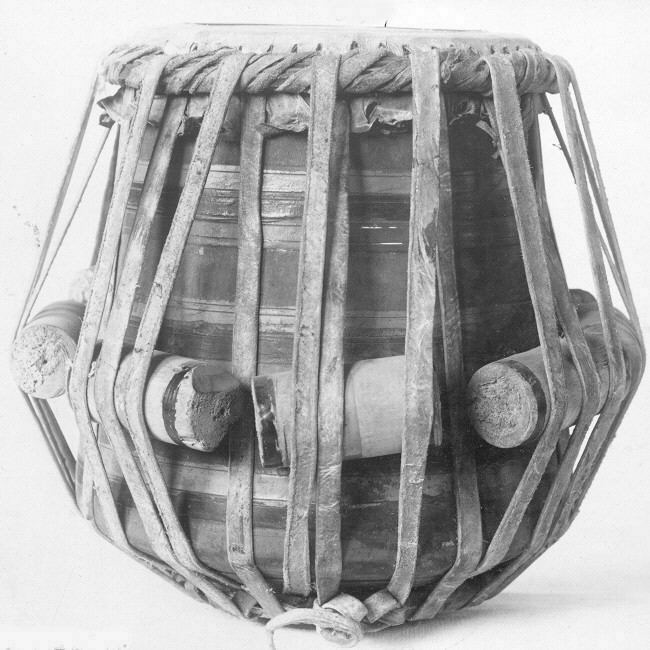
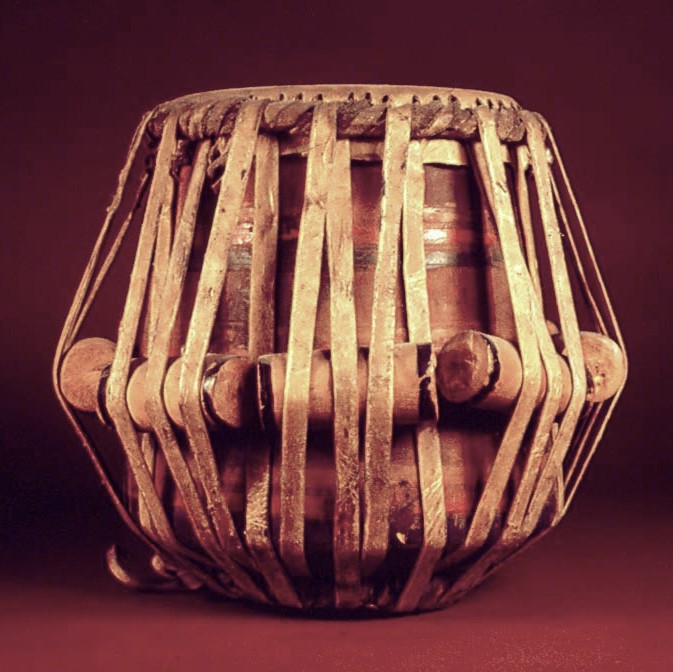

Tabla
तबला
| Category | Percussion |
|---|---|
| Country of origin | India |
| Classification | type of musical instrument |
| Wikipedia | en.wikipedia.org |
| Wikidata | Q213100 |
Listen
Audio: Jeuwre, CC BY-SA 4.0 / via Wikimedia Commons
Audio: Sitar: Ashok Ayengar, Tabla:Unknown, CC BY-SA 4.0 / via Wikimedia Commons
Audio: Sitar: Ashok Ayengar, Tabla: Unknown, CC BY-SA 4.0 / via Wikimedia Commons

Overview
The tabla is a pair of small hand-played drums that together provide the rhythmic foundation of Hindustani classical music in northern India, Pakistan, Bangladesh, and Nepal. Although the two drums are physically separate, the tabla is best understood as a single instrument played with two hands. The smaller wooden drum on the right, the dayan, is precisely tuned to a specific pitch; the larger metal-bodied drum on the left, the bayan, provides a deeper, sliding bass tone shaped by hand pressure on the head.
That combination of tuned melodic resonance and pliable bass is unusual among hand drums and helps explain why the tabla has become one of the world’s most internationally recognised percussion instruments. It is the rhythmic partner of choice for sitar, sarod, vocal, kathak dance, and many fusion settings.
Origin & History
DBpedia places the tabla’s standardisation in the 18th century, which is consistent with most surviving museum specimens. The Metropolitan Museum of Art holds a late-19th-century north Indian tabla (object 500712), entered into the Crosby Brown Collection in 1889. By that point the form, materials, and tuning system were already close to those of a modern instrument.
Several origin stories circulate within the Indian musical tradition itself, including the well-known account that links the tabla to the splitting of an older barrel drum, the pakhawaj, in the Mughal court. Modern scholars treat such stories cautiously and tend to describe the tabla as the product of a longer regional evolution, with the modern paired form crystallising during the late Mughal era and stabilising during the colonial period as Hindustani classical music took its present concert shape.
Construction & Materials
The Hornbostel-Sachs system classifies the tabla as 211.12 — a set of instruments in which the body of the drum is dish- or bowl-shaped. The MET’s late-19th-century specimen lists its materials as wood and skin, which still describes the dayan accurately today: a single piece of turned hardwood, hollowed and topped with a goat-skin head laced with leather straps and tuning blocks.
The bayan is built differently. Originally made from clay and now usually from copper, brass, or steel, it is heavier, deeper, and slightly squatter than the dayan. Both drum heads carry the tabla’s most distinctive feature: a thick black circular patch called the syahi, made from a tuned paste of iron filings, flour, and gum. The syahi gives each drum its tuned, bell-like overtones and is the reason the tabla can play melodic phrases as well as rhythmic ones.
How It’s Played
Players sit on the floor with the dayan in front of the right hand and the bayan in front of the left. Each finger of the right hand has specific roles for striking different parts of the drum head; the left hand uses the heel and palm against the bayan to slide pitch up and down in real time. Tabla repertoire is organised around a vocabulary of named strokes — na, tin, dhin, ge, ka and many others — that combine into rhythmic cycles called talas.
A complete performance can last anywhere from ten minutes to over an hour, weaving composed sections, improvised variations, and rhythmic dialogues with a soloist or dancer.
Cultural Significance
The tabla is the rhythmic backbone of most northern Indian classical concerts and is also central to qawwali devotional music, ghazal, and kathak dance. Its standing inside Hindustani music is comparable to that of the drum kit in jazz: it is both an accompaniment instrument and, in solo recitals, a virtuoso lead voice in its own right.
Its international recognition grew rapidly after Zakir Hussain’s recordings and tours from the 1970s onward, but its meaning at home remains tied to the guru-shishya lineage system, the major tabla gharanas (Delhi, Lucknow, Ajrara, Farrukhabad, Banaras, Punjab), and to the long apprenticeship still expected of professional players.
Notable Examples & Recordings
The Metropolitan Museum of Art’s late-19th-century tabla (object 500712) is among the better-documented historical examples available online. Recordings by Alla Rakha, Zakir Hussain, Anindo Chatterjee, Swapan Chaudhuri, and Yogesh Samsi offer a strong introduction to the instrument’s range — both as accompaniment and as the lead voice in solo tabla concerts.
Related Instruments
- Sitar – the long-necked lute most often paired with tabla in concert
- Sarod – fretless plucked lute also typically accompanied by tabla
- Pakhawaj – the older barrel drum from which the tabla is sometimes said to descend
- Mridangam – the Carnatic (south Indian) double-headed barrel drum cousin
- Tanpura – the drone instrument that anchors most tabla-accompanied performances
Where to Hear It
Hindustani classical concerts are the natural home of the tabla, and many are now streamed by Indian cultural institutions and university music departments. The instrument also appears regularly in qawwali performances, in film soundtracks across South Asia, and in jazz, electronic, and global-fusion projects.
Learning Resources
Beginners usually start by learning a small set of named strokes on each drum and then combining them into simple theka patterns for the most common talas. Tuning the dayan with a small hammer is itself a learned skill and tends to be taught early. Studying with a teacher remains the most respected route, but introductory video courses and notation-based method books exist in several languages.
Frequently Asked Questions
Is the tabla one instrument or two?
It is best treated as a single instrument played in two pieces. The smaller wooden dayan is tuned to a specific pitch and the larger metal bayan provides a sliding bass; together they form one rhythmic and melodic voice.
What is the black circle on the drum head?
That patch is called the syahi, a tuned paste of iron filings and other ingredients applied to the head. It gives the tabla its bell-like overtones and is essential to the instrument’s characteristic sound.
Where does the tabla come from?
It developed in northern India during the late Mughal era and stabilised in its modern form during the eighteenth and nineteenth centuries. Surviving specimens such as the MET’s 19th-century tabla show that today’s design was already in place by then.
How is the tabla tuned?
The dayan is tuned with a small hammer that taps the wooden tuning blocks held between the head straps and the drum body, raising or lowering the head tension to match the soloist’s tonic.
Is the tabla difficult to learn?
The basics of producing each named stroke cleanly take consistent practice over several months. True fluency in the rhythmic system, tuning, and improvisation typically takes many years of study under a teacher.


