.jpg)
.jpg)
.jpg)
Riq
رق
| Category | Percussion |
|---|---|
| Country of origin | Arab world |
| Classification | tambourine |
| Wikipedia | en.wikipedia.org |
| Wikidata | Q17057067 |
Listen
Audio: via Wikimedia Commons
Overview
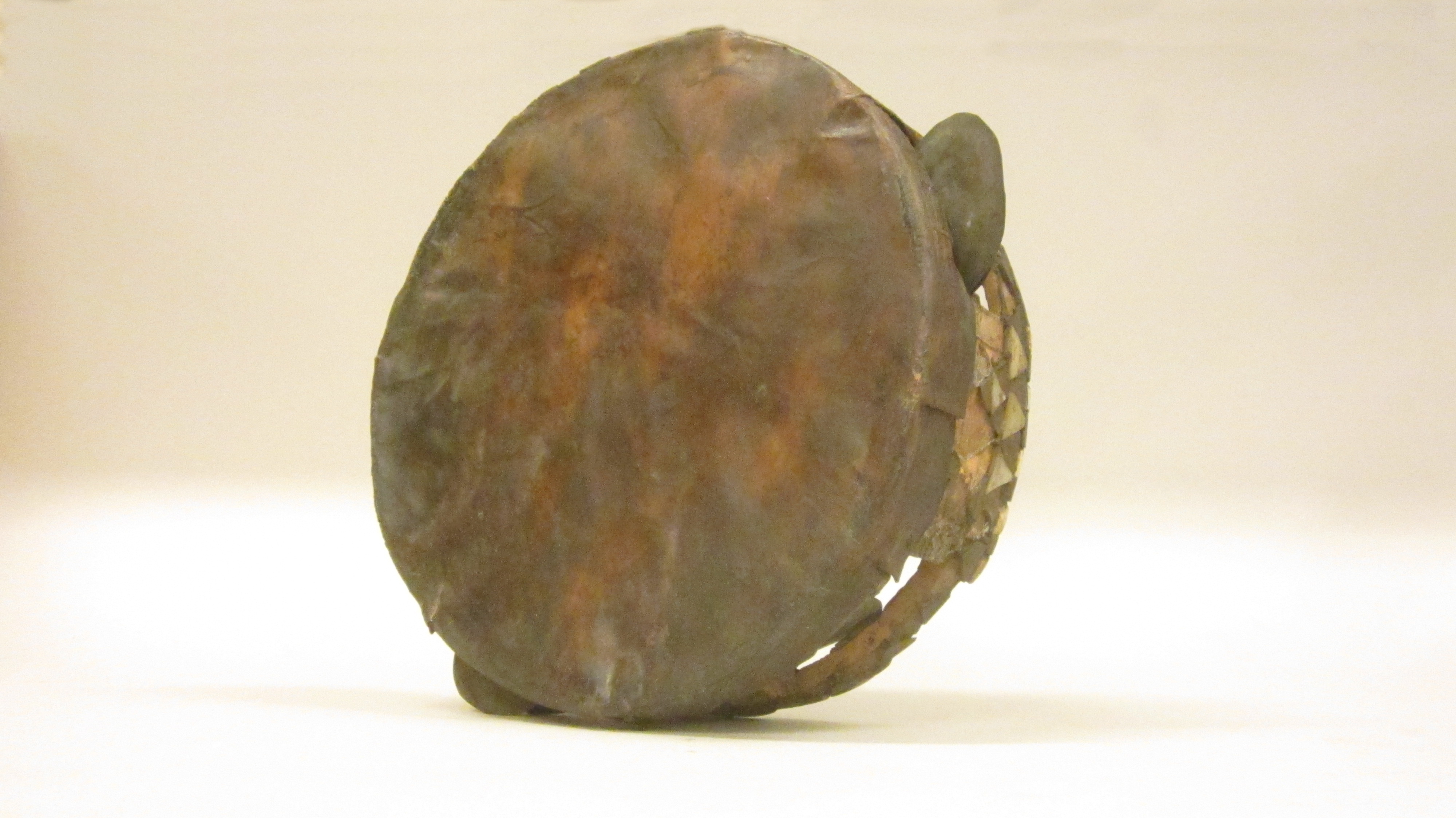
The riq is a small Arab tambourine — a single-headed frame drum with five pairs of small brass cymbals (called tūsa or sagat) set into the wooden frame. The drumhead, traditionally fish skin, is around twenty centimetres in diameter, and the frame is wide enough to hold the cymbal pairs in slits cut around its perimeter. The combination of head strokes and cymbal jingles gives the riq an unusually wide tonal palette for a single hand-held instrument, and it has become the central rhythmic instrument of Arab classical music.
Wikidata describes the riq as an “Arabic tambourine,” classified within the tambourine, Arabic-musical-instrument and frame-drum families. The MET catalogues its specimens as Membranophone-single-headed / frame drum.
Origin & History
Frame drums with attached jingles are documented in Mesopotamian and Egyptian iconography from the third millennium BCE. The modern Arab riq descends from this ancient family, with a continuous documented presence in Arab musical life since at least the early Islamic period (7th–9th centuries CE). Through the medieval and Ottoman periods the riq was used in both court music and Sufi ceremony across the Arab world.
The Metropolitan Museum’s collection holds four related Arab frame drums donated through the Crosby Brown Collection in 1889 and held in the Musical Instruments department. An Egyptian riq (object 500950) of the late 19th century is built of wood, ivory and pearl. Two Syrian instruments — a Dāyerah or Riq (object 501006) of wood, hide, felt, metal and leather, and a Riqq (object 501008) of wood, mother-of-pearl, bone and hide — sit alongside it. A Moroccan Tar (object 501885), a related but cymbal-less North African frame drum of wood and skin, completes the set. Together the four specimens document the Arab frame-drum family across Egyptian, Syrian and Moroccan production in a single decade.
In the late 19th and early 20th centuries the riq became the standard percussion instrument of the Arab classical takht ensemble — the small chamber group of oud, qanun, ney, violin and riq that is the central performance unit of Arab classical music. Through the work of leading 20th-century Egyptian players such as Mohamed el-Arabi and the Cairo radio orchestra, the riq’s role in this ensemble became firmly fixed. Modern players including Hossam Ramzy, Ali Jihad Racy and Souhail Kaspar have carried the instrument into international concert, recording and academic contexts.
Construction & Materials
A standard riq frame is around 20 centimetres in diameter and 5 to 6 cm deep. The frame is normally turned from beech, ash or walnut and is decorated with mother-of-pearl, bone or ivory inlay (as on the MET’s Egyptian and Syrian specimens) on better-quality professional instruments. The single playing head — traditionally fish skin (most often catfish), now also synthetic on many modern instruments — is stretched over the frame and held by tacks or by adjustable lacing.
Five pairs of small brass cymbals are set into slits cut around the perimeter of the frame, with each pair held loosely on a small metal pin. When the frame is shaken or struck the cymbal pairs ring against each other, producing a bright metallic shimmer. The professional Egyptian-style riq has these cymbals tuned to specific pitches relative to the head — a level of tonal refinement not found in most other tambourine traditions.
The MET’s specimens, with their wood-and-mother-of-pearl decoration, represent the high-end professional construction of late-19th-century Egyptian and Syrian production.
How It’s Played
The riq is held in the left hand, with the thumb hooked into the inside of the frame. The right hand strikes the head with the fingertips, producing the small vocabulary of named strokes — dum (a deep bass stroke), tek (a sharp treble stroke at the rim), sak (a closed sound), and trel (a roll) — that are combined into rhythmic patterns called iqā’āt in Arab music theory.
For the cymbal sound the player either shakes the entire drum (which produces a continuous metallic shimmer) or strikes the head in a way that vibrates the cymbal pairs (which produces a short jingled accent on a specific stroke). Skilled players use rapid finger-tapping techniques, called senalat, to produce extremely fast complex rhythmic figures, often holding multiple polyrhythmic layers within a single phrase.
The Egyptian classical playing style is the most technically refined and is the basis of nearly all modern conservatory-level riq instruction.
Cultural Significance
The riq is the central rhythmic instrument of Arab classical music, and any standard takht ensemble of the 20th and 21st century includes a riq player as one of the five core musicians. Major Egyptian classical recordings — the work of Umm Kulthum’s orchestra, the Cairo Radio Orchestra, Mohammed Abdel Wahab’s ensembles and the modern Cairo conservatory groups — all feature riq as the central percussion voice.
In Arab folk music the riq is also widely used for wedding music, dance accompaniment and informal singing gatherings. In Sufi ceremony it joins the larger daf and tar in zikr invocations across the Arab world. The riq has also entered international world-music ensembles through Egyptian players such as Hossam Ramzy, who collaborated extensively with Western artists from the 1980s onward, and through the Cairo Symphony’s international tours.
Notable Examples & Recordings
The MET’s four specimens (objects 500950, 501006, 501008, 501885) document the Egyptian, Syrian and Moroccan branches of the family.
For listening:
- Hossam Ramzy, Sources of Sand — leading modern riq player with extensive international collaborations.
- Souhail Kaspar, Music for Belly Dance — central modern Egyptian-style riq playing.
- Ali Jihad Racy, Ancient Egypt — riq as part of Arab classical chamber music.
- Cairo Symphony Orchestra archival recordings — the riq in classical Arab orchestral music.
Related Instruments
- Daf – the larger Persian/Kurdish frame drum with metal rings inside the frame.
- Bendir – the Moroccan and Maghrebi frame drum, related but cymbal-less.
- Tar – the Arab/North African frame drum without cymbals (not to be confused with the Iranian long-necked lute of the same name).
- – the Irish frame drum, in the same wider global family.
- – the larger Egyptian frame drum used in Sufi hadra ceremony.
Where to Hear It
The Cairo Opera House and the Cairo Conservatoire programme regular Arab classical concerts featuring the riq. The Beiteddine Festival in Lebanon, the Bait al-Oud in Cairo and Abu Dhabi, the Aga Khan Music Initiative concerts, and the Arab Music Festival each November in Cairo all feature the instrument prominently. International tours of the Asil Ensemble, the Damascus Chamber Music Ensemble and the Egyptian National Folkloric Troupe bring the riq to audiences worldwide.
- Wikipedia: Riq
- The MET: Riq, Egyptian (object 500950)
- The MET: Dāyerah or Riq, Syrian (object 501006)
- The MET: Riqq, Syrian (object 501008)
- The MET: Tar, Moroccan (object 501885)
- Wikimedia Commons: Dafs (includes riq images)
Learning Resources
The riq is taught at the Cairo Conservatoire, the Lebanese National Conservatory in Beirut, the Damascus Higher Institute of Music and the Bait al-Oud institutes in Cairo and Abu Dhabi. Standard tutor materials include the publications of Hossam Ramzy and Souhail Kaspar in English, and Arabic-language conservatory textbooks. Outside the Arab world, the major Arab music institutions in Berlin (the Arab Music Society), Paris (the Institut du Monde Arabe) and the United States (the Arabic Music Retreat at Mount Holyoke) offer regular workshops. New professional-grade riqs by Egyptian makers run from approximately 200 to 600 USD; high-end concert instruments by leading Cairo workshops can reach 1,200 USD.
Frequently Asked Questions
What is the difference between a riq and a daf?
The riq is a smaller Arab tambourine (around 20 cm diameter) with five pairs of brass cymbals set into the frame. The daf is a larger Persian/Kurdish frame drum (around 50 cm diameter) with small metal rings hanging inside the frame rather than cymbals around the rim.
What are the cymbals on a riq made of?
Five pairs of small brass cymbals (called tūsa or sagat) are set into slits cut around the perimeter of the frame, with each pair held loosely on a small metal pin. The cymbals are tuned to specific pitches relative to the head on professional Egyptian-style instruments.
What music is the riq used for?
The riq is the central percussion instrument of the Arab classical takht chamber ensemble — the standard small group of oud, qanun, ney, violin and riq. It is also widely used in Arab folk music, in Sufi zikr ceremony, and increasingly in world-music ensembles internationally.
Are old riq in museums?
Yes. The Metropolitan Museum holds four Arab frame drums from the late 19th century: an Egyptian riq (object 500950), two Syrian instruments (501006 and 501008), and a Moroccan tar (501885), all in the Musical Instruments department.
Why is the head traditionally made of fish skin?
Catfish skin in particular has the right combination of thinness, elasticity and tonal response for the small Arab tambourine. It is also widely available in the Egyptian Nile delta and Levantine coast where the instrument was historically made. Modern instruments increasingly use synthetic heads for greater stability across temperature and humidity changes.
Where is the riq played outside the Arab world?
The riq is played in Arab diaspora communities worldwide (particularly large communities in Detroit, Paris, Berlin, London and Sydney) and increasingly by international world-music players. Major US and European universities with Arab music programmes — Mount Holyoke, the Sorbonne, the Berlin University of the Arts — train international riq players regularly.


