.jpg)
.jpg)
.jpg)

Daf
دف
| Category | Percussion |
|---|---|
| Country of origin | Persia / Kurdish region |
| Classification | type of musical instrument |
| Wikipedia | en.wikipedia.org |
| Wikidata | Q11084057 |
Listen
Audio: Rabbi Breitowitz, CC BY / via Internet Archive
Overview
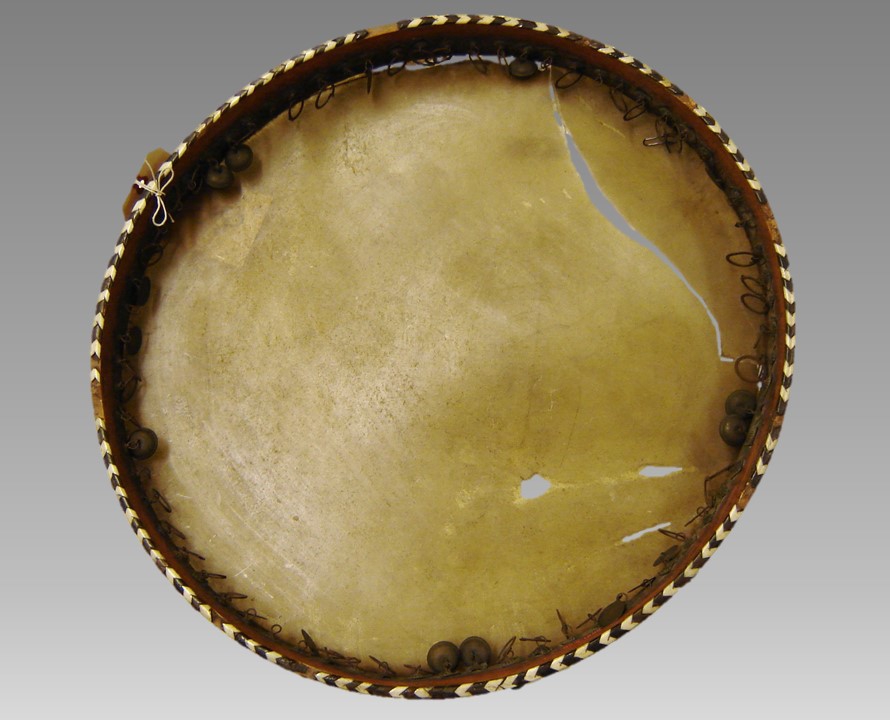
The daf is a large frame drum from the Persian, Kurdish and wider Iranian world, around 50 centimetres in diameter, with a single goatskin head stretched over a wooden hoop and a set of small metal rings hanging from the inside of the frame. The rings give the drum its distinctive shimmering “rain shower” sound — a continuous metallic rustle that surrounds every drum stroke. The daf is associated above all with Sufi sema ceremony and with modern Iranian classical music, and is one of the largest and most resonant frame drums of any tradition.
Wikidata describes the daf as “a frame drum” and classes it within the family of single-skin frame drums without handle. The MET catalogues its specimen as Membranophone-single-headed / frame drum.
Origin & History
Frame drums are among the oldest documented musical instruments in the world, with surviving examples from the third millennium BCE in Mesopotamian iconography. The daf and its relatives are part of this ancient family. By the early Islamic period (7th–9th centuries CE) the daf is documented in Persian and Arab sources as both a court and a Sufi ceremonial instrument, and it has continued in continuous use across Persia, Kurdistan, Azerbaijan, Tajikistan and the wider Iranian cultural region ever since.
The Metropolitan Museum holds an Azerbaijani daf of the late 19th century (object 502486), built of wood, skin, metal, bone and leather and donated through the Crosby Brown Collection in 1889. It is catalogued as Membranophone-single-headed / frame drum and represents the standard high-quality Caucasian and Iranian construction of the late Qajar and early Pahlavi period.
The daf has been particularly central to two musical contexts. In Sufi practice — particularly in the Kurdish Qaderi and Naqshbandi orders — the daf accompanies the zikr chanted invocation and the sema circular dance, with the drum’s rhythmic patterns supporting the slow trance-inducing structure of the ceremony. In modern Iranian classical music, particularly from the 1980s onward, the daf has acquired a substantial concert presence as a solo and ensemble instrument, with leading players such as Bijan Kamkar, Behnam Samani and the Khaledi family carrying the instrument into international concert tours.
Construction & Materials
The daf frame is a circular wooden hoop, around 50 cm in diameter and 4 to 5 cm deep, made from steam-bent walnut, beech or other tonewood. The single playing head — traditionally goatskin, now also synthetic on some modern instruments — is stretched over the hoop and held in place either by tacks (older instruments) or by a tunable lacing system (most modern instruments).
The defining structural feature is the ring system. Inside the frame, between sixty and one hundred small metal rings (usually steel or brass) hang from short hooks attached to the inside of the hoop. When the drum is moved, even slightly, the rings rustle against each other and against the inside of the head, producing the characteristic continuous metallic shimmer that surrounds every direct drum stroke. The number, size and material of the rings vary by region and by maker — Kermanshah dafs are particularly prized for their specific ring tuning.
The MET’s Azerbaijani specimen, with its combination of wood, skin, metal, bone and leather, represents standard late-19th-century construction and includes the ring system characteristic of the family.
How It’s Played
The player holds the daf vertically in the left hand, with the thumb hooked into the inside of the frame and the fingers supporting the back of the head. The right hand strikes the head with the fingertips, the palm and the heel of the hand, producing a small vocabulary of named strokes (tom, bak, tek, trel) that are combined into rhythmic patterns called usul in the Iranian tradition.
The left hand can rotate, lift and drop the drum to control the rustling of the metal rings — bringing them in for emphasis, damping them with the hand for quieter passages, and shaking the drum vigorously between strokes to produce the characteristic “rain shower” effect. The combination of direct head strokes and shaken-ring textures gives the daf an unusually wide tonal palette for a single drum.
In Sufi sema the daf typically plays slow, repeated rhythmic cycles that accelerate gradually over the course of the ceremony — a structural pattern that mirrors the dancers’ rotation and the chanters’ invocations.
Cultural Significance
The daf is the central percussion instrument of Kurdish Sufi practice and one of the central percussion instruments of modern Iranian classical music. Its presence at sema ceremonies in Kurdish takyeh lodges across western Iran, eastern Iraq and southeastern Turkey has been continuous for centuries, and the instrument carries significant religious and spiritual weight in these contexts.
In the modern Iranian classical concert tradition the daf entered the standard ensemble through the work of Bijan Kamkar in the 1970s and has since become a regular presence alongside the santur, ney, tar and setar. International tours by the Kamkars Ensemble, the Sussan Deyhim group, the Hossein Alizadeh ensemble and many others have brought the daf to audiences across Europe, North America and East Asia.
Notable Examples & Recordings
The MET’s Azerbaijani specimen (object 502486) is documented in the Musical Instruments department.
For listening:
- Bijan Kamkar, Daf and Avaz — the central modern recordings establishing the daf in concert use.
- Behnam Samani, Daf — leading German-Iranian player in classical and contemporary contexts.
- Pejman Hadadi, Tombak and Daf — modern Iranian percussion recordings.
- Sufi qaderi takyeh archival recordings — daf in Kurdish Sufi ceremonial use.
Related Instruments
- Bendir – the Maghrebi frame drum, the North African parallel of the daf.
- Riq – the Arab tambourine, related in size and use.
- Tar – the Persian/Arab frame drum (not to be confused with the Iranian long-necked lute of the same name).
- – the Irish frame drum, in the same wider family.
- – the Iranian goblet drum, the daf’s principal classical-music partner.
Where to Hear It
Sufi takyeh in Kurdish western Iran (Sanandaj, Kermanshah, Mahabad), eastern Iraq (Sulaymaniyah, Halabja) and southeastern Turkey (Diyarbakır) host regular zikr and sema ceremonies in which the daf is the principal percussion. Modern Iranian classical concerts in Tehran, Isfahan and Shiraz regularly feature the daf, as do the international tours of leading Iranian and Kurdish ensembles. The annual Fajr Music Festival in Tehran and the Kurdish music festivals of Erbil and Sulaymaniyah provide regular performance opportunities.
Learning Resources
Conservatory-level study on the daf is offered at the Tehran Conservatory of Music, the University of Tehran’s Faculty of Performing Arts, and at the major Kurdish music academies in Sanandaj and Sulaymaniyah. Standard tutor materials include the publications of Bijan Kamkar and Behnam Samani in Persian and the more recent English-language tutor The Art of Daf Playing by Pejman Hadadi. New concert-grade dafs by Tehran and Sanandaj makers run from approximately 200 to 600 USD; high-end Kermanshah-tradition dafs can reach 1,000 USD.
Frequently Asked Questions
What is the difference between a daf and a riq?
The daf is much larger (around 50 cm diameter) and uses metal rings on the inside of the frame for its characteristic rustling sound. The riq is a smaller Arab tambourine (around 20 cm diameter) with five pairs of brass cymbal-pairs set into the rim, producing a different metallic timbre.
What are the metal rings inside the daf for?
The rings (typically 60-100 small steel or brass rings hanging from hooks inside the frame) rustle continuously whenever the drum is moved, producing the daf’s distinctive “rain shower” sound that surrounds every direct drum stroke. The number, size and material of the rings affects the drum’s overall tonal character.
Why is the daf used in Sufi ceremonies?
The daf’s slow rhythmic patterns and continuous metallic shimmer support the trance-inducing structure of Sufi zikr (chanted invocation) and sema (circular dance). The drum’s role in Kurdish Sufi practice has been continuous for centuries.
Are old daf in museums?
Yes. The Metropolitan Museum holds a late-19th-century Azerbaijani daf (object 502486) in its Musical Instruments department.
Where is the daf played today?
The daf is played throughout the Iranian and Kurdish cultural region — Iran, eastern Iraq, southeastern Turkey, Azerbaijan, Tajikistan — and increasingly by Iranian and Kurdish diaspora communities worldwide. It also appears in modern Iranian classical and world-music concert programmes internationally.
Is the daf the same as the tar?
The Persian/Arab frame drum sometimes called tar is a smaller, ringless cousin of the daf — typically around 30 cm in diameter, without the metal-ring system. Note that tar is also the name of an entirely different instrument: the Iranian long-necked plucked lute.


