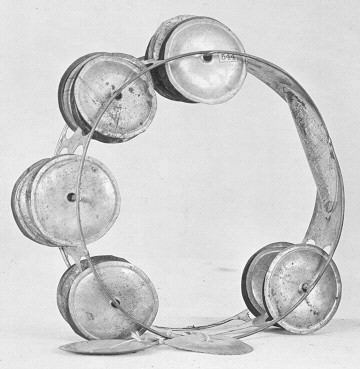


Pandeiro
Pandeiro
| Category | Percussion |
|---|---|
| Country of origin | Portugal / Brazil (medieval Iberian origin) |
| Classification | musical instrument |
| Wikipedia | en.wikipedia.org |
| Wikidata | Q1437089 |
Listen
Audio: SGaola, CC BY 4.0 / via Wikimedia Commons
Overview
The pandeiro is a hand-played frame drum widely used in Brazilian music. It has a single drumhead stretched over a circular wooden shell about 25 to 30 centimetres in diameter, with five sets of small metal jingles (platinelas) set into the rim. The Hornbostel-Sachs system files the instrument at 211.311 — a single-skin frame drum. Wikidata describes it simply as a hand frame drum.
The pandeiro is one of the central percussion instruments of Brazilian music. It anchors the rhythmic foundation of samba, choro, baião, frevo, capoeira and many other Brazilian genres. A skilled pandeirista plays the entire rhythm section of a samba ensemble on a single instrument by combining bass tones, slap tones, dampened tones and the constant shimmer of the platinelas.
Origin & History
The pandeiro arrived in Brazil from Portugal during the colonial period (1500 onward). The Portuguese frame drum, in turn, descended from earlier Iberian and Moorish frame drums of the medieval Mediterranean, themselves part of the wider frame-drum family that stretches from the Middle Eastern riq and bendir to the Irish bodhrán and the Sami runebomme. The Portuguese instrument carried metal jingles in the rim — the configuration that became the modern pandeiro standard.
The Metropolitan Museum’s collection includes two early-19th-century Portuguese pandeiros: object 501456 (described as tin) and object 501457 (metal), both donated to the Crosby Brown Collection in 1889. These two specimens document the Portuguese frame drum tradition in roughly the form it would have taken when it arrived in colonial Brazil — circular shell, single head, jingles in the rim — and provide a direct visual comparison point with the wooden-shell modern Brazilian instrument.
In Brazil the pandeiro absorbed African rhythmic conceptions and playing techniques brought by enslaved Africans and developed a distinctive role in the emerging genres of Brazilian popular music. By the late 19th century it was a fixture of the choro ensembles of Rio de Janeiro, where it provided the rhythmic foundation for the small-group instrumental music being developed by Joaquim Callado, Chiquinha Gonzaga and later Pixinguinha. By the early 20th century it had become equally central to samba, where it remained when samba moved from the favelas of Rio into the carnival blocks and the recording studios.
The 20th and 21st centuries saw the pandeiro become an internationally recognised concert instrument through the work of Brazilian virtuosi. Jorginho do Pandeiro, Marcos Suzano and Bernardo Aguiar have together transformed the pandeiro from a folk-rhythm-section instrument into a serious solo and chamber concert voice with its own concert repertoire and international audience.
Construction & Materials
A modern pandeiro has a circular wooden shell about 10 cm tall and 25–30 cm in diameter, with a single drumhead — traditionally of goatskin, increasingly of synthetic materials such as Nikola or Pellestrina film — stretched over the open face and held in place by an adjustable tension ring with tuning bolts. Five evenly spaced rectangular slots are cut into the wooden shell, and into each slot is fitted a pair of small metal jingle discs (platinelas) that vibrate against each other when the drum is shaken or struck.
Modern professional pandeiros use synthetic heads almost exclusively because of their stable tuning across temperature and humidity changes, but traditional goatskin heads remain widely used in folk and capoeira contexts. The wooden shell is typically built from laminated layers of birch, mahogany or jacarandá. Standard tuning of the head varies by style — samba pandeiros are tuned higher and tighter than choro instruments, and capoeira pandeiros are typically the most slack of the three.
How It’s Played
The player holds the pandeiro vertically in one hand (typically the non-dominant), with the thumb on top of the rim and the four fingers gripping under the rim, and strikes the head with the other hand using a combination of fingertips, knuckles, palm and thumb. The basic samba pandeiro pattern involves four characteristic strokes per cycle: a low bass tone with the heel of the hand near the rim, an open fingertip tone in the centre, a sharp slap with the fingertips on the rim and a small high thumb stroke. These four strokes combine with simultaneous wrist motions of the holding hand that shake the platinelas to produce a continuous rhythmic pattern with built-in jingle accompaniment.
The pandeiro’s full rhythmic vocabulary is large. A skilled pandeirista can articulate a samba partido alto, a choro baião, a frevo marcha-frevo and a capoeira toque de Angola on the same instrument simply by changing the combination of strokes and the holding-hand movement. Modern concert pandeiristas including Marcos Suzano and Bernardo Aguiar have extended the technique with extreme finger-independence patterns drawn from drumset and tabla practice.
Cultural Significance
The pandeiro is one of the central instruments of Brazilian musical identity. It is a featured instrument in samba — the country’s national popular music style — in choro (the early-20th-century instrumental genre that is samba’s older cousin), in capoeira (the Afro-Brazilian martial-art-and-dance form, where the pandeiro plays alongside the berimbau and the atabaque), and in many regional genres including the northeastern Brazilian forró and baião.
In capoeira specifically, the pandeiro is one of the four canonical instruments of the bateria (orchestra) that frames each roda (circle of play): the lead berimbau, the supporting medium and small berimbaus, two pandeiros, an atabaque and an agogô. The pandeiro’s ability to maintain a complex rhythmic foundation while a single player keeps both hands functioning as a rhythm section makes it essential to the small-ensemble economy of capoeira.
Notable Examples & Recordings
- Jorginho do Pandeiro, Choro do Jorginho — definitive choro pandeiro recordings.
- Marcos Suzano, Sambatown — landmark contemporary solo pandeiro album.
- Bernardo Aguiar, Bola Brasil — modern virtuoso pandeiro work.
- Trio Madeira Brasil, multiple choro recordings featuring pandeiro in standard ensemble role.
- Pixinguinha, historical choro recordings on which the modern pandeiro role was set in the 1920s and 1930s.
- The MET’s two early-19th-century Portuguese specimens (objects 501456 and 501457) document the immediate Iberian ancestor of the Brazilian instrument.
Related Instruments
- – the wider Western frame drum family that includes the pandeiro.
- Riq – the Arab tambourine, a Middle Eastern relative.
- – the Irish frame drum, a Northern European relative.
- – the Spanish frame drum that is the closest historical sibling.
- Atabaque – the Brazilian barrel drum that pairs with the pandeiro in capoeira and Afro-Brazilian religious music.
Where to Hear It
Live pandeiro is heard at every samba performance in Brazil, in the choro circles of Rio de Janeiro (especially the famous Bip Bip and Carioca da Gema venues in Lapa), in capoeira rodas in Salvador and around the world, and at Brazilian-music festivals including Rock in Rio, the Festival de Inverno de Campos do Jordão, and the international Brazilian-music festivals in New York, London, Paris and Tokyo. Recordings appear on Brazilian labels Biscoito Fino, Acari Records, Trama and Universal Brazil, and on international Brazilian-music labels including World Village and Xenophile.
- Wikipedia: Pandeiro
- Wikidata: Pandeiro (Q1437089)
- The MET: Pandeiro (object 501456)
- Wikimedia Commons: Pandeiros
Learning Resources
The principal teachers in Brazil include Bernardo Aguiar (Rio de Janeiro), Celsinho Silva and Marcos Suzano. Outside Brazil, the Brazilian-music programmes at California State University Los Angeles, the New England Conservatory, the SOAS School in London and the Hochschule für Musik Köln offer pandeiro instruction. Method books include Marcos Suzano’s A Arte do Pandeiro, Vince Cherico’s Brazilian Percussion Handbook and Henrique de Almeida’s The Brazilian Pandeiro. A serviceable student pandeiro from a Brazilian maker (Contemporanea, Liberty) starts at around 120 USD; concert-grade instruments by named luthiers run from 300 to 800 USD.
Frequently Asked Questions
What is a pandeiro?
A Brazilian hand-played frame drum with a single head and five sets of metal jingles in the rim, used as a central rhythm-section instrument in samba, choro and capoeira.
How is the pandeiro different from a tambourine?
The pandeiro has a tunable head, deeper shell and more refined jingles than a standard Western tambourine, and its playing technique uses four distinct stroke types to produce a complete rhythmic pattern from a single instrument. A Western tambourine is typically a fixed-pitch shaker-and-rim-strike instrument.
Where did the pandeiro come from?
From Portugal, originally a Mediterranean frame-drum tradition with Moorish roots. The Portuguese instrument arrived in Brazil during the colonial period and was reshaped through African rhythmic influence into the modern Brazilian pandeiro.
What kind of music is the pandeiro used for?
Samba, choro, baião, frevo, capoeira and most regional Brazilian musical styles. A growing concert solo and chamber repertoire has developed since the late 20th century.
Who is the most famous pandeiro player today?
Marcos Suzano and Bernardo Aguiar are the most internationally visible contemporary virtuosi. Within Brazil, the older masters Jorginho do Pandeiro and Celsinho Silva remain reference figures.


