

Talking Drum
dùndún / tama
| Category | Percussion |
|---|---|
| Country of origin | West Africa |
| Wikipedia | en.wikipedia.org |
| Wikidata | Q1321104 |
Listen
Audio: Bamidele S. Ajayi, CC BY-SA 4.0 / via Wikimedia Commons
Audio: Michael Drake, CC BY-SA / via Internet Archive
Audio: Tina E Andrus, CC BY / via Internet Archive

Overview
The talking drum is a family of West African pressure drums whose pitch can be changed in real time during play, allowing the instrument to imitate the rising and falling tones of West African languages. The Yoruba dundun, the Wolof tama and the Hausa kalangu are the best-known members, all hourglass-shaped drums with two skin heads laced together by tension cords running along the length of the body.
The phrase “talking drum” applies more loosely to other African drums that have been used for long-distance speech transmission — including some that are not pressure drums at all — and the broader category includes some of the most culturally important percussion instruments in West African music.
Origin & History
Pressure-drum traditions are documented in West Africa from at least the medieval period, with the Yoruba dundun in particular tied to the courts of the Oyo Empire in present-day southwestern Nigeria. The drum’s role in court ceremony, in praise singing, and in long-distance communication between villages — using stylised tonal imitation of speech — is well established in oral histories and in early European travel accounts.
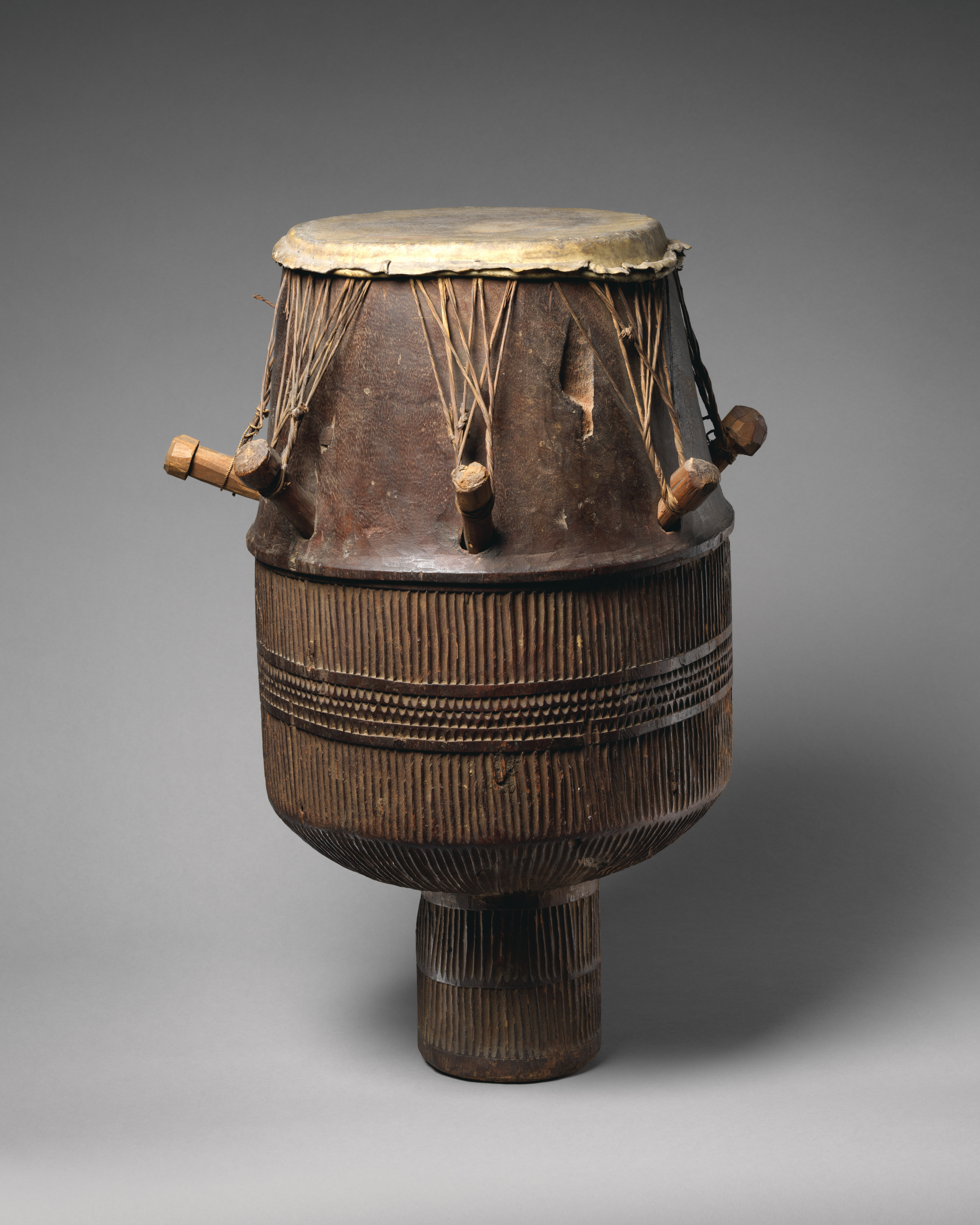
The Metropolitan Museum’s collection holds two relevant West African drum specimens that broaden the picture. The Asante atumpan (MET object 501976), a 19th-century paired drum from present-day Ghana, illustrates a different but parallel speech-drum tradition: the atumpan is not a pressure drum but a pair of large open-bottomed wooden drums whose tonal patterns are similarly used to imitate the tonal language of Twi. A 19th-century Fulbe nyanyeru (MET 502106), built from a gourd with various materials, sits in the same Musical Instruments department and represents another West African ceremonial percussion form.
Across the 1900s the talking drum has spread well beyond West Africa, both through the Yoruba and other West African diasporas of the Americas and through international popular music — King Sunny Adé and Babatunde Olatunji being two of its most influential exporters.
Construction & Materials
The Hornbostel-Sachs system places hourglass pressure drums in 211.24 (variable-tension drums). The body is carved from a single piece of wood, typically a hardwood, into the characteristic hourglass shape — wide at both ends, narrow in the middle. Two thin skin heads (often goat or kid) are stretched across each end and laced together with cords of leather or cotton running along the length of the body.
Squeezing the cords against the side with the upper arm increases the tension on both heads simultaneously and raises the pitch. Releasing the squeeze drops the pitch. A skilled performer can shift the pitch by an octave or more inside a single stroke, sliding through the pitch range much like a vocal portamento. The Asante atumpan (MET 501976), by contrast, is a fixed-tension drum: its tonal patterns come from striking different parts of the head, not from squeezing the body.
How It’s Played
The player carries the drum slung from the shoulder, holding it under the upper arm so that the lacing cords can be squeezed against the side of the body. The right hand strikes the upper head with a curved wooden stick. The left arm controls the squeeze pressure, raising and lowering the pitch in real time as the right hand strikes.
This makes the talking drum unusual: a single-headed-from-the-player’s-perspective drum that nevertheless produces a continuously variable melodic line. The patterns played are conventionalised imitations of phrases in the local tonal language, and a competent player can produce drum patterns that are immediately recognisable as specific words or proverbs by anyone in the language community.
Cultural Significance
In Yoruba culture the dundun is associated with royal ceremony, with praise poetry, with the religious music of orisha worship, and with everyday social events from naming ceremonies to weddings. The lead dundun in a Yoruba ensemble — the iya ilu (“mother drum”) — is one of the most prestigious instruments in West African music.
Among the Hausa, the kalangu serves similar ceremonial and praise-singing functions in northern Nigeria. The Wolof tama in Senegambia is closely tied to mbalax music, the contemporary popular genre that brought the talking drum to international audiences through artists such as Youssou N’Dour. Across all these traditions the drum is more than a musical instrument — it is a cultural transmitter of language, history and social authority.
Notable Examples & Recordings
The MET’s Asante atumpan (object 501976) and Fulbe nyanyeru (object 502106) document parallel West African ceremonial percussion traditions in the same collection, even though neither is a pressure drum proper. For listening, recordings by King Sunny Adé (especially the Island Records albums of the early 1980s), Youssou N’Dour, and Babatunde Olatunji cover the international popular face of the instrument. Field recordings in the Smithsonian Folkways and Ocora archives document traditional dundun, kalangu and tama performance.
Related Instruments
- – the Asante (Ghana) paired speech drums, fixed-tension cousins
- Sabar – the Wolof open-bottomed hand drum, often played alongside tama
- Djembe – the West African goblet drum from the Mande tradition
- Bata – the Yoruba double-headed religious drums of the orisha tradition
- Tabla – the Indian pair of hand drums (no historical relation, but a useful comparison for tonal drumming)
Where to Hear It
Yoruba ceremonial events in southwestern Nigeria — particularly weddings, funerals, religious festivals and royal ceremonies — feature the dundun ensemble as a central element. Senegalese mbalax concerts in Dakar and on international tour feature the tama in lead-percussion roles. The Wikimedia Commons category collects images and audio across the family.
- Wikipedia: Talking drum
- The MET: Atumpan (object 501976)
- The MET: Nyanyeru (object 502106)
- Wikimedia Commons: Talking drums
Learning Resources
Serious talking-drum study is most easily pursued in West Africa, where master players in Lagos, Ibadan and Dakar accept long-term students. Outside Africa, instruction is offered through the African music programmes at several universities (UCLA, Northwestern, SOAS) and through community-based teachers in the West African diaspora communities of London, New York and Paris. Method books are scarce; the central skill — translating between local language and drum patterns — is best learned through direct apprenticeship.
Frequently Asked Questions
What family is the talking drum in?
It is a variable-tension drum, classed as 211.24 in the Hornbostel-Sachs system.
How does the talking drum change pitch?
Pressing the lacing cords against the body of the drum with the upper arm raises the tension across both drumheads at once, which raises the pitch. Releasing the pressure lowers the pitch. A skilled performer can shift the pitch by an octave or more during play.
What does the talking drum say?
It plays stylised imitations of phrases in the local tonal language — Yoruba, Wolof, Hausa or others. Members of the language community can recognise specific words and proverbs in the drumming.
Where did the talking drum originate?
Pressure-drum traditions are documented in West Africa from at least the medieval period. The Yoruba dundun is particularly tied to the courts of the Oyo Empire in present-day southwestern Nigeria.
Are talking drums in museums?
Yes. The Metropolitan Museum of Art holds related West African drums including a 19th-century Asante atumpan (object 501976) and a Fulbe nyanyeru (object 502106), both speech-related percussion instruments.
Is the talking drum difficult to learn?
Basic pitch control with the squeeze technique can be acquired in months. The deep skill — translating language into drum patterns idiomatically — requires fluency in the local tonal language and years of study with a master player.


