
Ngoma
Ngoma
| Category | Percussion |
|---|---|
| Country of origin | Bantu Africa (across Sub-Saharan Africa) |
| Wikipedia | en.wikipedia.org |
| Wikidata | Q7022514 |
Overview
The ngoma is a category-name for a wide family of drums played across Bantu-speaking Africa, from the Great Lakes region down through East Africa and southern Africa to Angola and Namibia. Wikidata classifies the ngoma as a Bantu drum and as a directly struck membranophone. The Wikipedia entry treats ngoma both as the drum itself and as the wider Bantu cultural concept of organised ceremonial drumming, dance and healing in which the drum is embedded.
In its most common form an ngoma drum is a single-headed barrel- or cone-shaped wooden drum with a head of cow, antelope or goat skin laced or pegged onto a hollowed wooden body. Sizes range from small hand drums of around 30 centimetres tall to large ceremonial drums standing more than a metre high. Across the Bantu world, ensembles of ngoma in graduated sizes provide the rhythmic foundation for dance, healing ceremony, royal court ritual and community celebration.
Origin & History
The ngoma family is rooted in the deep history of Bantu-speaking peoples across sub-Saharan Africa. As the Bantu language family expanded southward and eastward from a probable origin in the present-day Cameroon-Nigeria border region between roughly 1500 BCE and 500 CE, the practice of carved-wood single-headed drums travelled with it and developed regional variants in each area where Bantu speakers settled. By the time of the early historical record — the Portuguese accounts of the Kingdom of Kongo from the late 15th century onward, the Dutch and English accounts of the Cape from the 17th century, and the Arab accounts of the Swahili coast going back to the 12th century — the ngoma was a deeply established institution across what is now Angola, the two Congos, Tanzania, Kenya, Uganda, Mozambique, Zambia, Zimbabwe, Malawi and South Africa.
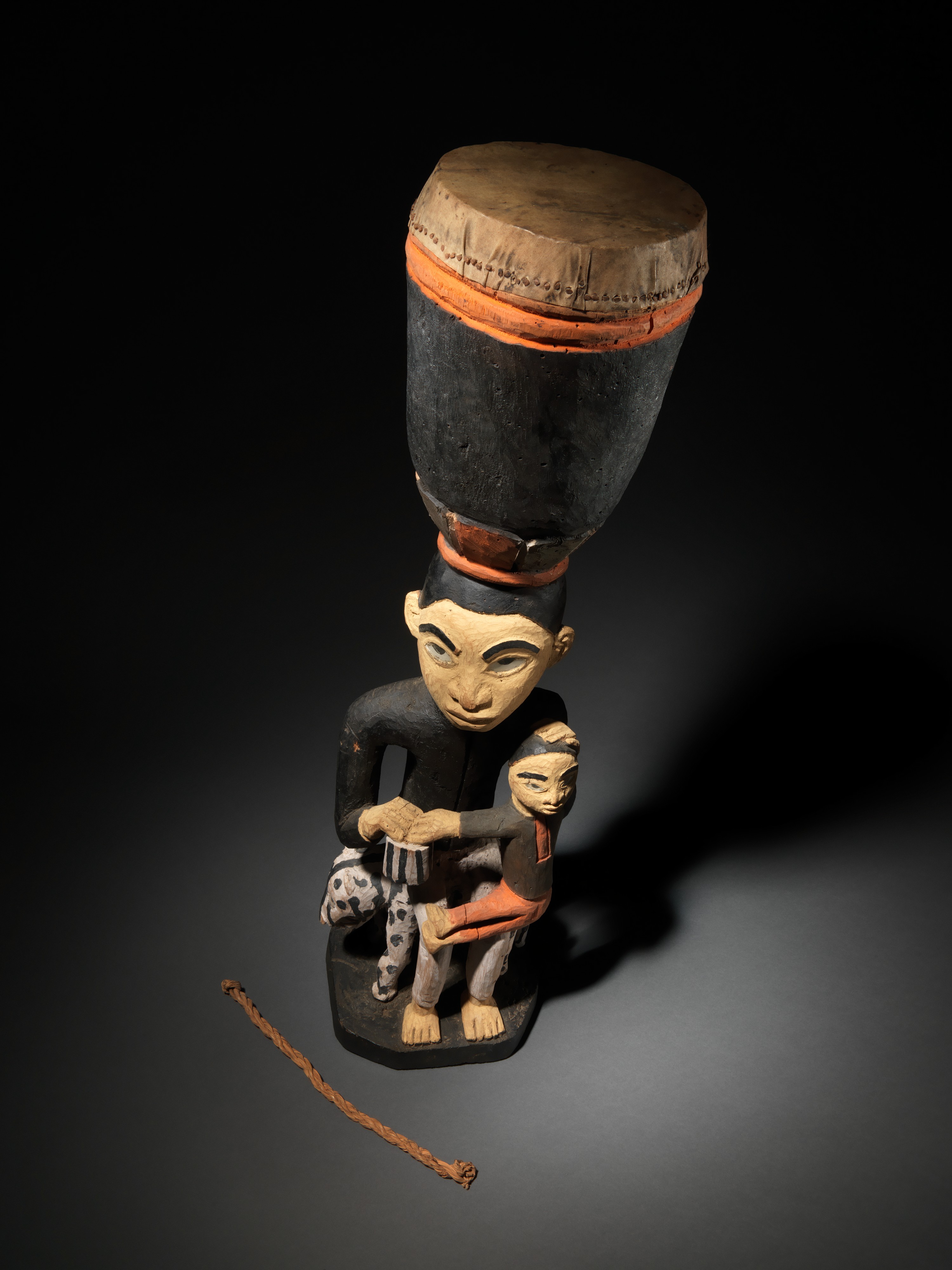
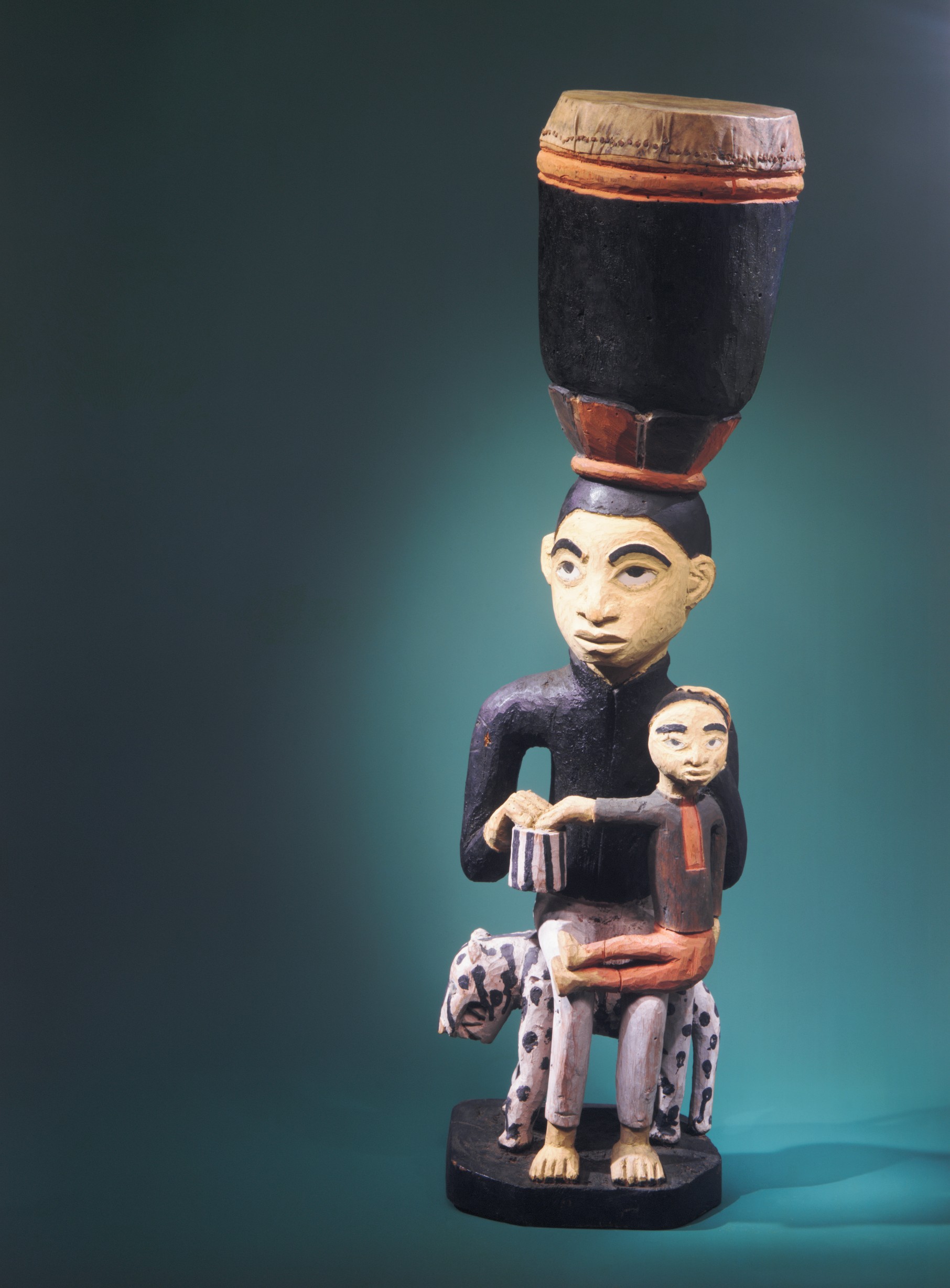
The Metropolitan Museum’s collection includes a 19th-century ngoma drum from the Vili or Yombe people (object 502290), made of wood, fiber and glass beads. The Vili-Yombe are coastal Bantu peoples of the Loango coast in what is now the Republic of the Congo and Cabinda, and their ngoma tradition is notable for the elaborate carving and beading of the drum body — the drum is treated as both a musical and a sculptural object, with the carving often depicting royal or ancestral figures.
In the colonial and postcolonial periods the ngoma has remained at the centre of community life across Bantu Africa. National dance and music ensembles in Tanzania, Uganda, Kenya, Zambia, Zimbabwe and elsewhere have institutionalised regional ngoma traditions for the concert stage, and contemporary popular musicians from Mahlathini to the Soul Brothers have built popular styles on ngoma rhythmic foundations.
Construction & Materials
A typical ngoma is carved from a single piece of hardwood — mvule (East African iroko), mukwa, sausage tree (kigelia) or local mahogany are common choices — into a single-headed cylindrical, barrel or cone shape. The body is hollowed from one end with adze and chisel and finished with the closed end forming a tail or pedestal. The drum head is goat, cow or antelope skin, prepared by drying and scraping, and is attached either by lacing through a row of pegs hammered into the body or by lacing through holes drilled near the rim of the body.
Body sizes vary widely with regional tradition. Small hand-held ngoma of around 30 to 40 centimetres are used in Tanzania, Kenya and Uganda for solo dance accompaniment; larger free-standing ngoma of 60 to 100 centimetres provide the bass and mid-range voices in ensemble; the largest ceremonial drums of more than a metre tall are used for royal-court and major ritual events. The Vili-Yombe specimen at the MET incorporates glass beads as decorative elements — a luxury treatment characteristic of Loango-coast aristocratic objects of the 19th century.
How It’s Played
The player strikes the head with bare hands, with sticks, or with a combination of the two depending on the regional tradition. Tanzanian and Kenyan dance ngoma are usually played with the hands; Ugandan royal entenga and Burundian royal drum ensembles use sticks; Zimbabwean ngoma buntibe uses a combination. The player may stand and strike a free-standing drum, sit and hold a small drum between the knees, or hold a small drum under one arm and strike with the other hand.
Ensemble ngoma playing is built around interlocking rhythmic patterns. A small group of differently sized drums each play a single repeating pattern; the patterns lock together to produce a composite rhythm in which no individual drum carries the whole rhythmic line. This hocketing approach is one of the foundations of Bantu rhythmic music and has had a wide influence on the broader African drum traditions, on Afro-Caribbean and Afro-American music, and (through these) on global popular music.
Cultural Significance
The wider Bantu ngoma concept extends well beyond the drum itself. In many Bantu cultures the word denotes the whole institution of organised drumming-dance-healing ceremony — the drum, the dancers, the singers, the audience and the ritual purpose are all ngoma. The healing ngoma traditions of the Swahili coast (especially in southern Tanzania and northern Mozambique), of the Shona of Zimbabwe and of the Tsonga of southern Mozambique and South Africa are continuous practices in which drum patterns, dance and trance combine to address spiritual and medical concerns within the community.
In national cultural policy across Bantu Africa, the ngoma has become emblematic of national identity. The Royal Drummers of Burundi (the Karyenda ensemble) — whose royal drums are technically of the ngoma family — toured internationally throughout the late 20th century and shaped global perceptions of African drumming. Tanzania’s national dance ensembles, Zimbabwe’s Mbira/Ngoma combinations and South Africa’s adapted Zulu ingoma have all carried the tradition into contemporary national and international concert settings.
Notable Examples & Recordings
- The Royal Drummers of Burundi, Live at Real World — landmark international ngoma recording.
- Mahlathini and the Mahotella Queens, Paris-Soweto — popular South African mbaqanga built on ngoma rhythmic foundations.
- Hukwe Zawose, Tanzania: Spoken & Sung Poetry of the Wagogo — Wagogo ngoma traditions in concert framing.
- Thomas Mapfumo, recordings featuring Shona ngoma alongside the mbira.
- The Vili-Yombe ngoma at the Metropolitan Museum (object 502290) is one of the few well-documented 19th-century West-Central African ngoma specimens in a major Western museum.
Related Instruments
- Djembe – the West African Mande goblet drum from a different but neighbouring drum tradition.
- Talking drum – the West African hourglass drum.
- Conga – the Cuban descendant of the wider African single-headed drum tradition.
- – the Akan ceremonial drum pair of Ghana.
- Mbira – the Shona thumb piano, often paired with ngoma in Zimbabwean ceremony.
Where to Hear It
Live ngoma is part of community life across Bantu Africa — at weddings, harvest festivals, royal ceremonies, healing events and national-day celebrations. National dance ensembles in Tanzania, Kenya, Uganda, Burundi, Rwanda, Zambia, Zimbabwe and South Africa programme regular concerts. International world-music festivals — WOMAD, Festival au Désert, the Cape Town International Jazz Festival — regularly feature ngoma-led ensembles. Recordings are extensive on Smithsonian Folkways, the Real World Records label, World Music Network, and the Sublime Frequencies catalogue.
- Wikipedia: Ngoma drums
- Wikidata: Ngoma (Q7022514)
- The MET: Ngoma (object 502290)
- Wikimedia Commons: Ngoma
Learning Resources
In Tanzania the Bagamoyo College of Arts and the University of Dar es Salaam’s Department of Fine and Performing Arts offer formal training in ngoma. Makerere University in Uganda, the University of Zimbabwe and the Music Academy of South Africa run similar programmes. Outside Africa the ethnomusicology departments at SOAS London, UCLA, Wesleyan and the Hochschule für Musik Köln offer ngoma-focused courses. Method materials in English are limited; John Janzen’s Ngoma: Discourses of Healing in Central and Southern Africa (1992) is the standard scholarly reference. Handcrafted ngoma from East African or Central African makers run from 100 to 800 USD depending on size and decoration.
Frequently Asked Questions
What is an ngoma?
A Bantu drum — typically a single-headed wooden drum with a skin head — and, in many Bantu cultures, also the wider institution of community drumming, dance and ceremony in which the drum is used.
Where is the ngoma played?
Across Bantu-speaking sub-Saharan Africa: from Cameroon and the Congos in the west, through the Great Lakes region, East Africa (Tanzania, Kenya, Uganda) and southern Africa (Zambia, Zimbabwe, Mozambique, South Africa, Angola).
What is ngoma healing?
A widespread Bantu institution in which drum patterns, dance and song combine in organised ceremony to address spiritual and medical concerns within the community. The Swahili-coast healing ngoma, the Shona healing traditions and the Tsonga ngoma are major contemporary examples.
How is the ngoma different from the djembe?
Different families. The ngoma is the Bantu drum tradition of central, eastern and southern Africa; the djembe is a goblet drum of the Mande peoples of West Africa. They have different shapes, different head-attachment systems and different playing traditions, although both are central to their respective regional musical cultures.
Are ngoma drums in museums?
Yes. The Metropolitan Museum of Art holds a 19th-century Vili-Yombe ngoma (object 502290) elaborately decorated with carving and glass beads. The British Museum, the Smithsonian National Museum of African Art and the Royal Museum for Central Africa in Tervuren also hold significant historical ngoma specimens.


