

Gong
Gong
| Category | Percussion |
|---|---|
| Country of origin | East and Southeast Asia (ancient origin) |
| Classification | family of musical instruments, type of musical instrument |
| Wikipedia | en.wikipedia.org |
| Wikidata | Q208320 |
Listen
Audio: stephan, Public domain / via Wikimedia Commons
Audio: PDSounds description: http://www.pdsounds.org/sounds/gong_or_bell_vibrant, CC0 / via Wikimedia Commons
Audio: PhilipDM, CC BY-SA 2.5 / via Wikimedia Commons
Overview
The gong is a metal percussion instrument — most often built from a bronze alloy — whose sound comes from the vibration of the metal body itself when it is struck. The Hornbostel-Sachs system files gongs among the percussion vessels (idiophones with a vessel-shaped body), and Wikidata classifies them as idiophones, musical instruments and percussion vessels. The Wikipedia summary characterises it as a metal percussion vessel whose sound is generated by the vibrating body itself.
The gong is a wide family rather than a single instrument. Major types include the Chinese tam-tam and bo (large flat hanging gong), the Chinese luo (small high-pitched gong used in opera), the Burmese kyizi (triangular gong), the Indonesian gong ageng (the large central gong of the gamelan), the Vietnamese cồng chiêng (Central Highlands gong-set, UNESCO-inscribed in 2005), and the modern Western symphony orchestra tam-tam developed from the Chinese instrument in the 18th and 19th centuries.
Origin & History
The gong is one of the oldest documented metal instruments of East and Southeast Asia. Bronze gongs are documented archaeologically in China going back as far as the sixth century of our era and in Southeast Asia in roughly the same period, with continuous regional development since. The Wikipedia article notes the long association of the gong with Chinese, Vietnamese, Burmese, Thai, Malay and Indonesian musical traditions, and the instrument is central to the gamelan ensembles of Java and Bali (where the gong ageng is the largest, lowest-pitched and most acoustically central instrument), to the Vietnamese highland cồng chiêng sets, and to Chinese opera and ceremonial music.
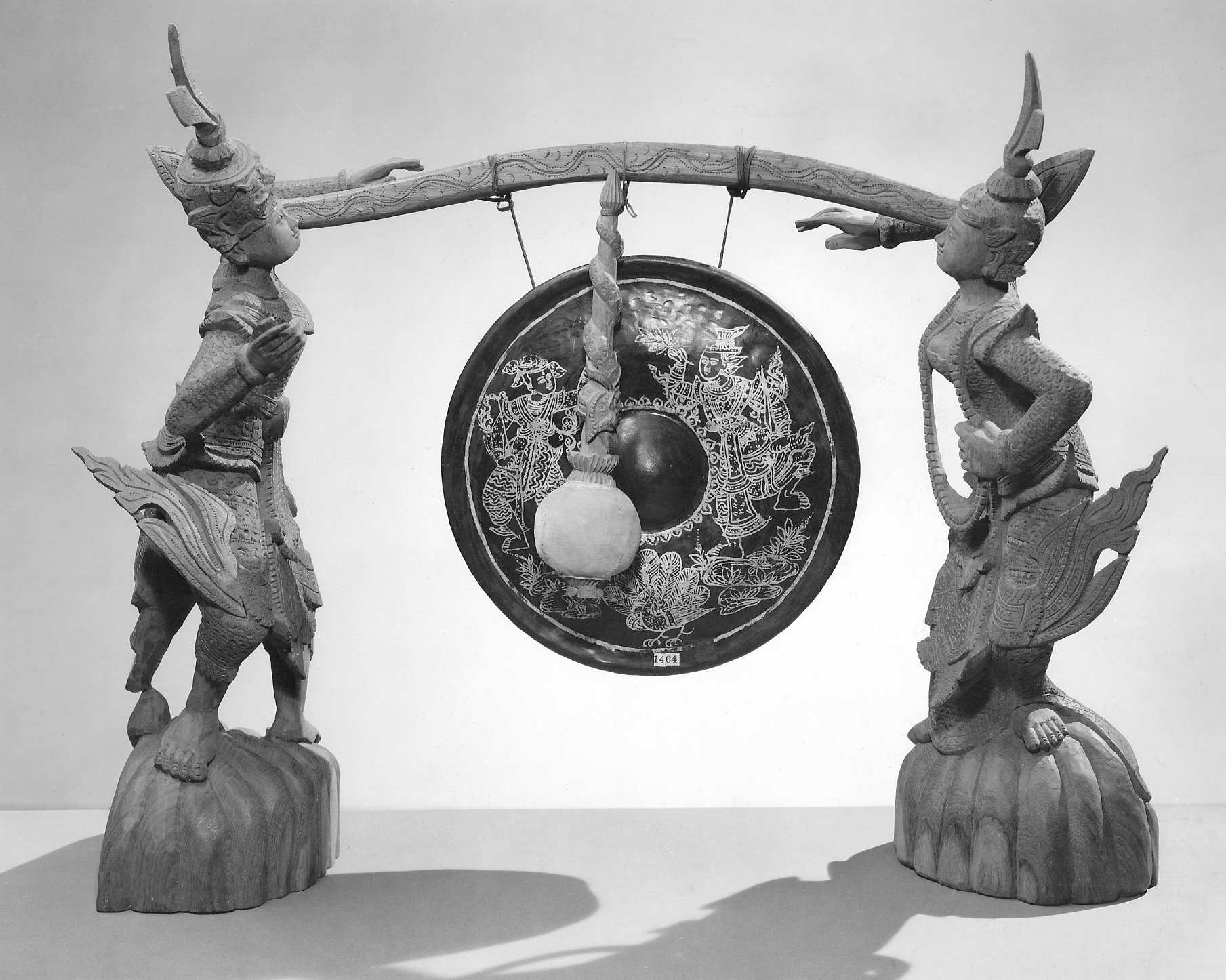
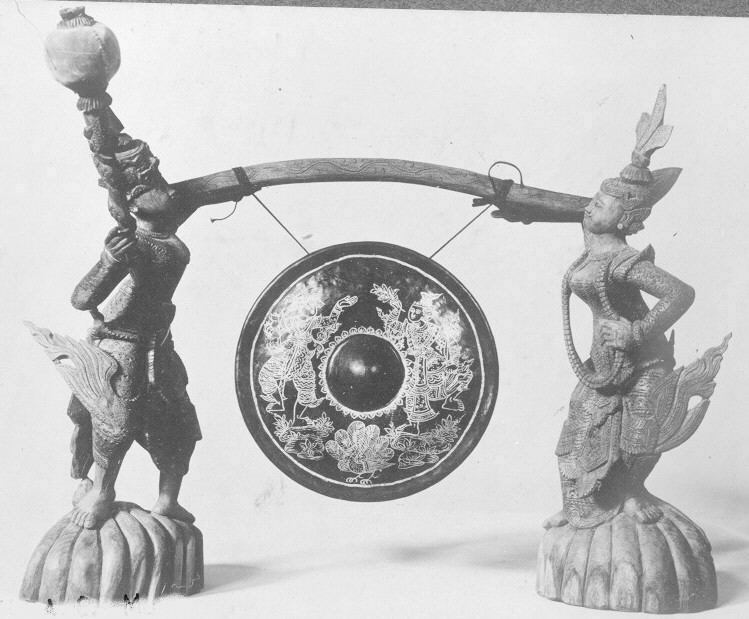
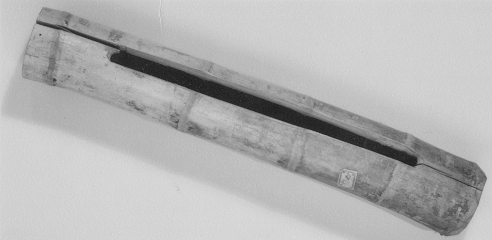
The Metropolitan Museum’s collection includes two 19th-century gongs that document distinct regional traditions. Object 502039 is a late-19th-century Burmese gong made of metal, wood and skin — likely a kyizi-type triangular gong with its supporting frame and accompanying parts. Object 502044 is a late-19th-century Chinese gong notable for its bamboo construction, an unusual material for a gong (most are bronze) and possibly a smaller framed-and-suspended type.
The gong reached the Western symphony orchestra in the 18th century. François-Joseph Gossec used a Chinese gong in his 1791 Marche funèbre for Mirabeau, and the instrument became a standard symphonic accompaniment from the early 19th century onward. The modern orchestral tam-tam (the term for the unpitched flat hanging gong used in symphony orchestras) is a direct descendant of the Chinese instrument and is used by composers including Berlioz, Tchaikovsky, Mahler, Stravinsky and Shostakovich for moments of climactic intensity. In the 20th century the gong became central to contemporary art music through composers including John Cage, Karlheinz Stockhausen and Toru Takemitsu.
Construction & Materials
A traditional gong is hammered from a flat bronze disc into either a flat or slightly raised circular shape with a downward-curving rim. Bronze alloys vary by tradition — Indonesian gamelan gong-makers use specific copper-tin alloys with small additions of zinc and lead to produce the desired tone; Chinese gong-makers use slightly different proportions; Burmese and Thai gong-makers each have their own traditional alloys. The disc is hammered for many hours by master gong-smiths working in pairs or larger teams, with the hammering pattern determining the final pitch, overtone series and tonal character of the instrument.
Sizes vary enormously. Small Chinese opera luo are around 15 to 25 cm in diameter; the large flat hanging Chinese tam-tam used in the symphony orchestra is typically 60 to 100 cm in diameter; the largest Indonesian gong ageng is over 1 metre in diameter and weighs over 30 kg. The MET’s Burmese specimen (502039) is built into a wooden frame with skin elements; the Chinese specimen (502044) uses bamboo as part of its construction, which is unusual and may indicate a smaller suspended type.
Striking implements vary by gong type. Most large flat gongs are struck with a padded mallet — felt or leather over a hardwood core — that produces a deep gradual swelling tone. Smaller gongs may be struck with hard wooden sticks for sharper articulation.
How It’s Played
The basic technique is simple: the player strikes the gong with a mallet to produce a single tone that swells in volume after the strike (the bloom of the gong) and then decays gradually. Idiomatic technique includes struck rolls (rapid alternating strikes that produce a sustained sound), volume-control through striking-position choice (centre of the gong for the lowest tone, edge for higher and harsher tones), and pitch-bending through pressure with the free hand on the gong surface during sustained vibration.
In Indonesian gamelan the gong ageng punctuates the largest cyclical phrases of the music, providing the metric anchor around which the entire ensemble structures its time. In Chinese opera the small luo provides sharp rhythmic accents and dramatic-mood signals. In the Vietnamese cồng chiêng tradition a graduated set of small to large gongs is played by an ensemble of seated players, each holding one gong and producing interlocking patterns. In the Western symphony orchestra the tam-tam is generally used for single dramatic strokes at climactic moments.
Cultural Significance
The gong is one of the most culturally significant instrument families of Asia. In Indonesian gamelan the gong ageng is treated as a sacred or semi-sacred object and is given a name as if it were a person. In Vietnamese highland culture the cồng chiêng set is the central ceremonial instrument of the Central Highlands ethnic groups and was inscribed by UNESCO on the Representative List of the Intangible Cultural Heritage of Humanity in 2005. In Burmese and Thai Buddhist culture the gong is associated with temple ceremony and meditation practice. In Chinese opera and ritual the gong has continuously held a central role for over a thousand years.
The gong’s adoption by the Western symphony orchestra and by contemporary art music has made the instrument’s voice familiar globally. The dramatic tam-tam stroke at the end of a Mahler symphony or in a film score is one of the most internationally recognised gong sounds.
Notable Examples & Recordings
- Indonesian gamelan recordings, multiple titles on Smithsonian Folkways, World Music Network and the Indonesian Gamelan label.
- Vietnamese Cồng Chiêng of the Central Highlands, Smithsonian Folkways recording.
- Chinese opera recordings from the China Record Corporation feature the luo and bo in standard ensemble use.
- Karlheinz Stockhausen, Mikrophonie I — concert work entirely for tam-tam and electronics.
- Mahler Symphony No. 2 — definitive symphonic use of the tam-tam.
Related Instruments
- – the Western orchestral term for the large flat hanging Chinese-derived gong.
- – the Indonesian gamelan kettle-gong rack with multiple small tuned gongs.
- – the Vietnamese highland gong-set tradition.
- – the wider metal-percussion-vessel family that includes the gong.
- – another bronze percussion vessel of independent ancient origin.
Where to Hear It
Live gong is heard in any gamelan performance worldwide (university gamelan programmes at Wesleyan, UCLA, Cambridge, the Royal Conservatoire The Hague and many others run regular concerts), in any major Western symphony orchestra performance featuring tam-tam, in Chinese opera performances at the Beijing Opera Theater and the Liyuan Theater in Beijing, and at Vietnamese cultural festivals featuring cồng chiêng sets. Recordings are extensive on Smithsonian Folkways, Nonesuch Explorer, World Music Network, the China Record Corporation, the Indonesian Lokananta label, and on essentially all major classical-music labels.
- Wikipedia: Gong
- Wikidata: Gong (Q208320)
- The MET: Gong (object 502039)
- The MET: Gong (object 502044)
- UNESCO: Space of gong culture (Vietnam)
- Wikimedia Commons: Gongs
Learning Resources
Gamelan gong technique is taught at university gamelan programmes worldwide and at the Indonesian conservatories ISI Yogyakarta, ISI Surakarta and ISI Denpasar. Western orchestral percussion programmes — Curtis Institute, Juilliard, the Royal Academy of Music London, the Hochschule für Musik Köln — teach tam-tam technique within their wider percussion training. Chinese opera luo is taught at the Central Conservatory in Beijing and the Shanghai Conservatory. Method books include James Blades’s Percussion Instruments and Their History (the standard reference for orchestral percussion including tam-tam) and various gamelan instructional materials. A small Chinese opera luo costs 30 to 80 USD; a concert-grade Western tam-tam by Paiste, Sabian or Zildjian runs from 800 to 4,000 USD; a full Indonesian gong ageng by a Yogyakarta or Surakarta gong-smith starts at around 5,000 USD.
Frequently Asked Questions
What is a gong?
A metal percussion instrument — typically of bronze — that produces sound from the vibration of its body when struck with a mallet. The gong is a wide family rather than a single instrument and includes Chinese, Burmese, Thai, Indonesian, Vietnamese and Western symphony-orchestra forms.
What is the difference between a gong and a tam-tam?
A tam-tam is the Western orchestral term for the large flat hanging Chinese-derived unpitched gong. The wider word gong covers all instruments in the family, including the tam-tam.
Where did the gong come from?
From East and Southeast Asia — bronze gongs are documented archaeologically in China going back as far as the sixth century of our era, with continuous regional development across China, Vietnam, Myanmar, Thailand, Malaysia and Indonesia.
Has UNESCO recognised the gong?
Yes, indirectly. The “Space of Gong Culture” inscription for the Vietnamese highland region was inscribed on the UNESCO Representative List of the Intangible Cultural Heritage of Humanity in 2005, recognising the cồng chiêng tradition associated with the highland peoples of Vietnam.
Who makes gongs today?
In Indonesia the gong-smiths of Yogyakarta and Surakarta continue the gamelan tradition. In China the workshops of Wuhan, Suzhou and Beijing produce gongs for opera and concert use. Western orchestral tam-tams are made primarily by Paiste (Switzerland), Sabian (Canada), Zildjian (USA) and Wuhan (China). Burmese and Thai temple-gong workshops continue the regional traditions.


