Japanese Peace Bell
日本平和の鐘
| Category | Percussion |
|---|---|
| Country of origin | Japan |
| Classification | bonshō, peace bell |
| Wikipedia | en.wikipedia.org |
| Wikidata | Q2067390 |
Editorial note: The Japanese Peace Bell is a single named object rather than a generic instrument category. This page describes that specific bell and links to the broader tradition for the wider context of Japanese Buddhist temple bells. WP publication of this page is recommended subject to CEO review.
Overview
The Japanese Peace Bell is a single bronze bell housed in a small Shinto-style wooden shrine on the grounds of the United Nations Headquarters in New York City. Donated to the United Nations by Japan in 1954, it is in the form of a Japanese Buddhist temple bell (bonshō) and is sounded twice each year — at the start of the spring season and on the International Day of Peace in September — by senior UN officials and visiting dignitaries.
Origin & History
The bell was the initiative of Chiyoji Nakagawa, a member of the Japanese delegation observing UN proceedings in the early 1950s. Nakagawa raised funds across Japan to cast a bell that would be presented as a gift from the Japanese people. The bell was cast at a foundry in Japan using donated coins and metal contributions from people across the country and from many other UN member states.
It was formally presented at the United Nations on 8 June 1954. The accompanying inscription reads “Long live absolute world peace” in Japanese characters.
Construction & Sound
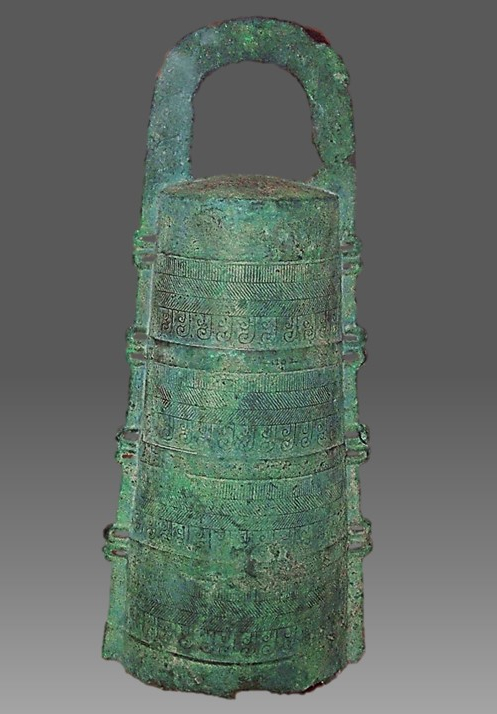
The bell is a classical bonshō in form: a roughly cylindrical bronze body with a flared lower rim, a domed top with twin loops for suspension, and a band of raised bosses (chichi) around the upper section. It is sounded by swinging an external wooden striker (shumoku) against a designated striking point on the outside of the rim. The sound is the deep, slow, swelling tone characteristic of Japanese Buddhist temple bells, sustained by long resonance and a rich set of low partials.
Cultural Significance
The bell has become a quiet but enduring symbol at the United Nations of the post-war Japanese peace movement and of the broader global hope for peace embodied in the United Nations Charter. Its public ringings on the spring equinox and the International Day of Peace each year are widely reported and have become a small but meaningful UN ritual.
Related Pages
- – the broader category of Japanese Buddhist temple bells
- Bridge of Nations Bell – another peace-related Japanese bell
- Singing bowl – a related Buddhist resonant idiophone
- Gong – the broader struck-idiophone family


