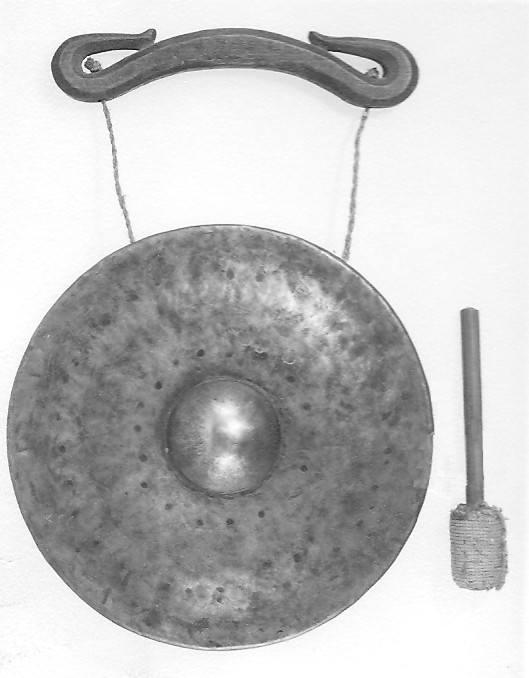
Image: דג בלי מלח, CC BY-SA 4.0 — via Wikimedia Commons
Singing Bowl
Singing bowl / Tibetan singing bowl
| Category | Idiophone |
|---|---|
| Country of origin | Himalayan region (origin debated) |
| Wikipedia | en.wikipedia.org |
| Wikidata | Q1413983 |
Listen
Audio: Lufke, CC BY-SA 4.0 / via Wikimedia Commons
Audio: Luis Alvaz, CC BY-SA 4.0 / via Wikimedia Commons
Audio: Kevin MacLeod, CC BY 3.0 / via Wikimedia Commons
Overview
The singing bowl is a metal-alloy bowl, typically beaten or cast from bronze, that produces a sustained tone when struck on the rim with a padded mallet or rubbed continuously around the rim with a wooden stick. Wikidata describes it as a Himalayan metal bowl that is generally struck or rubbed with a padded mallet and classifies it under melodic percussion instrument.
In modern global practice the singing bowl appears in three overlapping settings: contemplative and meditation contexts (yoga studios, mindfulness retreats, sound baths); the sound-healing and energy-work alternative-health industry; and as a small but established voice in contemporary classical-percussion repertoire. Its association with Tibetan Buddhism is the most familiar but, as discussed below, the historical evidence for its pre-modern Tibetan ritual use is more limited than popular sources suggest.
Origin & History
The metal-alloy bowl as a household and ritual object is documented across South, Central, and East Asia for at least 2,000 years. Bronze and brass eating bowls are standard in Tibetan, Nepalese, and Himalayan domestic life; ritual offering bowls appear in monastic settings; and the wider East Asian tradition of standing bell percussion (Japanese rin and keisu, Chinese qing, Korean ching) supplies a clear comparative context.
The specific use of the metal bowl as a sustained-tone musical or meditation instrument — struck and then either listened to or rubbed around the rim to maintain the tone — has a more uncertain history. Pre-1950s Tibetan and Nepalese ethnomusicological sources contain remarkably little discussion of singing-bowl practice; the instrument does appear in monastic contexts but typically as a struck bell, not as the prolonged-tone meditative resonator that defines modern usage.
The contemporary global singing-bowl industry consolidated after the 1959 Tibetan diaspora and the wider 1960s and 1970s Western adoption of Tibetan Buddhism. Tibetan and Nepalese craft workshops in Kathmandu, Patan, and the Tibetan diaspora communities in northern India began producing singing bowls in commercial quantities for Western buyers from the early 1970s onward. The “ancient Tibetan singing bowl” framing is a 20th-century marketing and cultural-construction phenomenon as much as a continuous historical practice — a conclusion that ethnomusicologists including Mireille Helffer and Ricardo Canzio have argued in print since the 1990s.
Quartz-crystal singing bowls — a different instrument, made of fused silica rather than metal alloy, developed in California in the late 1980s — are sometimes confused with the metal Himalayan bowls. They produce a similar sustained-tone effect but have no Asian historical precedent.
Construction & Materials
A traditional Himalayan singing bowl is hand-beaten from a single disc of bronze alloy. Older and higher-quality bowls use a copper-tin bronze with small additions of other metals (iron, zinc, lead, silver, gold) — the so-called panchaloha (five-metal) and saptaloha (seven-metal) alloys of South Asian metallurgy. The alloy composition affects timbre: higher tin content produces a brighter sound, higher copper a warmer one.
Modern mass-produced singing bowls are often cast (rather than hand-beaten) and use a simpler bronze alloy. The visible distinction is hammer marks on the bowl’s exterior — present on hand-beaten bowls, absent on cast bowls. Hand-beaten bowls are substantially more expensive and are preferred by serious meditation and sound-healing practitioners.
The accompanying mallet (the puja stick) is typically a wooden dowel, sometimes wrapped in suede or felt at the playing end. Larger bowls (over about 25 cm diameter) often come with wooden cushion rings to keep them from rolling.
How It’s Played
Two techniques dominate. Striking — hitting the bowl’s outer rim with the padded end of the mallet — produces a clear, sustained tone that decays over 30 seconds to a minute, depending on bowl size and material. Rubbing (the technique that gives the instrument its English name) — moving the wooden end of the mallet around the outer rim of the bowl with steady downward pressure — sets up a continuous standing wave that can be sustained indefinitely.
The rubbing technique requires steady speed and pressure; the bowl tends to “sing back” once the standing wave is established, with the tone gradually rising in volume. Most players use a combination — strike to set the fundamental, rub to sustain and build it.
Standard playing range covers individual bowls from about 200 Hz (a 35-cm bowl) up to about 1500 Hz (a 7-cm bowl). Large meditation collections often include 10 or more bowls of different sizes, allowing the practitioner to combine multiple tones.
Cultural Significance
The singing bowl is the central instrument of the modern sound bath — a meditation format developed in Western yoga and wellness contexts since the 1990s, in which a practitioner plays a series of singing bowls (often combined with gongs, tingsha cymbals, and other tuned-resonance instruments) over a passive lying audience for 30 to 90 minutes. Sound baths are now offered in yoga studios, retreat centres, and corporate wellness programmes across Europe, North America, Asia, and Australia.
In contemporary classical-percussion writing the singing bowl has appeared in works by Karlheinz Stockhausen, Tan Dun, Zoe Keating, and many film composers. The Brian Eno Music for Airports legacy and the wider ambient-music movement use singing-bowl-like sustained tones extensively, though often produced electronically rather than from physical bowls.
In actual Tibetan, Nepalese, and Bhutanese Buddhist monastic practice, struck bells and ritual cymbals (the tingsha, the drilbu) are far more central than the rub-tone meditation use that defines the global market. The relationship between modern sound-bath practice and traditional Himalayan religious practice is best described as inspired by rather than continuous with.
Notable Examples & Recordings
- Frank Perry, Sounds of Light (1992) — early singing-bowl recording for meditation use.
- Suren Shrestha’s published method and accompanying recordings on the use and instruction of Himalayan bowls.
- The Tibetan Bells recording series (1972 onward) by the duo Henry Wolff with Nancy Hennings — early Western recordings combining bowls with other Himalayan ritual percussion.
- Klaus Wiese, Tibet and the wider Wiese ambient-meditation catalogue.
- Karma Moffett, San Francisco — long-running solo bowl-and-bell artist.
Related Instruments
- Gong — the larger struck-bronze percussion ancestor and partner instrument.
- — the small Tibetan ritual cymbals.
- Hang — the modern Swiss steel resonator with overlapping meditative use.
- — the late-20th-century quartz-glass relative.
- — the friction-on-glass European cousin.
- — the Japanese Buddhist ritual bell.
Where to Hear It
Live: yoga studios and meditation centres worldwide; the Sound Bath festivals (UK, US, Germany); the dedicated retreat-centre programmes at Esalen, Spirit Rock, and similar venues. Some traditional contexts: monastic services in Tibetan diaspora communities in India and Nepal, though typically as struck rather than rubbed sound. Recording catalogues on labels including Real Music, Sounds True, and the wider new-age and ambient-music distribution networks.
- Wikipedia: Standing bell
- Wikidata: Singing bowl (Q1413983)
- DBpedia: Singing bowl
- Wikimedia Commons: Singing bowls
Learning Resources
A starter modern cast singing bowl costs 25 to 80 USD; a hand-beaten Himalayan bowl from a recognised Kathmandu or Patan workshop runs 100 to 800 USD depending on size and alloy quality; antique bowls (genuinely 19th-century or earlier, with documented provenance) start around 500 USD and run to several thousand. Pedagogy: Suren Shrestha’s published bowl method, the Frank Perry instructional series, and the Bodhi Sound Bath training programmes are the established contemporary teaching routes.
Frequently Asked Questions
Are singing bowls really ancient Tibetan?
The metal bowl as an object is ancient across Asia. The specific sustained-tone meditation use that defines modern singing-bowl practice is largely a 20th-century construction that consolidated after the 1959 Tibetan diaspora.
What are singing bowls made of?
Traditionally a copper-tin bronze with small additions of other metals (the panchaloha five-metal alloy of South Asian metallurgy). Modern mass-produced bowls use simpler bronze; quartz-crystal bowls are a separate, more recent invention.
Do singing bowls actually heal?
Sound has well-documented effects on the autonomic nervous system (slowing heart rate, deepening breath, reducing reported stress). Specific medical claims for singing-bowl therapy beyond this general relaxation effect are not supported by controlled clinical evidence.
How do I get a sustained tone from a singing bowl?
Hold the bowl on a flat palm or cushion ring; set the wooden end of the mallet against the outer rim and rotate it around the rim with steady downward pressure. After several seconds the standing wave establishes itself and the bowl “sings”.
Are crystal singing bowls the same as metal singing bowls?
No. Crystal bowls are made of fused quartz, are a recent (1980s) Californian invention, and have a different sound profile from the traditional metal Himalayan bowls.