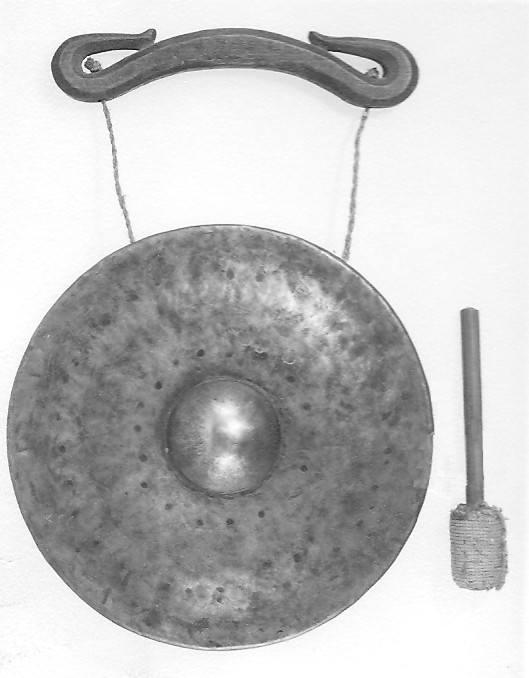
Image: The Crosby Brown Collection of Musical Instruments, 1889, CC0 — via Wikimedia Commons
Hang
Hang / handpan
| Category | Idiophone |
|---|---|
| Country of origin | Switzerland (PANArt, 2000) |
| Classification | Wikimedia disambiguation page |
| Wikipedia | en.wikipedia.org |
| Wikidata | Q235091 |
Overview
The Hang is a melodic percussion instrument — a steel-alloy convex shell, roughly the size and shape of a flying-saucer turned sideways, with a central note (the Ding) on the upper face and a ring of seven to nine tuned tone fields surrounding it. Wikidata’s entry is a disambiguation page; in the musical-instruments context the term refers specifically to the instrument designed and built by PANArt Hangbau AG in Bern, Switzerland, between 2000 and 2013.
The wider category of similar instruments built by other makers worldwide is normally called handpan, a distinct term that PANArt have repeatedly asked to be kept separate from their trademarked Hang. Together the Hang and the handpan family are the most successful new acoustic-instrument category to emerge in the 21st century.
Origin & History
Felix Rohner and Sabina Schärer founded PANArt in Bern in the late 1980s as a steel-pan tuning workshop — they were established Swiss makers of the Trinidadian steelpan (see the separate entry on steelpan). Their work on the wider physics of tuned steel sheets led, over the 1990s, to a series of experiments combining the convex shell of the Indian ghatam clay pot, the central note of the steelpan, and the harmonic relationships of the Trinidadian ping pong. The result, named Hang (the Bernese German word for hand), was first produced in 2000 and reached its definitive form by 2009.
PANArt deliberately kept production small and personal. Customers could not order a Hang; they had to write a letter explaining their interest, and the workshop selected recipients case-by-case from the resulting backlog. PANArt produced four numbered generations of Hang between 2000 and 2013, then announced that they would no longer build the instrument and would move on to a successor design (the Gubal and other related instruments).
This restricted-production-by-design approach left a vast unmet demand. Other makers — notably the U.S. company Pantheon Steel (now Saraz), the U.K. maker Ayasa Instruments, and dozens of others worldwide — began building visually similar steel-shell tuned instruments, marketed under the generic name handpan. By the mid-2010s the handpan was a global category with hundreds of working makers and an active festival circuit, none of which involved PANArt.
Construction & Materials
A Hang is built from two deep-drawn nitrided-steel half-shells, glued together at the equator. The upper shell carries the Ding (a domed central note) and seven or eight peripheral tone fields, each hand-hammered and tuned to a specific pitch within a chosen scale. The lower shell carries a single circular opening (the Gu), which acts as a Helmholtz-resonator port and gives the instrument its characteristic deep bass note when struck or rubbed.
Total diameter is typically about 53 cm and weight around 4.5 kg. The PANArt Hang scales were chosen by the makers — Akebono, Equinox, Hijaz, Ake Bono, and others — and a buyer received whichever scale was being made at the time of acceptance, not one of their choosing. Modern handpan makers offer a much wider scale catalogue, often by customer request.
How It’s Played
The player sits with the instrument resting in the lap, the Ding facing upward and the Gu facing down. Both hands strike the tone fields with the fingertips, the pads of the fingers, the thumb, or occasionally the heel of the hand. The Ding is normally struck with the thumb or a flat hand; the surrounding tone fields with the fingertips for melody and the finger pads for sustained tones. The Gu can be struck or palmed for bass effects.
Standard playing technique is restrained, lyrical, and rhythmic — the instrument’s sustained, harmonic-rich tone is its primary attraction, and most players develop a meditative, slowly-unfolding melodic style rather than a virtuosic percussion attack. Standard repertoire is almost entirely improvised; no canonical written method exists.
Cultural Significance
The Hang and the wider handpan family occupy a particular cultural niche: ambient and meditative music, yoga and wellness contexts, busking and street performance, and a small but active solo-recording presence. Daniel Waples (UK) and Manu Delago (Austria) are the two most internationally recognised solo handpan players; David Charrier (France) is a leading teacher and performer.
The instrument has also entered mainstream film and television soundtracks — Manu Delago’s collaborations with Björk on the Biophilia (2011) and Vulnicura (2015) album projects, and the use of handpan in the Avatar: The Way of Water (2022) Simon Franglen score, are both widely cited.
The Hang’s restricted-production history and the resulting rapid growth of the wider handpan industry has been the subject of business-school and design-industry case studies on the trade-offs of deliberate scarcity in artisan manufacturing.
Notable Examples & Recordings
- Manu Delago, Living Room (2009) — the first widely-distributed solo Hang recording.
- Daniel Waples, Hang in Balance — solo handpan reference recording.
- Björk, Biophilia (2011) — orchestral and electronic collaboration with handpan.
- David Charrier, online teaching catalogue — leading published pedagogy.
- Sam Maher’s London Underground busking videos — the viral introduction of the instrument to a wider general audience after 2014.
Related Instruments
- Steelpan — the Trinidadian tuned-percussion ancestor in the same family of work that produced the Hang.
- Tongue drum — a related steel-cut tongue idiophone.
- — the Indian clay-pot percussion instrument that influenced the Hang shell shape.
- Singing bowl — the Himalayan metal-bowl resonator with overlapping meditative usage.
- Berimbau — unrelated formally but overlaps in solo-improvisational performance practice.
- — overlaps in solo-meditative usage.
Where to Hear It
Live: handpan festivals on every continent — HangOut UK (England), Handpan Spirit Festival (Germany), the Masters of Handpan series (Spain). Yoga retreats, meditation centres, and street-busking venues are the everyday performance settings. Recording catalogues on labels such as ECM (Manu Delago), independent direct-to-streaming releases, and the YouTube-driven solo-handpan publishing world.
- Wikipedia: Hang (instrument)
- Wikipedia: Handpan
- Wikidata: Hang (Q235091)
- DBpedia: Hang (instrument)
- MET Object 500825 (Thai Klong meng gong, related idiophone family)
Learning Resources
A used PANArt Hang from a private seller — the only way to acquire one today — costs 5,000 to 12,000 USD depending on generation and condition. A new handpan from a reputable maker (Saraz, Ayasa, Pantheon, Symphonic Steel) costs 1,200 to 3,500 USD; entry-level handpans from less-established makers start around 600 USD. Pedagogically the instrument is well served online: David Charrier’s video courses, Daniel Waples’s masterclasses, and the active handpan-community forums fill the absence of a written tradition.
Frequently Asked Questions
Is the Hang the same as a handpan?
No. Hang is the trademarked name of the specific instrument made by PANArt in Bern between 2000 and 2013. Handpan is the generic term for the wider family of similar instruments built by other makers worldwide.
Can I still buy a new Hang?
No. PANArt stopped making the Hang in 2013 and have moved on to other related instruments (the Gubal). The only way to get a Hang is to find a used one on the private resale market.
Is the Hang related to the steelpan?
Yes — the makers of the Hang were established steelpan builders before they developed the Hang in 2000. The two instruments share the principle of tuned hand-hammered steel sheets but differ in shape, playing posture, and musical role.
What scales does the handpan come in?
Modern makers offer dozens — pentatonic, diatonic, modal, Middle-Eastern maqam-based, and others. Most instruments are built in a single fixed scale; some makers offer interchangeable systems.
Who invented the Hang?
Felix Rohner and Sabina Schärer of PANArt Hangbau AG in Bern, Switzerland, in 2000. The wider handpan industry that grew from their work was developed by many other makers worldwide from the late 2000s onward.

