
Maraca
Maraca
| Category | Percussion |
|---|---|
| Country of origin | Caribbean / South America (pre-Hispanic origin) |
| Classification | type of musical instrument |
| Wikipedia | en.wikipedia.org |
| Wikidata | Q39777 |
Listen
Audio: Tralala-12000, CC BY-SA 3.0 / via Wikimedia Commons
Audio: Wikipedia-ce, Public domain / via Wikimedia Commons
Audio: Audofilia, CC0 / via Internet Archive

Overview
The maraca is a percussion instrument played by holding and shaking. The Wikipedia summary describes it concisely; the Hornbostel-Sachs system files the maraca at 112.1 — a shaken idiophone or rattle. Wikidata adds the more specific category of vessel rattle — that is, an idiophone in which a closed container holds a quantity of small loose objects (seeds, pebbles, beans or beads) that strike the inside walls of the container when the instrument is shaken.
The maraca is one of the most internationally familiar Latin American percussion instruments. It is a fixture of Cuban son and salsa, of Venezuelan joropo, of the wider Caribbean musical landscape, and of countless Latin-influenced popular songs across the global popular-music repertoire.
Origin & History
The maraca is among the oldest documented instruments of the pre-Hispanic Americas. Vessel rattles of broadly identical construction are documented archaeologically across the wider Caribbean and northern South American region from the pre-Columbian period, with surviving ceramic and gourd specimens in major American museum collections going back several thousand years.
The instrument was widely used by the Taíno people of the Caribbean — the indigenous population of the Greater Antilles encountered by Columbus in 1492 — for ritual, healing and social purposes. Spanish colonial-era accounts of the Caribbean from the early 16th century onward describe Taíno religious practitioners (behiques) using gourd rattles in cohoba ritual ceremonies, and the maraca’s continued role in Afro-Caribbean and Afro-Brazilian religious traditions (including Cuban Santería and Puerto Rican folk-Catholicism) is at least partly a continuation of this Taíno religious heritage.
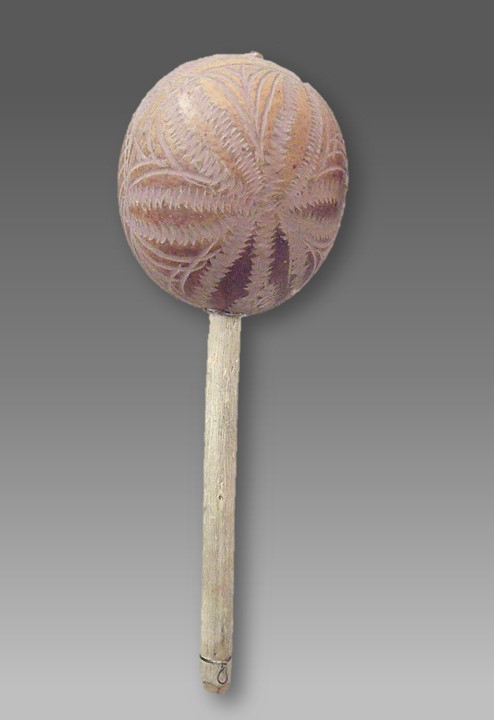
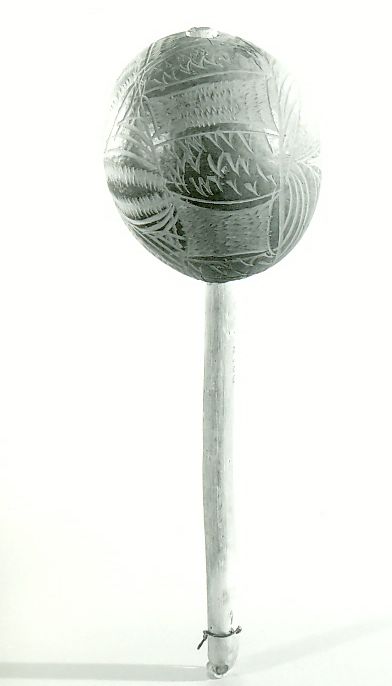
The Metropolitan Museum’s collection includes two 19th-century Native American (Puerto Rican) specimens that document the survival of the older indigenous and colonial-era rattle tradition into recent times. Object 502806 is a 19th-century maraca made of gourd, wood, and pebbles or pellets, classified as a Native American (Puerto Rico) instrument. Object 505171 is a wooden rattle from around 1865 to 1889, also classified as Native American (Puerto Rican). Together these two specimens document the indigenous-Caribbean rattle tradition just before its absorption into the modern Latin popular-music maraca.
In the 20th century the maraca became one of the canonical instruments of the Cuban son and son-derived genres including mambo, cha-cha-chá and salsa. Through these genres the instrument reached global popular audiences and acquired its modern role as a standard Latin-percussion instrument worldwide.
Construction & Materials
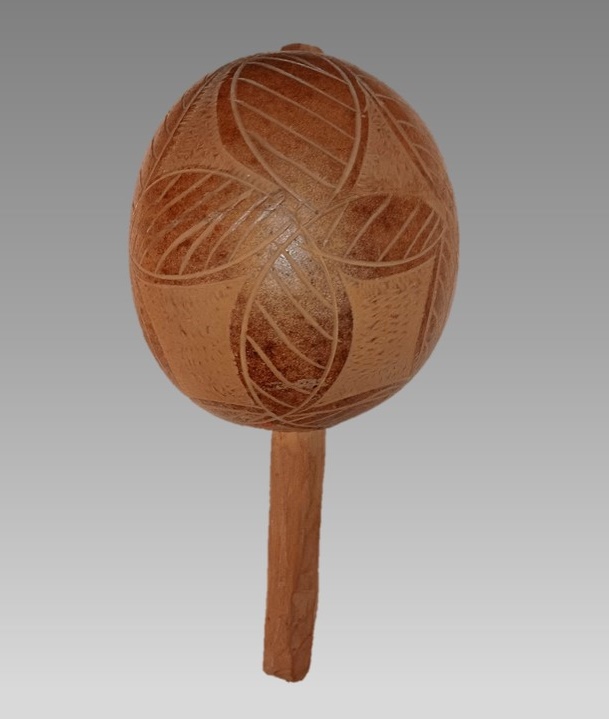
A traditional maraca is constructed from a dried gourd — typically the Crescentia cujete (calabash tree) gourd of the Caribbean and South American tropics — with a small portion of the dried pulp removed and replaced with a small quantity of dry seeds, pebbles or beans. A wooden handle is inserted into the gourd through a hole drilled in the base, and the gourd is sealed around the handle. Decoration with carved patterns, painted designs or burnt-in motifs is common in many regional traditions.
Modern professional maracas are increasingly made from moulded plastic or fibreglass for tuning consistency and durability, with the loose internal material being either dry seeds (the traditional choice for warmer tone) or small plastic beads (for more brittle sound). Concert-grade hand-made maracas by named makers (LP, Meinl, the Cuban maker Vergara) use specific gourd species and precisely measured quantities of internal material to produce instruments of consistent weight, balance and tone.
The MET’s Puerto Rican specimen (502806) is described as gourd, wood, and pebbles or pellets — the canonical traditional construction. Modern Venezuelan and Colombian maracas used in joropo music are typically larger and louder than Cuban-style maracas, and use capacho seeds (from the Canna lily plant) for a particularly bright, sharp tone.
How It’s Played
The player holds one maraca in each hand and shakes them rhythmically. The most basic technique is a simple single-stroke shake, but professional Latin-percussion playing develops this into a sophisticated rhythmic vocabulary built on the differential weight of the up-stroke and down-stroke. A skilled maraquero produces clean, consistent strokes at high speed and articulates complex syncopated patterns by combining hand-position changes with stroke-direction changes.
In Cuban son and salsa the maraca typically plays a steady eighth-note pulse that lays out the underlying rhythmic feel of the song and helps the rhythm section lock together. In Venezuelan joropo the maraca plays a more complex rhythmic pattern that interlocks with the harp and cuatro to produce the genre’s characteristic dance feel. In Cuban Santería religious music the maraca (the chekeré or atchere) carries specific ritual rhythms in invocations of certain orishas.
Cultural Significance
The maraca is one of the most widely recognised Latin American percussion instruments and is part of the international musical vocabulary in a way that few other indigenous-American-origin instruments have matched. The instrument’s continuous use from the pre-Columbian period through the colonial era to modern Latin popular music represents one of the longest documented continuities of any specific instrument in the Americas.
In Venezuela the maraca is part of the national folk-music heritage and is heard at every joropo dance event. In Cuba and Puerto Rico the instrument is essential to traditional and contemporary popular music. In Brazil the maracá survives in indigenous Amazonian Tupi-speaking traditions and in Afro-Brazilian Candomblé. Across Latin America and the wider Latin-influenced popular music world the maraca is one of the immediate audible markers of “Latin” musical identity.
Notable Examples & Recordings
- Tito Puente, Dance Mania — classic mid-20th-century New York salsa with extensive maraca.
- Celia Cruz with Sonora Matancera, classic Cuban son recordings with maraca in standard rhythm-section role.
- El Cuarteto Cimarrón, Venezuelan joropo recordings featuring the larger, sharper Venezuelan maracas.
- Mongo Santamaría, Cuban-American Latin percussion recordings.
- The MET’s two 19th-century Puerto Rican specimens (objects 502806 and 505171) document the indigenous-Caribbean rattle tradition.
Related Instruments
- Cabasa – the Brazilian beaded gourd rattle, a related but externally beaded vessel rattle.
- Chekeré – the Afro-Cuban large beaded gourd shaker used in Santería and popular music.
- – the West African beaded gourd shaker that is the African cousin of the chekeré.
- – the small Brazilian woven-basket rattle used with the berimbau.
- – the larger Brazilian Carnival shaker.
Where to Hear It
Live maraca playing is heard at every Latin music performance worldwide. In Cuba the son and salsa scenes of Havana, Santiago and Matanzas feature maracas in every band. In Venezuela the joropo dance halls of Caracas and the Llanos region are the principal venues. International salsa festivals from New York to Cali to Tokyo feature maraca players as standard rhythm-section members. Recordings appear on countless Latin-music labels including Fania, RMM, Sony Latin, Universal Latin and the Cuban EGREM.
- Wikipedia: Maraca
- Wikidata: Maraca (Q39777)
- The MET: Maraca (object 502806)
- The MET: Rattle (object 505171)
- Wikimedia Commons: Maracas
Learning Resources
Latin-percussion teaching is widespread internationally. The Berklee College of Music (Boston) and Manhattan School of Music’s Latin-jazz programmes include maraca technique. In Cuba the ENA (Escuela Nacional de Arte) and the Instituto Superior de Arte teach Latin percussion at conservatory level. In Venezuela El Sistema’s percussion programmes and the Universidad Central de Venezuela teach traditional and modern maraca technique. Method books include Alberto Borrego’s Latin Percussion Methods, Birger Sulsbrück’s Latin-American Percussion and Cuban maracas-specific instructional videos by Pancho Quinto. A serviceable pair of student maracas costs 20 to 50 USD; concert-grade hand-made instruments by named makers run from 80 to 300 USD.
Frequently Asked Questions
What is a maraca?
A vessel-rattle percussion instrument — a closed container (traditionally a gourd) holding a small quantity of loose seeds, pebbles or beads that strike the inside walls of the container when shaken.
Where do maracas come from?
From the pre-Hispanic Caribbean and northern South American region, where vessel rattles of broadly identical construction are documented archaeologically over several thousand years. The Taíno of the Caribbean used gourd rattles in religious ceremony before European contact, and the modern Latin maraca descends from this indigenous tradition.
What is inside a maraca?
A small quantity of dry, hard objects: traditionally seeds (the capacho seeds of the Canna lily are the canonical material in Venezuela) or small pebbles. Modern professional maracas may use precisely measured quantities of plastic beads or other materials for tuning consistency.
Why are maracas always played in pairs?
Because the standard Latin rhythmic patterns require alternating hand strokes between the two instruments, and the instruments are typically tuned slightly differently (one slightly higher, one slightly lower) so that the alternation produces a pulsing two-pitch rhythmic line.
What kind of music are maracas used for?
Cuban son, salsa, mambo, cha-cha-chá and other Cuban-derived genres; Venezuelan joropo; Puerto Rican folk and popular music; Afro-Caribbean and Afro-Brazilian religious music; and a vast range of Latin-influenced popular music worldwide.


