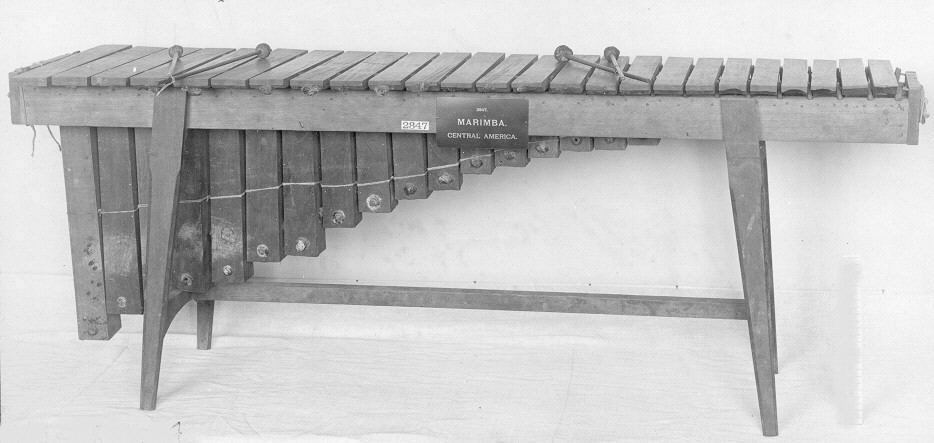

Marimba
marimba
| Category | Percussion |
|---|---|
| Country of origin | Africa / Latin America |
| Classification | type of musical instrument |
| Wikipedia | en.wikipedia.org |
| Wikidata | Q220971 |
Listen
Audio: Jeuwre, CC BY-SA 4.0 / via Wikimedia Commons
Audio: 中国新闻社, CC BY 3.0 / via Wikimedia Commons
Audio: Musica: Bulmaro Lopez Fernandez. Letra: Juan Arozamena Sánchez., Public domain / via Wikimedia Commons
Overview
The marimba is a wooden-key xylophone with tuned bars suspended over tubular metal resonators, struck with yarn-wrapped mallets. As a national instrument it is recognised by Guatemala and by several other Central American states, and one of the central concert and ensemble instruments of contemporary Western percussion.
The marimba is a clear case of musical migration. Its earliest forms travelled with enslaved West Africans across the Atlantic to the Spanish colonies of Central America, where the African balafon merged over several centuries with European musical practice to produce the modern instrument. The 20th-century concert marimba — with its chromatic five-octave range and tubular metal resonators — is then a further development of these Central American forms.
Origin & History
The marimba’s most direct ancestor is the West African balafon, the wooden-key xylophone with gourd resonators that has been central to Manding musical culture since at least the 13th century. Enslaved West Africans brought balafon-style instruments to the Spanish colonies, particularly to present-day Guatemala, southern Mexico, Honduras, and Colombia, during the 16th to 18th centuries. The instrument took root most strongly in Chiapas (Mexico), Guatemala and the Pacific coastal regions of Colombia and Ecuador.
By the 19th century the Central American marimba had developed several local features that distinguished it from its African ancestor: a chromatic two-row keyboard layout (in many regional variants), wooden box-resonators in place of gourds, and a much larger size that could require two or three players standing side by side. The Metropolitan Museum’s collection holds a 19th-century marimba (MET object 505369), described as “possibly Guatemalan” and dated to ca. 1825-89, in its Musical Instruments department.
The 20th century saw two parallel developments. In Central America the orchestral marimba — six to seven players sharing one large instrument — became the standard form for popular dance music, and the Guatemalan marimba was declared the national instrument by presidential decree in 1955. In the United States and Europe, percussionist-builders such as J.C. Deagan developed the smaller chromatic concert marimba with tubular metal resonators, and a serious classical solo and ensemble repertoire emerged from composers including Paul Creston, Keiko Abe, Toru Takemitsu and Steve Reich.
Construction & Materials
The Hornbostel-Sachs system places the marimba in 111.222 (xylophones with attached resonators). The bars are cut from rosewood (Dalbergia stevensonii in particular) or, increasingly, from synthetic materials such as fibreglass-reinforced resin. Each bar is tuned by removing material from the underside until the desired pitch is reached, then suspended over its own tubular metal resonator (in the modern concert form) or wooden box (in the traditional Central American form).
The MET’s “possibly Guatemalan” specimen (object 505369) is built entirely from wood, consistent with the 19th-century Central American tradition before the introduction of metal resonators. A modern concert marimba spans five octaves, has 61 wooden bars and 61 aluminium resonators, and weighs around 80 kg fully assembled. The Guatemalan orchestral marimba (marimba grande) can be over 4 metres long.
How It’s Played
In the concert tradition the player stands behind the instrument, holding a pair of mallets in each hand using one of several four-mallet grips (Burton, Stevens, Musser). Independent control of the four mallets allows the player to perform melody and harmony simultaneously, often in dense chordal textures that exploit the instrument’s broad chromatic range.
In the Guatemalan and Chiapas tradition multiple players stand together at one large instrument, each responsible for a specific range of notes. The lead player (tiple) plays melody at the high end; the centro and armonía players cover middle harmonies; the bajo player covers the low end. The result is a dense ensemble texture that supports popular dance forms such as son chapín.
Cultural Significance
The marimba is the national instrument of Guatemala and a national symbol of Chiapas in southern Mexico. UNESCO inscribed the marimba music of southern Pacific Colombia and Esmeraldas in Ecuador on its Representative List of the Intangible Cultural Heritage of Humanity in 2010, recognising the Afro-descendant communities that maintain the older Pacific tradition.
In the contemporary classical world, the marimba has become one of the most rapidly-developed solo instruments of the 20th and 21st centuries. The Japanese marimbist Keiko Abe is widely regarded as the most influential figure in this development, both through her own performance career and through the body of new repertoire commissioned and premiered for her.
Notable Examples & Recordings
The MET’s possibly-Guatemalan marimba (object 505369) documents the 19th-century Central American form before the introduction of metal resonators. For listening, classical recordings by Keiko Abe, Evelyn Glennie, Pius Cheung and Nanae Mimura cover the modern solo repertoire. The Marimba Chiapas group represents the Mexican orchestral tradition; Marimba Pan-American Express represents the Guatemalan dance-band tradition. Pacific Colombian marimba recordings include the work of Grupo Bahía and the late Petronio Álvarez.
Related Instruments
- Balafon – the West African ancestor of the marimba family
- – the orchestral cousin with smaller bars and a brighter tone
- Vibraphone – the metal-bar percussion instrument with motorised vibrato discs
- Mbira – the East and Southern African lamellophone (different family but related cultural function)
- – the Lobi and Dagara xylophone of Burkina Faso and Ghana
Where to Hear It
Guatemalan and Chiapan marimba ensembles play at public events year-round in their home regions, with major concerts at the Festival de la Marimba in Antigua Guatemala and at festivals throughout Chiapas. Pacific Colombian marimba is heard at the Festival Petronio Álvarez in Cali each August. Concert solo marimba performances are part of the regular programming at most major concert halls and conservatoires worldwide. The Wikimedia Commons category collects images and audio.
Learning Resources
Beginners typically start with two-mallet technique on a smaller four-octave instrument and progress to four-mallet technique over several years. Method books by Leigh Howard Stevens (Method of Movement) and Gordon Stout are widely used in Western conservatoires. Keiko Abe’s compositions are now standard advanced repertoire. For the Central American ensemble tradition, study should be pursued with a teacher in Guatemala or Chiapas; the conservatoires in Guatemala City and San Cristóbal de las Casas offer formal training.
Frequently Asked Questions
What family is the marimba in?
It is a xylophone with attached resonators, classed as 111.222 in the Hornbostel-Sachs system.
How is the marimba different from the xylophone?
The marimba carries larger, lower-tuned wooden bars and tubular metal resonators that yield a warmer and more sustained tone. The orchestral xylophone is built with smaller, higher-pitched bars and produces a brighter, more percussive sound.
Where did the marimba originate?
It descends from the West African balafon, brought across the Atlantic with enslaved West Africans during the 16th to 18th centuries. The instrument took its modern Central American form in present-day Guatemala, southern Mexico and the Pacific coastal regions of Colombia and Ecuador.
Is the marimba on the UNESCO heritage list?
Yes. UNESCO inscribed the marimba music of southern Pacific Colombia and Esmeraldas in Ecuador on its Representative List of the Intangible Cultural Heritage of Humanity in 2010.
Are old marimbas in museums?
Yes. The Metropolitan Museum of Art holds a 19th-century marimba “possibly Guatemalan” (object 505369, ca. 1825-89) in its Musical Instruments department.
Is the marimba difficult to learn?
Basic two-mallet technique can be acquired within a few months. Four-mallet technique and the modern concert repertoire take years of disciplined conservatory study. The Central American ensemble tradition requires close coordination with multiple players sharing one instrument.


