.jpg)
.jpg)
.jpg)

Angklung
angklung
| Category | Percussion |
|---|---|
| Country of origin | Indonesia (Sundanese region) |
| Classification | bamboo musical instrument, type of musical instrument |
| Wikipedia | en.wikipedia.org |
| Wikidata | Q540049 |
Listen
Audio: CC0 / via Internet Archive
Audio: CC0 / via Internet Archive
Audio: CC0 / via Internet Archive
Overview
The angklung is a tuned bamboo shake-rattle from the Sundanese region of West Java in Indonesia. Each angklung consists of two or three carefully tuned bamboo tubes mounted in a small wooden frame; when the frame is shaken, the tubes slide loosely against the frame and sound their tuned pitches. A complete angklung set covers a chromatic scale across multiple octaves, with each player typically holding one or two angklung — meaning angklung music is fundamentally an ensemble art, with twenty or more players each contributing one or two notes to the collective melody.
Wikidata describes the angklung as a bamboo-built Indonesian musical instrument, classed as a sliding rattle and a bamboo musical instrument. The MET specimen is catalogued as Idiophone-Shaken.
Origin & History
The angklung is documented in Sundanese sources from at least the 12th century and probably has older roots in the bamboo-rattle ritual instruments of the wider Austronesian world. In its traditional form the angklung was a fixed-pentatonic ritual instrument used in Seren Taun harvest ceremonies, in Gugon Tuhon spirit-summoning rites and in the Sundanese debus spiritual practice. Each village or community would have its own set of angklung tuned to the local pentatonic scale.
The instrument was transformed in 1938 by Daeng Soetigna of Bandung, who developed a fully chromatic angklung set capable of playing Western diatonic music. This redesign — which kept the basic shake-rattle structure but tuned the angklungs across the twelve-tone equal-tempered scale and across multiple octaves — opened the instrument to school music education, ensemble performance of Western and Indonesian repertoire, and broader cultural use.
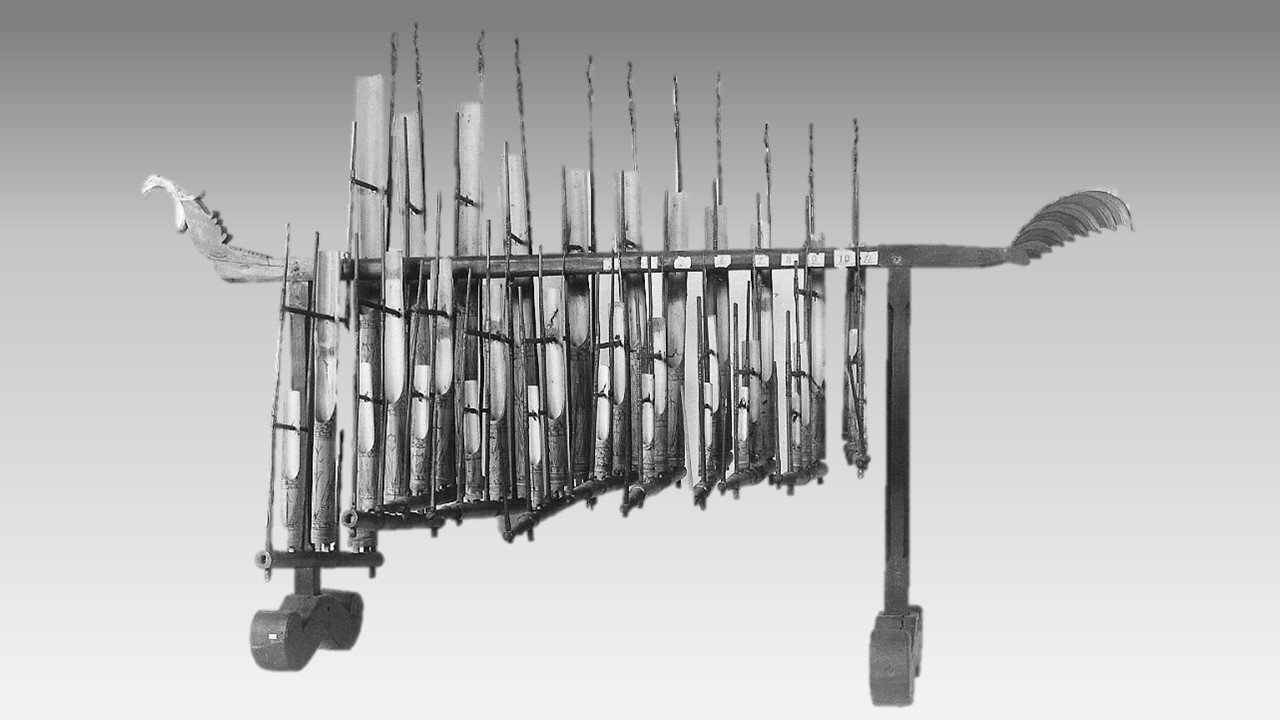
The Metropolitan Museum holds a Javanese angklung from the late 19th century (object 501371), built of wood and bamboo and donated through the Crosby Brown Collection in 1889. As a pre-1938 instrument it represents the older fixed-pentatonic form rather than Daeng Soetigna’s chromatic reform.
In 2010 UNESCO added the angklung to its representative inventory of humanity’s intangible cultural heritage, citing both the traditional ritual use and the chromatic-reform developments that have made the instrument central to Indonesian school music education and to Sundanese cultural identity. The Saung Angklung Udjo cultural centre in Bandung, founded in 1966, is the principal modern centre of angklung performance and education.
Construction & Materials
A single angklung consists of two or three bamboo tubes (a fundamental tube and one or two octave tubes) mounted in a small wooden frame approximately 25 to 40 cm tall. The bamboo tubes are normally cut from bambu hitam (black bamboo) or bambu wulung, both species particularly valued for their tonal qualities and for their resistance to splitting. Each tube is carefully shaved to tune its fundamental pitch and to set its octave relationships.
The tubes hang loosely in the frame, supported only by small wooden pins that pass through holes in the bamboo. When the frame is shaken horizontally, the tubes slide against the pins and sound. The lower bass angklung produce a soft, dry, woody pitch; the higher treble angklung produce bright, ringing notes.
A standard chromatic angklung set for school or concert use covers between two and three full octaves and contains between twenty-four and forty individual angklung — meaning angklung music for a school class of thirty children gives each child between one and two notes to play.
How It’s Played
Each player holds one or two angklung in their hands and shakes them in time with the conductor’s signals. The conductor cues each player when their angklung’s note is required in the melody — meaning the playing technique itself is simple (just shake the angklung at the right moment) but the ensemble coordination is complex. A successful angklung performance depends on every player listening for their cue and producing their note exactly on time.
This collective-melody structure makes the angklung one of the most participatory musical instruments in the world. A typical school angklung performance involves an entire class of twenty-five to thirty children producing a single chromatic melody together, with each child contributing only one or two notes.
For complex repertoire, players often play two angklung simultaneously (one in each hand) and shift between them during fast passages. Advanced ensembles such as Saung Angklung Udjo regularly perform full-length classical and pop arrangements in this way.
Cultural Significance
The angklung is the most widely recognised Indonesian instrument in international cultural representation, ahead of even the gamelan. Its participatory ensemble structure — anyone can play, no individual virtuosity required — has made it a standard cultural-diplomacy instrument used by Indonesian embassies and cultural centres worldwide. Mass-angklung performances involving thousands of participants are a regular feature of Indonesian Independence Day celebrations and have on several occasions set Guinness World Records for the largest simultaneous instrumental performance.
The 2010 UNESCO recognition reflects both the angklung’s central place in Sundanese ritual culture and its modern educational role. The instrument is now a standard part of the Indonesian primary-school music curriculum, alongside the gamelan, and is increasingly used in international school music programmes as a model for collaborative musical learning.
Notable Examples & Recordings
The MET’s late-19th-century Javanese specimen (object 501371) is documented in the Musical Instruments department.
For listening:
- Saung Angklung Udjo, The World of Angklung — the central modern angklung ensemble’s repertoire recordings.
- Daeng Soetigna, archival recordings from the 1940s and 50s — the chromatic angklung pioneer.
- Indonesian Institute of the Arts Bandung Angklung Ensemble — modern ensemble work in the Sundanese tradition.
- The Resonanz Music Studio angklung arrangements — modern arrangements of Western popular music for chromatic angklung ensemble.
Related Instruments
- – the wider Indonesian percussion ensemble tradition that the angklung complements rather than belongs to.
- Kacapi – the Sundanese box zither that occupies a parallel chamber-music role.
- Suling – the Indonesian bamboo flute often paired with angklung in modern performance.
- – tuned bamboo struck idiophones in related Indonesian and Pacific traditions.
- Bullroarer – another simple sound-producing instrument in the wider Austronesian ritual tradition.
Where to Hear It
The Saung Angklung Udjo cultural centre in Bandung gives daily public performances of full-length angklung programmes. Indonesian Independence Day celebrations every August 17 feature mass-angklung performances in cities across the country and in Indonesian diaspora communities worldwide. The annual Saung Angklung Udjo Festival in Bandung and the Sundanese cultural festivals across West Java provide further regular performance opportunities.
- Wikipedia: Angklung
- The MET: Angklung (object 501371)
- Wikimedia Commons: Angklung
- UNESCO: Indonesian Angklung (2010)
Learning Resources
The angklung is taught throughout the Indonesian primary-school music curriculum and through cultural centres in major cities. Standard tutor materials are published in Indonesian by the Saung Angklung Udjo press. Outside Indonesia, the Indonesian embassy network and the Sundanese cultural centres in Tokyo, The Hague, Sydney, Melbourne and many North American cities offer angklung classes and ensemble participation. A standard school-grade angklung set of 31 instruments covering 2.5 chromatic octaves can be bought from Saung Angklung Udjo for approximately 800 to 1,500 USD; individual angklung are available from around 25 USD.
Frequently Asked Questions
How is angklung music produced?
The bamboo tubes hang loosely in a wooden frame; when the frame is shaken, the tubes slide against small wooden pins and sound their tuned pitches. Each angklung produces a single fundamental note (with one or two octave reinforcements).
Why do you need so many people to play angklung?
Each angklung produces only one note (or one note plus its octave). A complete melody requires one angklung per pitch, so a complete chromatic ensemble covering two or three octaves needs between 24 and 40 individual angklung — and each player typically holds only one or two angklung. This makes angklung an inherently collective ensemble instrument.
Who developed the chromatic angklung?
Daeng Soetigna of Bandung developed the fully chromatic angklung set in 1938. His redesign retained the traditional shake-rattle structure but tuned the angklung across the twelve-tone equal-tempered scale across multiple octaves.
Why is the angklung listed by UNESCO?
UNESCO recognised the angklung within its 2010 inscription onto the world’s intangible cultural heritage inventory, citing both traditional Sundanese ritual use and the modern chromatic-reform development that has made the instrument central to Indonesian school music education and to Sundanese cultural identity.
Are old angklung in museums?
Yes. The Metropolitan Museum holds a late-19th-century Javanese angklung (object 501371) representing the pre-chromatic-reform pentatonic form, in its Musical Instruments department.
Where is the angklung played outside Indonesia?
Indonesian embassies and Sundanese cultural centres in many cities worldwide — Tokyo, The Hague, Sydney, Melbourne, Toronto, San Francisco, London — host regular angklung programmes and school visits as part of Indonesian cultural diplomacy.


