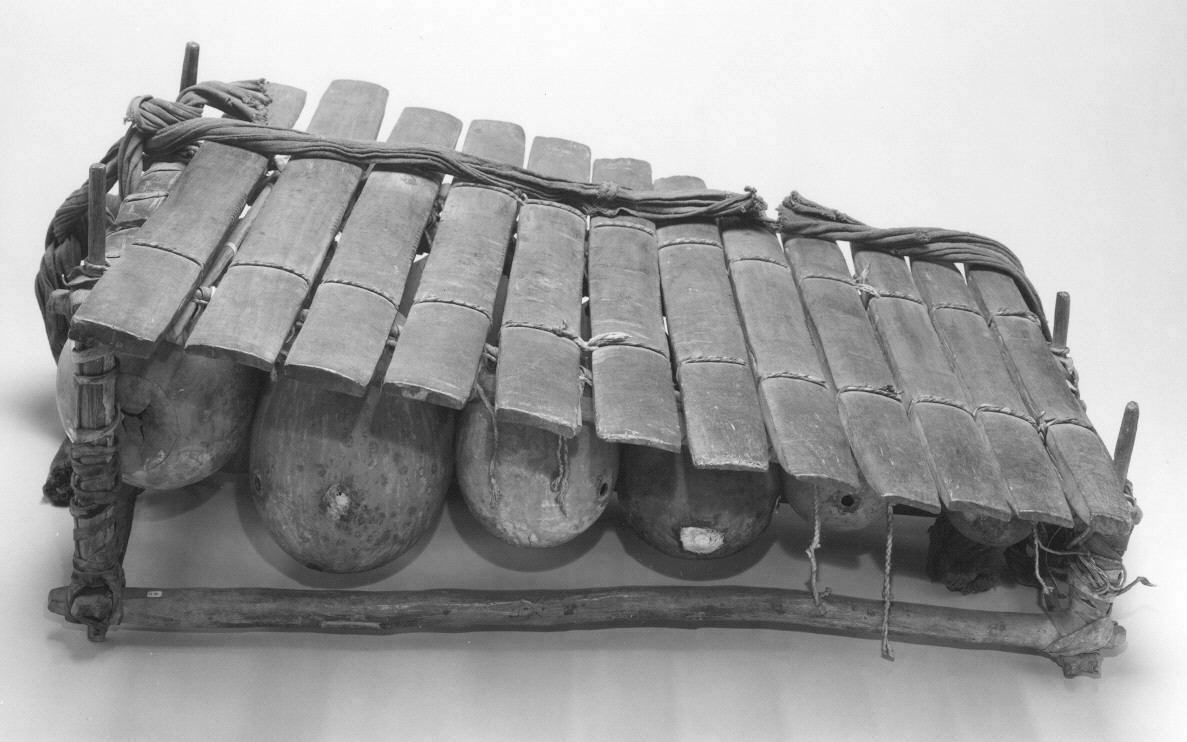

Balafon
balafon
| Category | Percussion |
|---|---|
| Country of origin | West Africa (Mali / Guinea / Burkina Faso) |
| Classification | type of musical instrument |
| Wikipedia | en.wikipedia.org |
| Wikidata | Q789141 |
Listen
Audio: CC0 / via Internet Archive
Overview
The balafon is a West African wooden-key xylophone, with a row of tuned hardwood bars suspended over individual gourd resonators and struck with rubber-tipped wooden mallets. Among continuously used musical instruments worldwide, it is one of the oldest documented anywhere, with origins tied to the 1200s founding of the medieval Mali state.
It sits at the centre of the music of the Manding peoples — Mandinka, Maninka, Bambara, and several others — across present-day Mali, Guinea, Burkina Faso, Senegal and Côte d’Ivoire. Within the Manding griot tradition, the balafon counts as one of the four sacred instruments of the jeli hereditary musician caste, alongside the kora, the ngoni and the voice.
Origin & History
Manding oral tradition dates the balafon’s origins to the 1200s, with the Sosso Bala — described as the personal instrument of Sumanguru Kanté, ruler of the Sosso Empire — said to have been captured around the year 1235 by Sundiata Keita, the founding Mali emperor. This single named instrument has been kept and played ceremonially in Niagassola, Guinea by the Dökala family for nearly eight hundred years.
UNESCO inscribed the Sosso Bala on its Representative List of the Intangible Cultural Heritage of Humanity in 2008. If the dating is correct — and there is no compelling reason to doubt it — the Sosso Bala may be the oldest individual musical instrument still in continuous ceremonial use anywhere in the world.
The Metropolitan Museum’s collection holds a late-19th-century African balafon (MET object 504447) made of wood, gourd and cloth, in the museum’s Musical Instruments department, alongside a closely related Malinke bala (MET 501109, 19th century) made of wood, gourd, hide and membrane. Together these document the instrument as it was being played at the time of European contact with the Manding heartlands.
Construction & Materials
The Hornbostel-Sachs system places the balafon in 111.212 (sets of percussion plaques). The frame is built from light wood — often bamboo or other lashed sticks — and supports a row of carefully tuned hardwood bars (typically Pterocarpus erinaceus, the African rosewood). Each bar is suspended above its own gourd resonator, with smaller gourds for the higher pitches and larger gourds for the lower.
A distinctive feature: each gourd has a small hole cut into its side, covered with a thin membrane of spider-egg silk or cigarette paper. When the bar above is struck, the resonator’s vibrating air sets the membrane buzzing, adding a characteristic raspy edge to the tone. This mirliton effect is one of the balafon’s signature acoustic features and is unique among xylophones in being designed-in rather than incidental.
The mallets (siri) are short wooden sticks with rubber heads. Players normally hold one in each hand and use them to play parallel melodic lines, often in octaves or at other fixed intervals.
How It’s Played
The balafon is played seated or standing, with the instrument supported on the player’s lap (small portable models) or on a low stand (concert models). Both hands strike the bars with the rubber-headed mallets, often alternating very rapidly to produce sustained note-runs above the buzzing resonator background.
Tunings vary by region and ensemble. The Mandinka tradition uses a heptatonic (seven-note) scale with intervals roughly corresponding to a Western diatonic scale, but with significant local variation. The Senufo and Sambla peoples to the east use slightly different tunings, and the giant Sambla bala of Burkina Faso has its own distinctive scale system.
Cultural Significance
In Manding culture the balafon is one of the four traditional instruments of the jeli (griot) caste — hereditary musicians whose role is the preservation and performance of historical narrative, praise poetry, and political commentary. The instrument is also tied closely to the great cycle of stories around Sundiata Keita and the establishment of the medieval Mali state, with specific tunes (such as Lamban) preserved for centuries in the jeli repertoire.
The Sosso Bala in Niagassola, kept and played by the Dökala family for some 28 generations, is the most concrete manifestation of this continuity. It is played publicly only on rare ceremonial occasions and is otherwise stored under traditional guardianship.
Notable Examples & Recordings
The MET’s late-19th-century balafon (object 504447) and Malinke bala (object 501109) document the instrument in its pre-modern form. For listening, recordings by Adama Dramé, Aly Keïta, the Trio Chemirani, and Mamadou Diabaté (the marimba/balafon player from Burkina Faso) cover the modern professional repertoire. The Bembeya Jazz National recordings from 1960s and 70s Guinea integrate the balafon into electric West African dance band music. The compilation Balafons Sénoufo on the Buda Musique label documents the Senufo tradition.
Related Instruments
- Marimba – the larger Latin American xylophone descended from West African models
- Kora – the Manding 21-string harp-lute, also part of the jeli tradition
- Ngoni – the Manding plucked lute, another of the four jeli instruments
- Mbira – the East and Southern African lamellophone (different family but related cultural function)
- – the closely related Lobi and Dagara xylophone of Burkina Faso and Ghana
Where to Hear It
Manding music concerts in Bamako, Conakry, Bobo-Dioulasso and other West African cities feature the balafon in nearly every ensemble. International touring by Mamadou Diabaté, Aly Keïta and others brings the instrument to European and North American world-music audiences. Festival sur le Niger in Ségou and the Festival des Musiques Métisses in Angoulême regularly feature balafon. The Wikimedia Commons category collects images and audio.
- Wikipedia: Balafon
- The MET: Balafon (object 504447)
- The MET: Bala (object 501109)
- Wikimedia Commons: Balafon
Learning Resources
Serious balafon study is most easily pursued in West Africa, where master players in Bamako, Conakry and Ouagadougou accept long-term students. Outside Africa, instruction is offered through African-music programmes at several universities and through community-based teachers in West African diaspora communities. Method materials by Mamadou Diabaté and others are increasingly available online. The instrument itself is now widely available through specialised African-music suppliers in Europe and North America.
Frequently Asked Questions
What family is the balafon in?
It is a set of percussion plaques, classed as 111.212 in the Hornbostel-Sachs system — the broad xylophone family.
How old is the balafon?
Manding oral tradition dates the Sosso Bala — a specific named instrument still in ceremonial use in Niagassola, Guinea — to the 13th century. The instrument family is at least that old and may be considerably older.
What is the buzzing sound the balafon makes?
Each gourd resonator beneath the wooden bars has a small hole covered with a thin membrane (spider-egg silk or paper). The vibration of the bar above sets this membrane buzzing, adding a characteristic raspy edge to the tone — a mirliton effect designed into the instrument.
Are old balafons in museums?
Yes. The Metropolitan Museum of Art holds a late-19th-century African balafon (object 504447) and a 19th-century Malinke bala (object 501109). The UNESCO-listed Sosso Bala is kept by the Dökala family in Niagassola, Guinea.
Where did the balafon originate?
In West Africa, with strong association to the Mali Empire that arose during the 1200s in present-day Mali and Guinea. The instrument family is older than this and has continuous regional variants across present-day Mali, Guinea, Burkina Faso, Senegal and Côte d’Ivoire.
Is the balafon difficult to learn?
Basic two-handed mallet technique can be acquired in a few months. Mastering the Manding repertoire — and the close coordination with kora, ngoni and voice in jeli ensemble — takes years of study with a teacher in the tradition.


