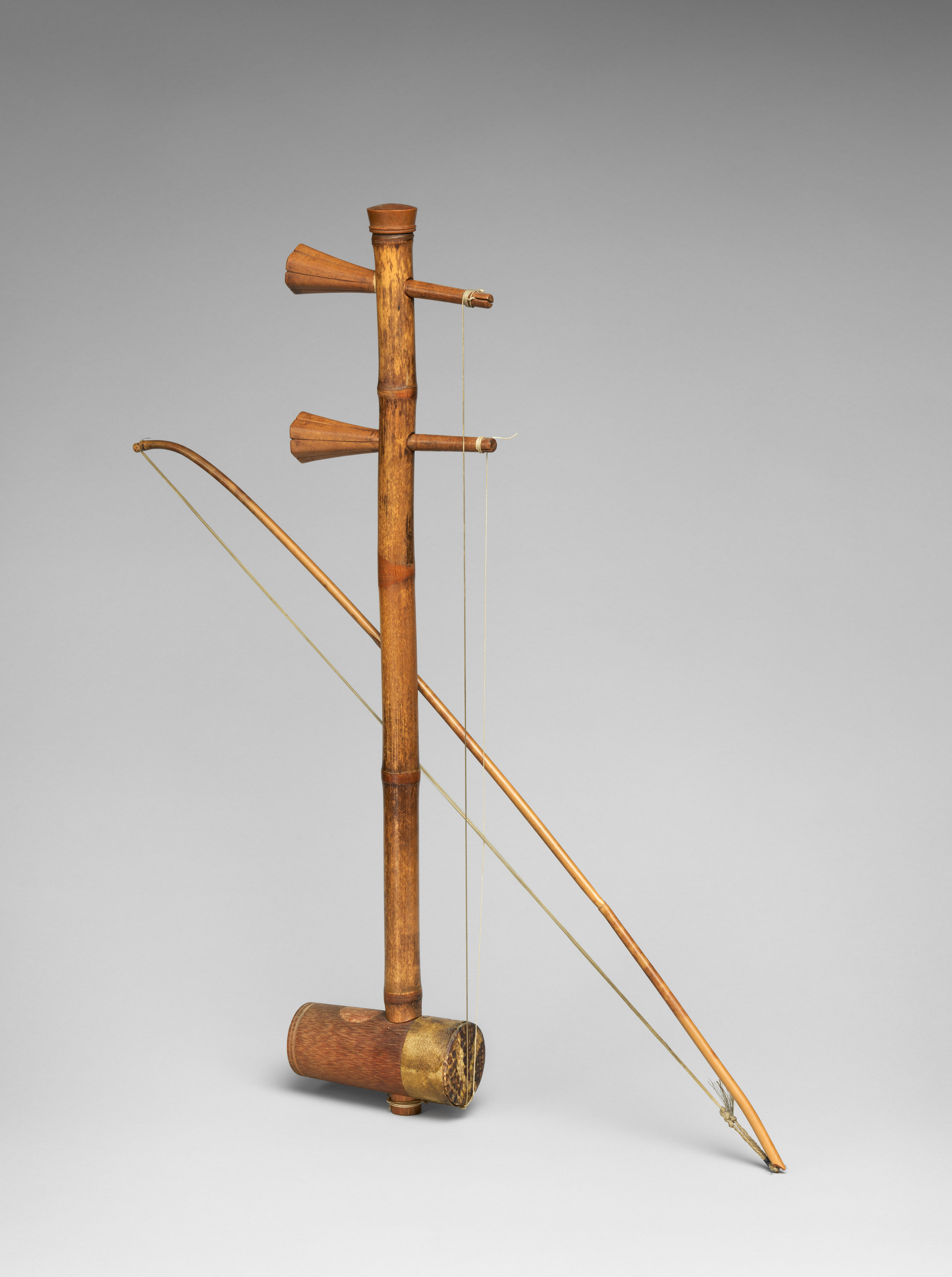
Image: Unnamed photographer, released into public domain by Metropolitan Museum of Art, CC0 — via Wikimedia Commons
Rubab
rabāb / rubāb
| Category | Strings |
|---|---|
| Country of origin | Afghanistan / Central and South Asia |
| Classification | type of musical instrument |
| Wikipedia | en.wikipedia.org |
| Wikidata | Q1640934 |
Listen
Audio: Speaker: WikiLucas00 Recorder: WikiLucas00, CC BY-SA 4.0 / via Wikimedia Commons
Audio: Ale Fernandez, CC BY-SA / via Internet Archive
Overview
The rubab, sometimes spelled rabab, is a short-necked plucked lute from Afghanistan and the surrounding region. It has a deeply waisted body carved from a single piece of mulberry wood, a skin soundboard stretched across the lower half, and a complex stringing arrangement that combines melody strings, drone strings, and a layer of sympathetic strings. Its bright, percussive tone is one of the defining sounds of Afghan music and has spread across Pakistan, Kashmir, Tajikistan, and into North Indian classical music as the ancestor of the sarod.
Origin & History
Instruments called rabab are mentioned in Persian and Arabic sources as early as the medieval period, and several distinct instruments share the name across the Islamic world. The Afghan rubab took its modern form in the seventeenth and eighteenth centuries and became closely identified with Pashtun musical culture and with the courts of Kabul and Kandahar.
In the nineteenth century, musicians at the courts of North India adapted the rubab by replacing the skin soundboard with metal and adding a fully chromatic fingerboard, eventually producing the sarod. The original rubab continued to flourish in Afghanistan as a folk and art instrument, and remains today the country’s most emblematic string instrument.
How It’s Played
The rubab is held diagonally across the body and plucked with a plectrum, traditionally cut from horn or shell. The player uses three main melody strings, several drone strings tuned to key pitches, and a row of eleven to fifteen sympathetic strings that ring beneath the fingerboard. The fingerboard carries gut frets that are tied around the neck and can be moved to suit different modal scales.
Players combine fast plectrum strokes with extensive use of slides, ornaments, and rhythmic right-hand patterns. The instrument is typically tuned in fourths and fifths, with the exact tuning varying by region and player. Its tone is bright, articulate, and slightly metallic, with a long ringing decay from the sympathetic strings.
Cultural Significance
The rubab is widely regarded as the national instrument of Afghanistan and a symbol of cultural continuity through periods of war and displacement. It is central to the klasik art-music tradition of Kabul, to Pashtun folk and ghazal singing, and to the broader cultural life of Pashtun communities across Afghanistan and northwestern Pakistan.
In Sufi tradition the rubab carries strong spiritual associations, and in Sikh devotional practice a related instrument was reportedly played by Bhai Mardana, the lifelong companion of Guru Nanak. Modern players such as Ustad Mohammad Omar, Homayoun Sakhi, and Quraishi have brought the instrument to international concert stages.
Related Instruments
- Sarod – the metal-fingerboard North Indian descendant of the rubab
- – a long-necked Central Asian lute
- – another long-necked lute of the broader region
- Setar – a Persian long-necked lute with a delicate tone
- Sarangi – an Indian bowed instrument with sympathetic strings
Where to Hear It
Recordings by Ustad Mohammad Omar, Homayoun Sakhi, Quraishi, and Daud Khan Sadozai are essential introductions. Sakhi’s collaborations with the Kronos Quartet show the instrument in cross-cultural settings, while archival recordings from Radio Kabul preserve mid-twentieth-century styles.
Learning Resources
Traditional rubab teaching follows the ustad-shagird (master-disciple) model, with students learning by ear and by close imitation over many years. A handful of conservatories and cultural centers in Kabul, Peshawar, Karachi, and the Afghan diaspora offer formal instruction. The Afghanistan National Institute of Music played a major role in modern rubab pedagogy until the political upheavals of recent years.
Frequently Asked Questions
Is the rubab the same as the sarod?
No, but they are closely related. The sarod is descended from the rubab and replaced the skin top and gut frets with a metal soundboard and fretless steel fingerboard.
How many strings does a rubab have?
Typically three melody strings, two or three drones, and eleven to fifteen sympathetic strings — about sixteen to twenty-one in total.
What is the rubab’s role in Afghan music?
It is the principal melody-leading instrument in both Afghan classical (klasik) and many folk traditions, and it is widely seen as the national instrument.
Is the rubab difficult to learn?
It is considered a demanding instrument because of its plectrum technique, modal scale work, and complex tuning, but committed students can play simple pieces within a few months.