
Koto
箏
| Category | Strings |
|---|---|
| Country of origin | Japan |
| Classification | type of musical instrument |
| Wikipedia | en.wikipedia.org |
| Wikidata | Q289037 |
Listen
Audio: Torsodog, CC BY 3.0 / via Wikimedia Commons
Audio: Alecmconroy, CC BY-SA 3.0 / via Wikimedia Commons
Audio: White Label, PD / via Internet Archive

Overview
The koto is a long zither, traditionally with thirteen strings, that has been the leading plucked instrument of Japanese chamber music for more than a thousand years. Built from a long curved board of paulownia wood, it is laid horizontally on the floor or on a low stand and played with three picks worn on the right hand. Each string passes over a small movable bridge, allowing the instrument to be tuned to any of dozens of traditional scales by sliding the bridges into position.
The koto sits at the heart of the sankyoku trio (with shamisen and shakuhachi or kokyū), as a solo instrument with its own large repertoire, and as a flexible vehicle for new compositions written across the 20th and 21st centuries.
Origin & History
The koto came to Japan from China during the Nara period (8th century) as part of the gagaku court music repertoire imported from the Tang dynasty. Its Chinese ancestor is the zheng (today usually called the guzheng), and the imported instrument originally carried twelve strings. Within a few centuries the standard configuration had settled at thirteen strings, and the instrument had largely separated from the formal court repertoire and entered the chamber and solo music traditions.
Two later figures shaped the modern koto. In the 17th century, Yatsuhashi Kengyō codified what became the zokusō tradition — the popular chamber-style koto music that remains the foundation of much of today’s repertoire. In the early 20th century, Miyagi Michio composed extensively for the koto and developed the larger 17-string bass jūshichigen, dramatically expanding the instrument’s range and its place in modern composition.
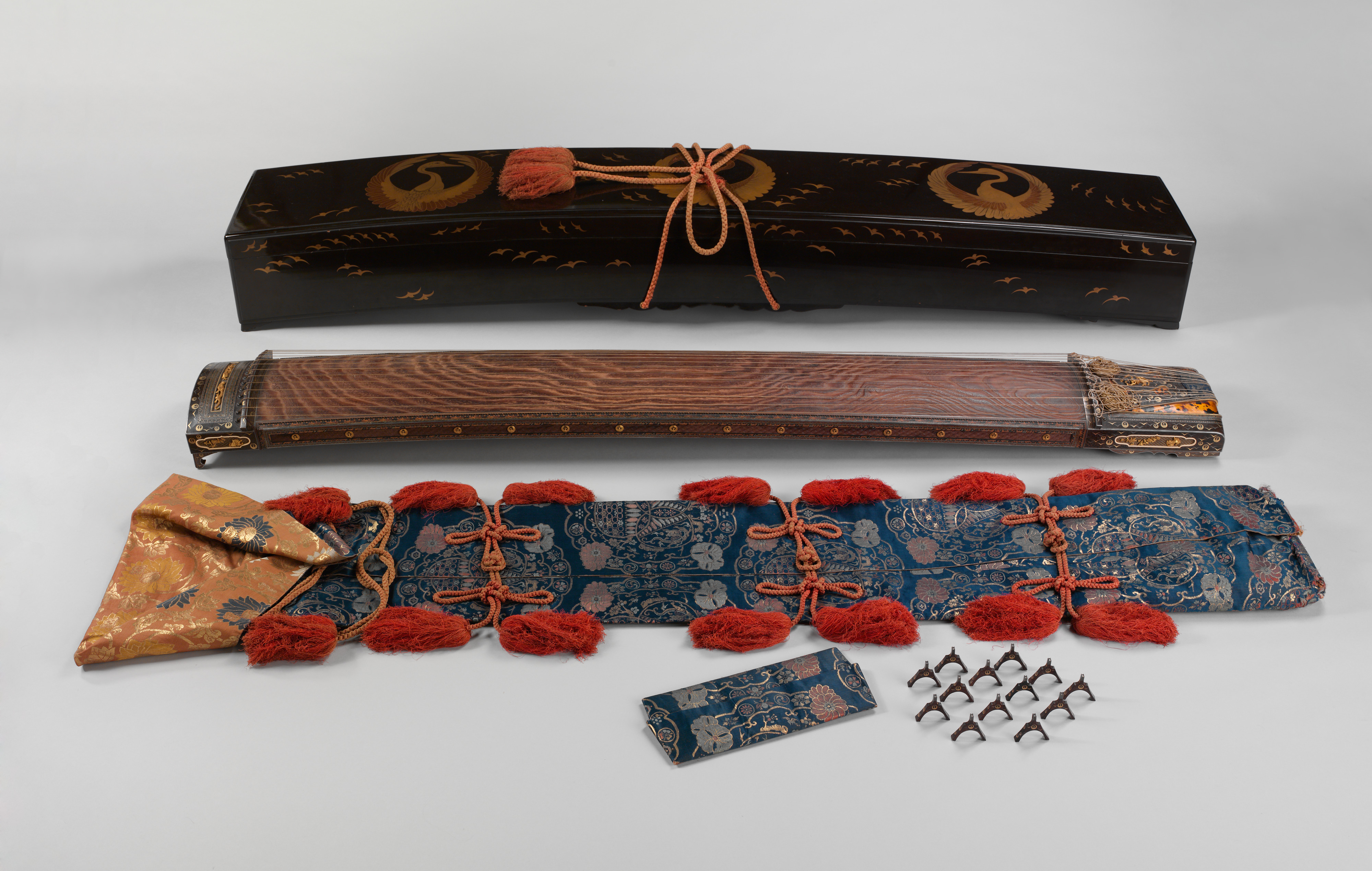
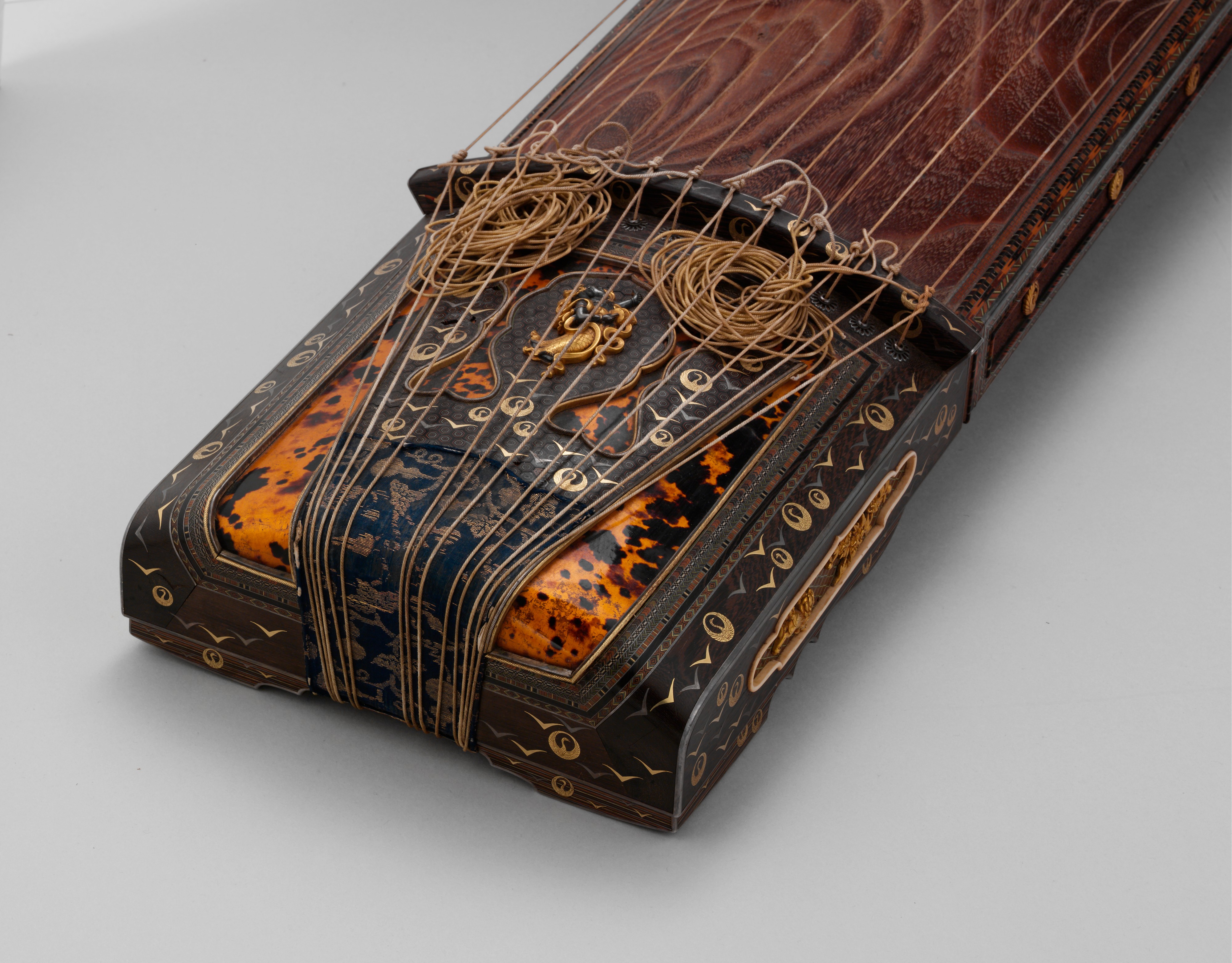
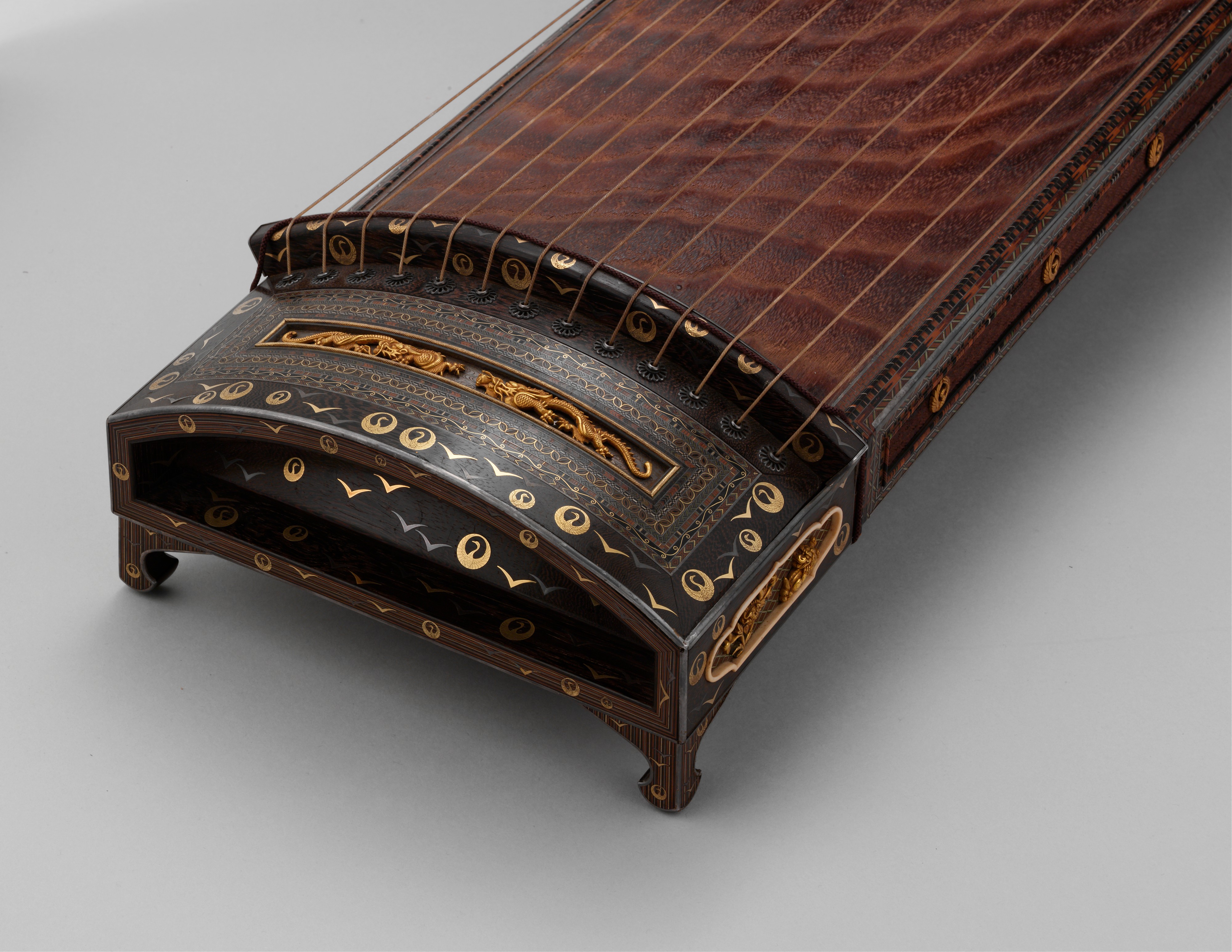
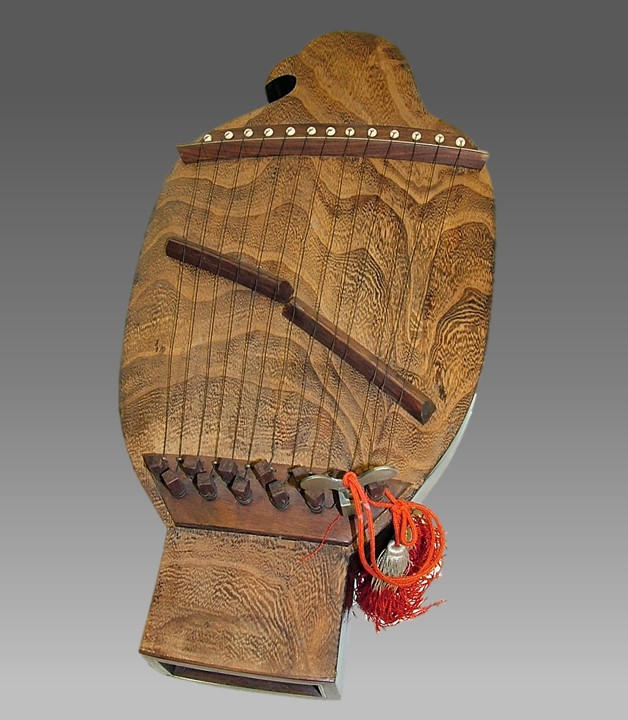
The Metropolitan Museum of Art holds an early-17th-century Japanese koto (object 505626) made of various woods with ivory, tortoiseshell, gold, and silver inlays, and a late-19th-century “hawk-shaped” koto (object 502124) of paulownia wood with metal strings. The two together show how the instrument has long served both serious music and high-status visual display.
Construction & Materials
A standard koto is about 180 centimetres long and built from a single hollowed plank of paulownia (kiri), prized for its lightness and resonance. The body is gently arched, with sound holes in the underside. Thirteen strings — traditionally silk, today usually tetron or another synthetic — run the full length of the instrument from a fixed bridge at one end to tuning pegs at the other. Between them, a row of small free-standing wooden bridges (ji) supports each string at an adjustable point.
It is this row of movable bridges, shared with the Chinese guzheng and the Korean gayageum, that defines the long-zither family. Tuning is set by sliding individual bridges along the soundboard. The MET’s early-17th-century koto demonstrates the long-standing tradition of decorating high-end instruments with ivory, tortoiseshell, and precious-metal inlay along the edges.
How It’s Played
The player kneels behind the koto, which lies horizontally on a low stand. The right hand wears three small picks (tsume) — one each on the thumb, index, and middle fingers — typically made of ivory in older instruments and now usually plastic. These pluck the strings on the side closer to the player.
The left hand works on the far side of the bridges, pressing the strings down to raise their pitch (oshide), producing vibrato (yuri), and generating slides (hikiiro) that give the koto its expressive character. Tunings are set by sliding the movable bridges into position before playing; the most common traditional tuning is hira-jōshi, a pentatonic mode characterised by a flat second and a perfect fourth.
Cultural Significance
The koto has been the central instrument of Japanese chamber music for many centuries. Together with the shamisen and the shakuhachi or kokyū, it forms the sankyoku trio that defines a large portion of the traditional Japanese instrumental repertoire. It is also a major solo instrument in its own right, with both centuries-old pieces such as Rokudan no Shirabe and a substantial 20th-century repertoire associated with Miyagi Michio, Sawai Tadao, Sawai Kazue, and others.
Internationally, the koto became more widely known through Sawai Tadao’s mid-20th-century concert tours and through composers such as Sawai Kazue and Yagi Michiyo, who have brought the instrument into contemporary chamber and improvised-music settings worldwide.
Notable Examples & Recordings
The Metropolitan Museum of Art’s two surviving historical kotos (objects 505626 and 502124) usefully bracket the period from early Edo to late Meiji. For listening, recordings of Rokudan no Shirabe and the broader Yatsuhashi school repertoire are essential starting points; modern composer-performers such as Sawai Tadao, Sawai Kazue, and Yagi Michiyo offer a clear sense of the instrument’s contemporary range.
Related Instruments
- Guzheng – the Chinese long zither, direct ancestor of the koto
- Gayageum – the Korean long zither cousin, traditionally with twelve strings
- Đàn tranh – the Vietnamese long zither in the same family
- Shamisen – the three-string lute typically paired with koto in sankyoku chamber music
- Shakuhachi – the end-blown bamboo flute frequently completing the sankyoku trio
Where to Hear It
Sankyoku chamber concerts and dedicated koto recitals are the natural settings for the instrument. The koto also appears regularly in Japanese film and game scoring and in contemporary chamber and improvised music with Western ensembles.
- Wikipedia: Koto
- The MET: Koto, early 17th century (object 505626)
- The MET: Hawk-shaped Koto, late 19th century (object 502124)
- Wikimedia Commons: Koto
Learning Resources
Beginners typically start by learning to attach the tsume finger picks securely and to produce a clean tone on the open strings before moving on to the basic tunings and short pieces such as Sakura Sakura. Most schools (ryūha) maintain their own notation and graded curricula; structured online lessons are increasingly available for both traditional and contemporary repertoire.
Frequently Asked Questions
How many strings does a koto have?
The standard koto has thirteen strings. The larger bass jūshichigen, developed by Miyagi Michio in the early 20th century, has seventeen strings; some modern composers also use 20- or 25-string variants.
How is the koto tuned?
Tuning is set by sliding the movable wooden bridges (ji) along the soundboard before playing. The most common traditional tuning is hira-jōshi, a pentatonic mode that gives the koto much of its characteristic sound.
How is the koto different from the guzheng?
The koto descends historically from the Chinese guzheng but has settled at thirteen strings (versus the modern guzheng’s twenty-one), uses different traditional tunings, and is played with three larger finger picks rather than the four smaller picks used on the guzheng.
Are old kotos displayed in museums?
Yes. The Metropolitan Museum of Art in New York holds at least two historical Japanese kotos (objects 505626 and 502124), spanning the early Edo to late Meiji periods.
Is the koto difficult to learn?
Producing a basic tone and learning a few short traditional pieces is reasonably approachable. The full range of tunings, ornaments, and the sankyoku chamber repertoire typically takes many years of structured study.


