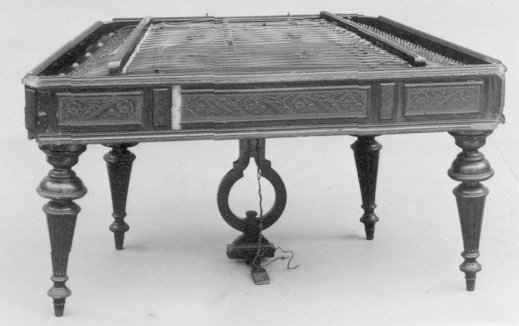

Cimbalom
cimbalom
| Category | Strings |
|---|---|
| Country of origin | Hungary (modernised after 1874) |
| Classification | type of musical instrument |
| Wikipedia | en.wikipedia.org |
| Wikidata | Q8374 |
Listen
Audio: Jeuwre, CC BY-SA 4.0 / via Wikimedia Commons
Audio: Jeuwre, CC BY-SA 4.0 / via Wikimedia Commons
Audio: [email protected]..., CC BY-SA / via Internet Archive
Overview
The cimbalom is the Hungarian member of the hammered-dulcimer family — a large, trapezoidal box zither played with two small mallets that strike four-to-five-string courses stretched across the instrument. Unlike most other hammered dulcimers, the modern concert cimbalom has legs, a damper pedal, and a chromatic four-octave compass, putting it on the same practical footing as a piano for art-music composition.
Wikidata describes the cimbalom plainly as a “hammered dulcimer” and identifies Hungary as the country of origin. The classification at the Metropolitan Museum is precise: Chordophone-Zither-struck-dulcimer.
Origin & History
The hammered dulcimer reached central Europe from Persia and the Middle East through Roma migrations and Ottoman trade routes, and it was well established in Hungary by the 16th century under various local names. The instrument was for centuries a folk and tavern instrument, played by Roma musicians in the banda cigánya ensembles that accompanied dancing across the Hungarian and Romanian countryside.
The instrument was transformed in 1874 by the Budapest maker József Schunda, who designed what is now called the concert cimbalom. Schunda’s redesign added legs, expanded the range to four chromatic octaves, introduced a damper pedal modelled on the piano sostenuto pedal, and standardised the string layout. The MET’s cimbalom (object 504386), made in Hungary after 1874 and donated by Agnes Kun in 1943, is exactly an instrument of this Schunda type — the design that defines the modern instrument and that allowed it to enter European concert music.
Franz Liszt incorporated the cimbalom into his Hungarian Rhapsody No. 6 in its orchestrated form, Igor Stravinsky used it in Renard (1916) and Ragtime for 11 Instruments (1918), Zoltán Kodály wrote a major part for it in his Háry János Suite (1926), and Pierre Boulez later integrated it into modern serial textures in works such as Eclat (1965). György Ligeti, Peter Eötvös and Harrison Birtwistle have all written substantial cimbalom parts in the late 20th and early 21st century.
In parallel with this concert development, the folk and Roma tradition of cimbalom playing has continued unbroken across Hungary, Romania, Slovakia and the southern Balkan and Czech lands.
Construction & Materials
A modern concert cimbalom weighs around 100 kilograms and measures roughly 145 by 95 centimetres. The trapezoidal soundbox, normally of spruce and birch, supports between 125 and 145 strings arranged in three to five-string courses tuned chromatically across four octaves (E2 to E6 on a standard instrument). Two long bridges divide each course into segments, and the player strikes either side of the bridges to produce different pitches from the same course.
The most distinctive modern feature is the damper pedal: a single foot pedal under the instrument that lifts felt dampers off all the strings simultaneously, enabling sustain in the manner of a piano. The MET specimen, as a post-1874 Schunda-type instrument, includes this mechanism.
The two beaters, around 25 cm long, are normally of cane with leather, felt or cotton tips. Different tip materials give different attacks: harder tips for clear melodic lines, softer for atmospheric textures.
How It’s Played
The player sits at the cimbalom and strikes the strings with the two beaters held one in each hand. The technique combines very rapid alternating-hand patterns (which give the cimbalom its characteristic shimmering tremolo) with single melodic notes, chord strokes, glissandi across the strings and damper-pedal sustain. Pedalling is part of the playing technique in the same way as on a piano.
The Roma folk tradition emphasises improvisation, ornamentation, and lightning-fast accompaniment patterns under solo violin lines; the concert tradition emphasises clear voicing, rhythmic precision and chromatic facility. Many players move between both worlds.
Cultural Significance
The cimbalom is the central iconic instrument of Hungarian Roma music. The image of the cimbalom player at the centre of a banda — surrounded by the prímás violin, the kontra viola, the bassist and a clarinet — is the standard visual representation of Hungarian café and wedding music from the 19th century to the present day. Its repertoire underpins much of what Brahms heard and reworked in his Hungarian Dances and what Liszt drew on for the Hungarian Rhapsodies.
In concert music the cimbalom carries a particular dramatic association — the instrument’s shimmering, decay-rich sound has been used by Stravinsky, Kodály, Boulez and many film composers to evoke central and eastern European folk character without literal quotation.
Notable Examples & Recordings
The MET’s Hungarian Schunda-type cimbalom (object 504386) is documented in the Musical Instruments department. The Hungarian National Museum and the Liszt Academy in Budapest hold further important historical and modern instruments.
For listening:
- Aladár Rácz, Magyar Cigányzene — the great early-20th-century cimbalom virtuoso whose recordings define the modern concert tradition.
- Kálmán Balogh, Roma Vándor — leading contemporary Hungarian player in both folk and contemporary music.
- Cimbalom Brothers, Cimbalom World — central European Roma ensemble work.
- Pierre Boulez, Éclat / Multiples — example of modern concert use.
Related Instruments
- Hammered Dulcimer – the wider global family, of which the cimbalom is the central European concert form.
- Santur – the Persian ancestor of the family that travelled north into central Europe.
- Yangqin – the Chinese member of the family, brought independently from the same Persian source.
- – the Italian and Spanish hammered dulcimer.
- – the Ukrainian member of the family.
Where to Hear It
The Liszt Academy in Budapest holds regular cimbalom recitals as part of its world-class folk-music programme. The Budapest Spring Festival, the Müpa Budapest concert hall, and the Roma music venues in Budapest’s seventh district feature the instrument throughout the year. In Romania, the Sibiu festivals and the taraf ensembles of southern Transylvania carry on the folk tradition. The Cimbalom World Association coordinates a biennial international congress.
Learning Resources
Beginning study on the cimbalom is normally undertaken with a folk- or concert-tradition teacher rather than from a method book; the size and weight of the instrument also mean that most beginners use a smaller school cimbalom or a smaller folk dulcimer for the first years. The Liszt Academy in Budapest offers cimbalom as a principal study to the doctoral level and is the central conservatory training centre worldwide. Method books in Hungarian by Ferenc Gerencsér and English-language publications by Viktória Herencsár cover the technique. New concert instruments by Hungarian makers such as the Bohák and Lestyán workshops run from roughly 5,000 to 12,000 EUR.
Frequently Asked Questions
What is the difference between a cimbalom and a hammered dulcimer?
The cimbalom is the Hungarian member of the global hammered-dulcimer family. The modern concert cimbalom (after 1874) is larger, on legs, fully chromatic across four octaves, and equipped with a damper pedal — features that no other hammered dulcimer in the family combines.
Who invented the modern concert cimbalom?
József Schunda, a Budapest instrument maker, redesigned the instrument in 1874, adding legs, expanding the range to four chromatic octaves and introducing the damper pedal. The MET’s cimbalom (object 504386) is from this redesigned generation.
Did major composers write for the cimbalom?
Yes. Liszt, Stravinsky, Kodály, Bartók, Boulez, Ligeti, Eötvös and Birtwistle have all written significant cimbalom parts.
Is the cimbalom related to the piano?
Both are zither-family instruments — strings stretched over a soundbox — but the piano uses keyboard-driven hammers while the cimbalom is struck directly with hand-held beaters. The cimbalom is much closer in family terms to the Persian santur and the Chinese yangqin.
Are old cimbaloms in museums?
Yes. The Metropolitan Museum holds a Hungarian Schunda-type cimbalom from after 1874 (object 504386) in its Musical Instruments department.
Where is the cimbalom most played today?
Hungary remains the centre, with strong continuing folk and concert traditions. Romania, Slovakia, the Czech Republic, Ukraine and the Balkan countries also have long-standing cimbalom traditions, and the instrument has spread to professional players in dozens of other countries through the late-20th-century concert repertoire.


