
Guitar
Guitar / guitarra / chitarra
| Category | Strings |
|---|---|
| Country of origin | Iberia / Mediterranean (developed from earlier lutes, 13th century onward) |
| Classification | type of musical instrument |
| Wikipedia | en.wikipedia.org |
| Wikidata | Q6607 |
Listen
Audio: Composer Unknown. Courtesy of Alias Guitar, CC0 / via Wikimedia Commons
Audio: Jeuwre, CC BY-SA 4.0 / via Wikimedia Commons
Audio: Jeuwre, CC BY-SA 4.0 / via Wikimedia Commons
Overview
The guitar is a fretted plucked-string instrument with a flat-backed wooden body, a long fretted neck, and (in standard modern form) six strings. Wikidata classifies it as a fretted string instrument and a necked, flat-backed, plucked lute. DBpedia gives the Hornbostel-Sachs reading 321.322 — a composite chordophone — and dates initial development to the 13th century.
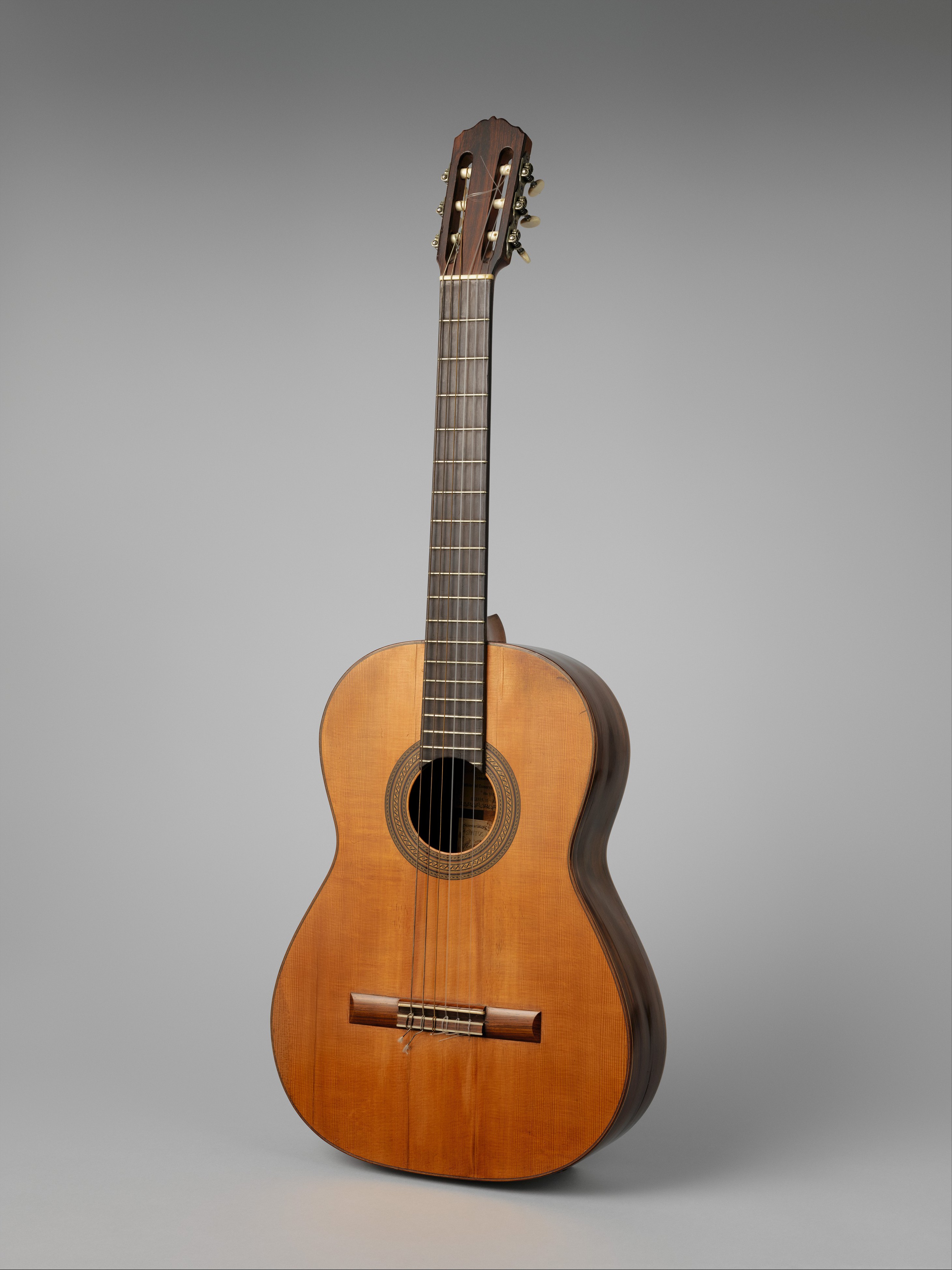
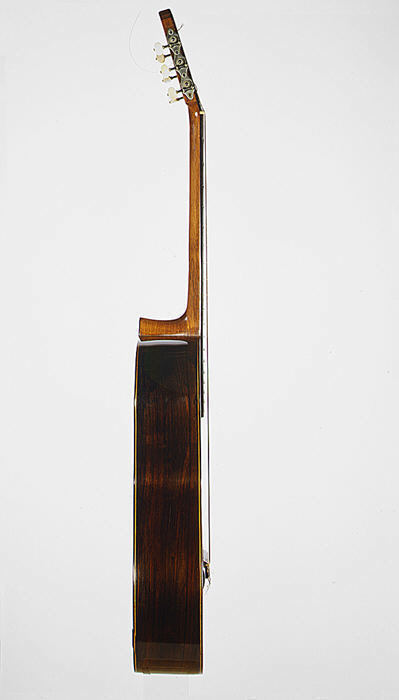
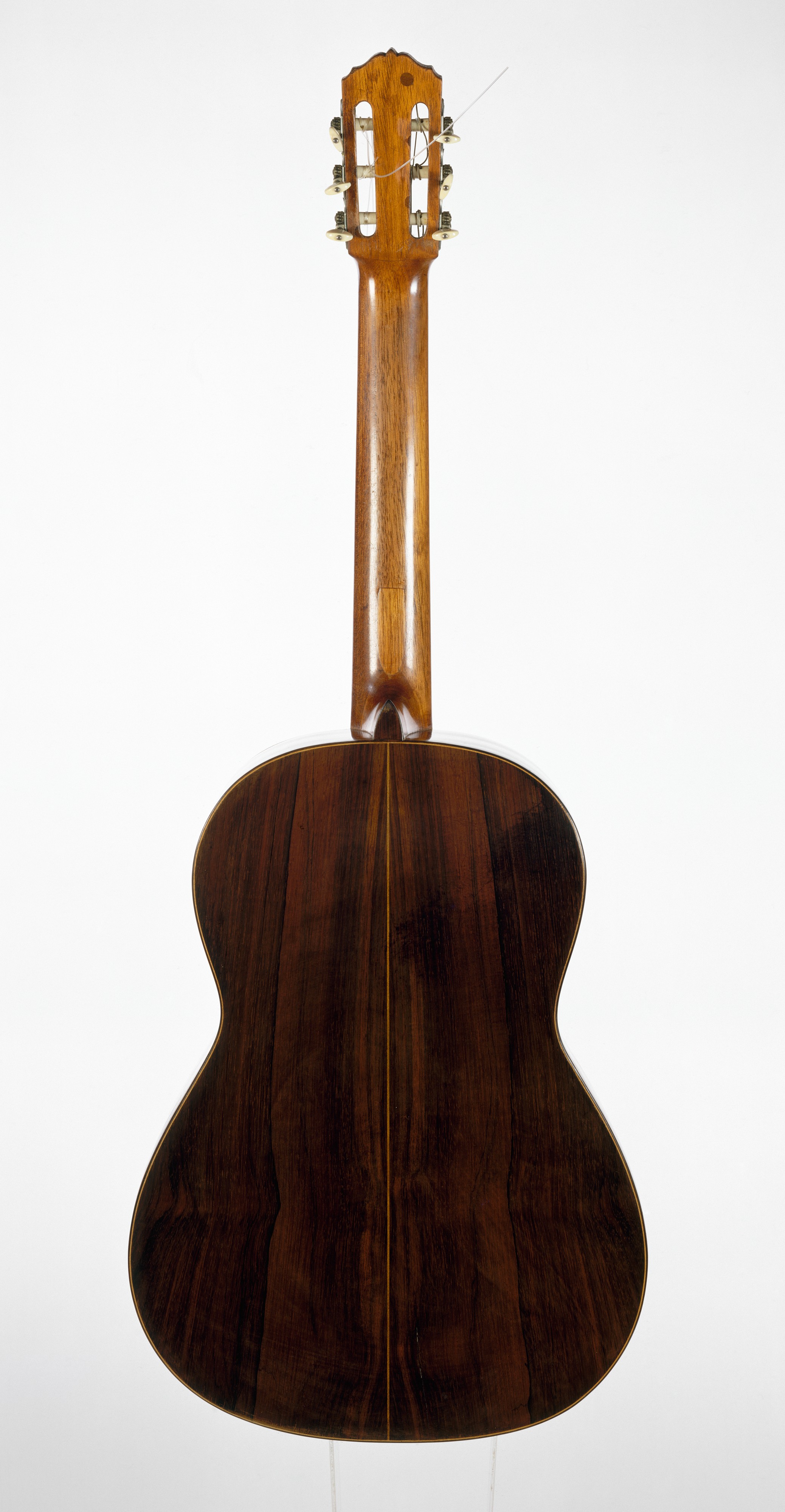
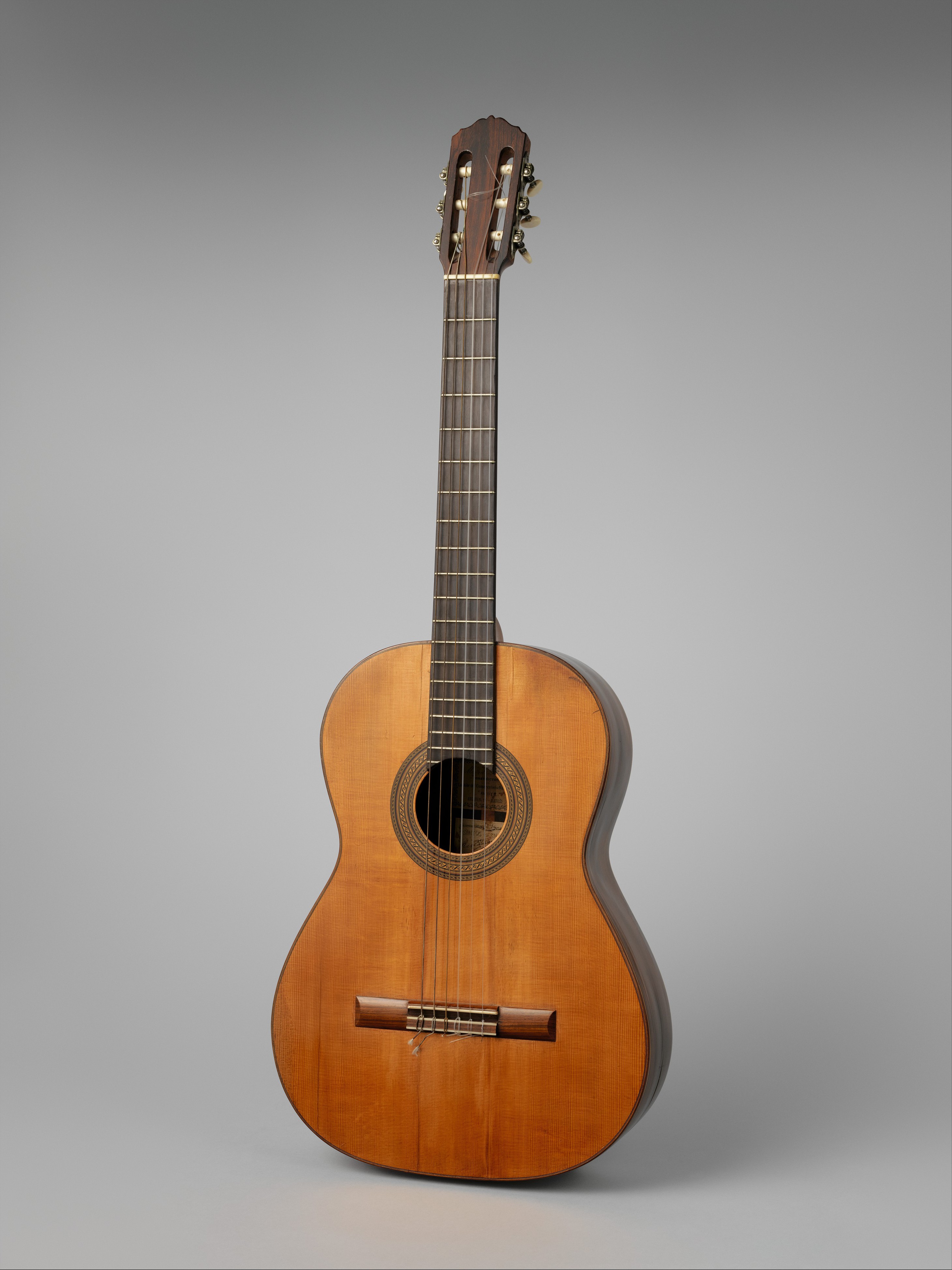
Wikidata enumerates the instrument’s main parts: sound hole, truss rod, fret, fretboard, bridge, neck, headstock, nut, sound board, guitar string, inlay, machine head, and body. Across these thirteen components there is room for almost unlimited variation — and the result is the most diverse single-instrument family on the planet, ranging from 90-cm flamenco guitars to extended seven- and eight-string jazz instruments to solid-body electric guitars in every imaginable shape.
Origin & History
The guitar’s ancestry runs through several earlier plucked-lute families: the Roman cithara, the medieval guitarra latina, the Arab oud introduced into Iberia after the 8th-century Moorish settlement, the Renaissance vihuela, and the four-course Renaissance and five-course Baroque guitars. By the 15th century the guitarra is documented as a distinct instrument in Spanish sources; by the late 17th century the five-course Baroque guitar is widespread across Europe.
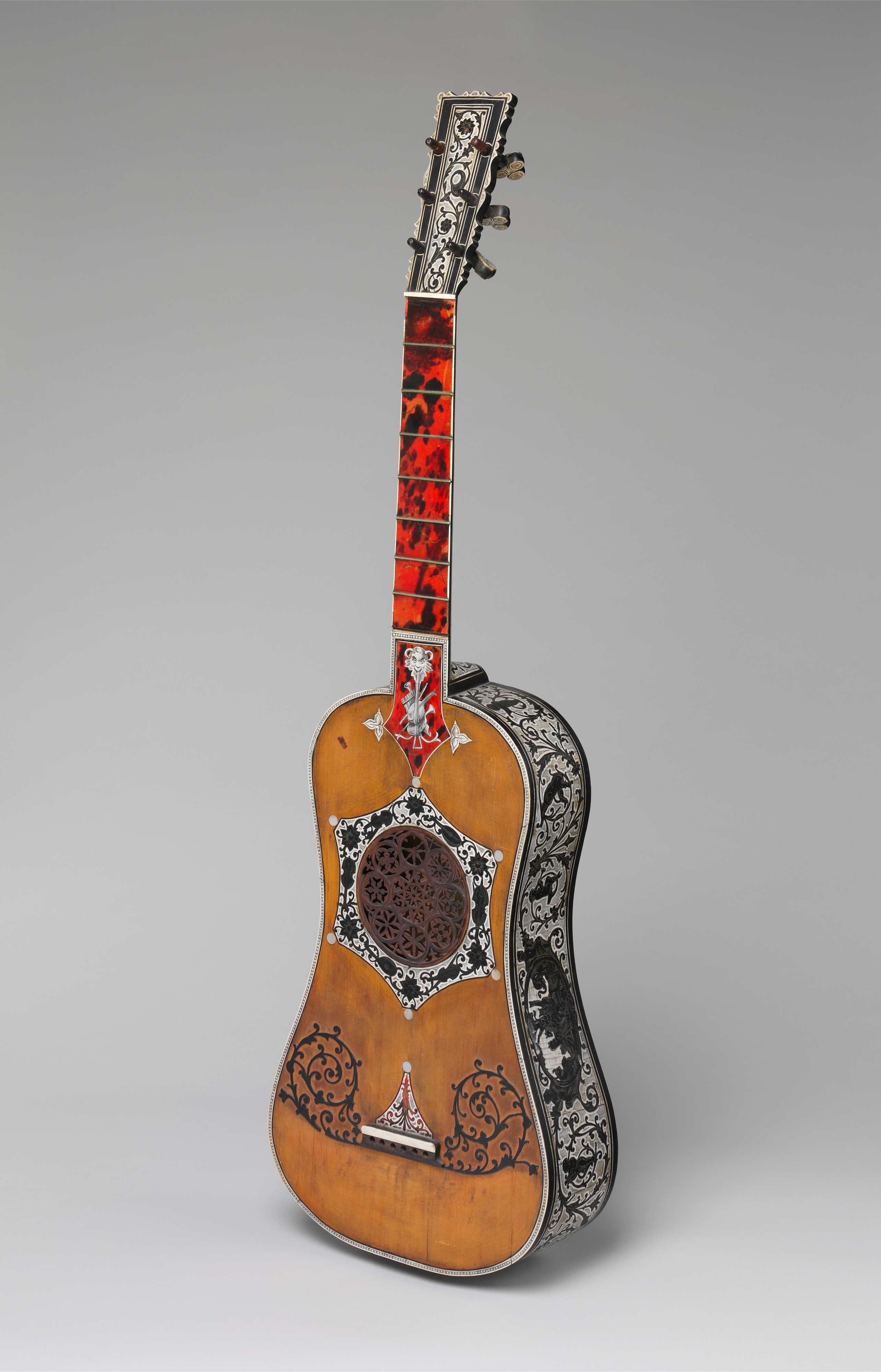
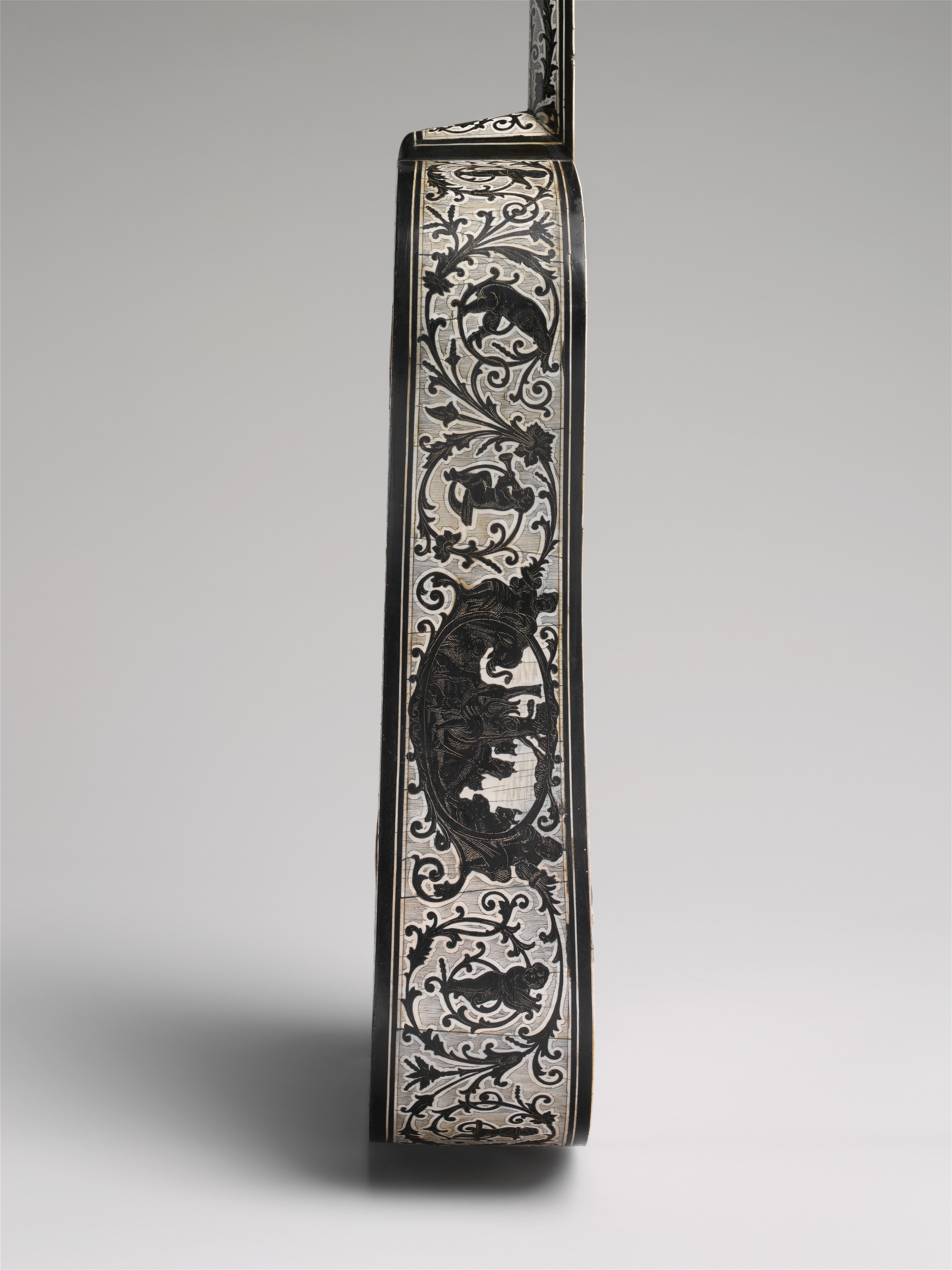
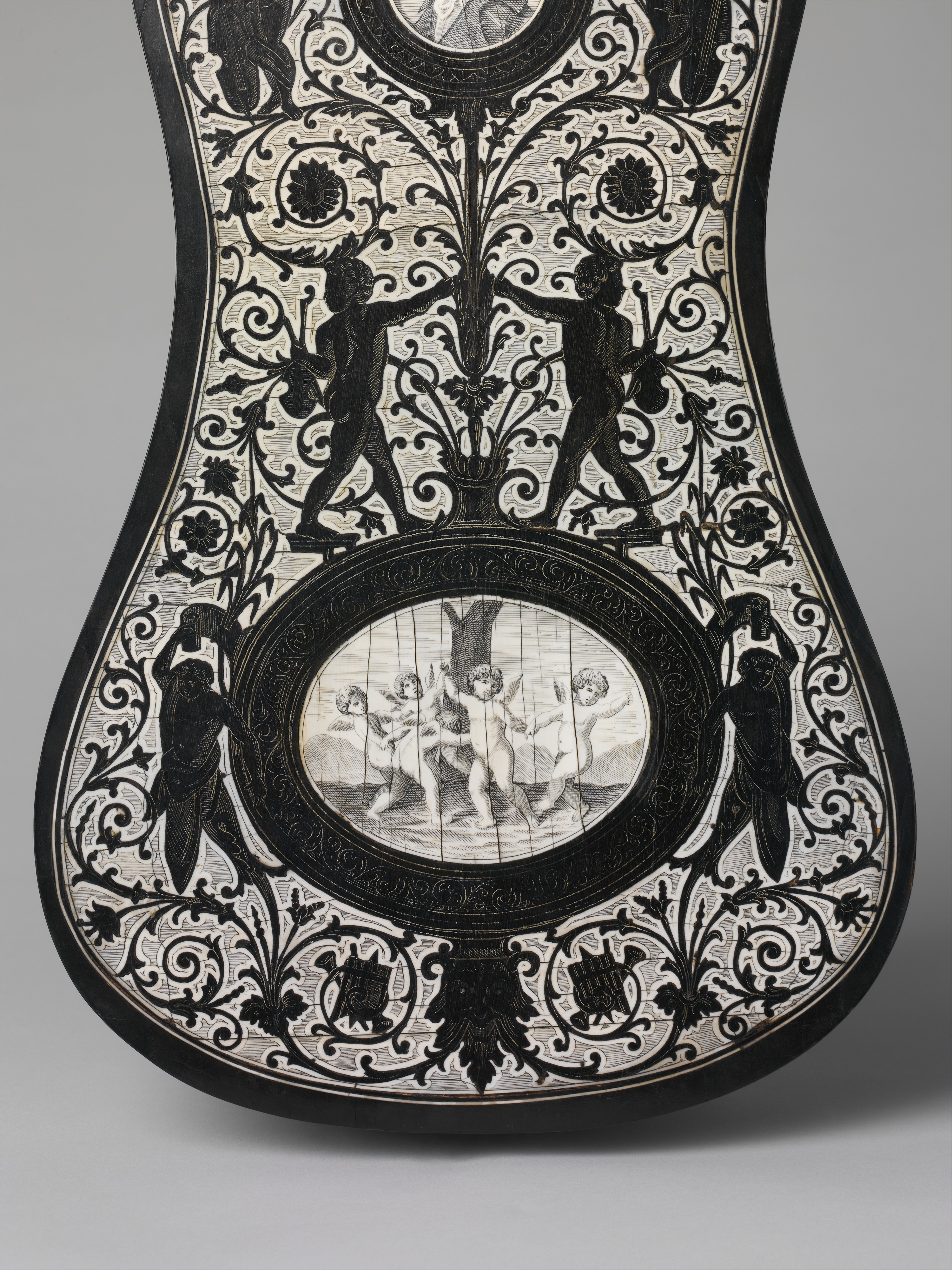
The MET collection documents the European making tradition with unusual continuity. Object 503385 is an Italian guitar of about 1630-50, made of spruce, bone, parchment, snakewood, and ivory. Object 503930 is a French guitar of 1697 by Voboam, a Paris court-instrument maker. Object 503932 is an Italian guitar of about 1800, made of spruce, ebony, ivory, tortoiseshell, mother-of-pearl, and brass. Object 503283 is a Spanish guitar of 1912, spruce, rosewood, cedar, ebony, ivory or bone — a late example of the post-Torres design. Together they show a 280-year continuous European craft tradition.
The decisive change to the modern instrument shape was made in southern Spain in the mid-19th century by Antonio de Torres Jurado, who fixed the body proportions, the internal fan-bracing pattern, and the string-length scale that almost every classical and modern acoustic guitar still follows. Torres’s instruments of the 1850s and 1860s are the immediate template for the modern Spanish guitar tradition.
The 20th century added the steel-string flat-top guitar (Martin and Gibson in the United States, late 19th and early 20th century), the archtop jazz guitar (Gibson L-5, 1922), the resonator guitar (National and Dobro, 1927-1928), and the solid-body electric guitar (Rickenbacker, Fender, and Gibson designs from 1932 onward). Each of these is a distinct instrument family in its own right, all built on the same six-string fretted-lute foundation.
Construction & Materials
A standard classical or acoustic guitar consists of a hollow wooden body (typically spruce or cedar top, rosewood or mahogany back and sides), a long mahogany or cedar neck with an ebony or rosewood fretboard, a slotted or solid headstock with six tuning machines, and six strings (nylon-and-wound for classical; bronze-wound steel for acoustic) anchored at the bridge and tuned at the headstock.
Inside the body, the soundboard is reinforced by a network of thin wooden braces — fan bracing in the Spanish tradition, X-bracing in the American steel-string tradition. The bridge transmits string vibration to the soundboard, which radiates it as audible sound. Frets are thin metal wires set into the fretboard at calculated positions corresponding to the equal-tempered chromatic scale.
The MET specimens illustrate the materials catalogue: spruce tops universal across all four examples; ebony and ivory fittings in the high-end Italian, French, and Spanish work; mother-of-pearl and tortoiseshell ornamentation in the early-19th-century Italian instrument; the lighter Spanish 1912 instrument shows the post-Torres design at its mature stage.
How It’s Played
The player holds the instrument across the lap (classical posture: left foot on a low stool, instrument balanced on the left thigh; or steel-string posture: instrument resting on the right thigh). The left hand presses strings against the frets to determine pitch; the right hand plucks the strings — with the fingertips and fingernails (classical, flamenco, fingerstyle), with a plectrum (rock, jazz, country), or with a mix of both.
Standard tuning is E-A-D-G-B-E (low to high). Many alternate tunings exist for specific repertoires: drop-D, DADGAD (Celtic), open G (slide blues), open D (folk fingerstyle), and others. Standard playing range is about three and a half octaves; extended-range instruments (seven- and eight-string guitars, baritone guitars) reach further.
Technique varies enormously by genre. Classical players use right-hand free-stroke and rest-stroke fingerings codified by Tárrega and refined by Segovia and his successors. Flamenco players use rasgueado, picado, and alzapúa techniques. Jazz players use a mix of plectrum and fingerstyle. Rock players add bending, vibrato, hammer-ons, pull-offs, slide, tapping, and electric-instrument controls (volume, tone, pickup selection, distortion, modulation) that have no acoustic-guitar equivalent.
Cultural Significance
The guitar is the most-played melodic instrument on Earth. It is central to: Spanish classical and flamenco music; Latin American song traditions in every country; American blues, country, folk, jazz, rock, and pop; African popular music (Congolese rumba, Nigerian highlife, Malian desert blues); Brazilian bossa nova and MPB; English and American singer-songwriter traditions; flamenco and gypsy guitar across Europe; classical and chamber repertoire from Sor and Giuliani in the 19th century through Villa-Heitor and Rodrigo in the 20th to contemporary composers worldwide.
Few cultural objects match the guitar’s combination of portability, affordability, expressive range, and visual identity. It is the standard solo accompaniment instrument for popular song in essentially every modern musical culture.
Notable Examples & Recordings
- Andrés Segovia’s complete recordings (1927-1980) — the foundation of the modern classical-guitar concert repertoire.
- Django Reinhardt with the Quintette du Hot Club de France (1934-1939) — gypsy jazz origin.
- Robert Johnson’s complete Mississippi Delta blues sessions (1936-1937).
- Jimi Hendrix, Are You Experienced (1967) and Electric Ladyland (1968) — modern electric-guitar reference.
- João Gilberto, Chega de Saudade (1959) — bossa nova reference.
- Paco de Lucía, Almoraima (1976) — flamenco reference.
- Ali Farka Touré, Talking Timbuktu (1994) — desert-blues reference.
Related Instruments
- — the nylon-string concert form.
- — the steel-string flat-top.
- — the solid-body amplified form.
- Bass guitar — the four-string low-pitched relative.
- Vihuela — the Renaissance Iberian ancestor.
- Lute — the older European plucked-lute family.
- Oud — the Arab fretless plucked-lute ancestor.
- Cavaquinho — the small Portuguese-and-Brazilian four-string relative.
- Cigar box guitar — the folk-craft simplified form.
Where to Hear It
Everywhere. Notable concert venues for classical guitar include the Wigmore Hall (London), the Carnegie Hall recital series (New York), and the dedicated international guitar festivals at Córdoba (Spain), Esztergom (Hungary), and Cleveland (US). For flamenco, the Bienal de Sevilla. For modern popular and rock guitar, every major arena worldwide.
- Wikipedia: Guitar
- Wikidata: Guitar (Q6607)
- DBpedia: Guitar
- MET Object 503283 (Spanish guitar, 1912)
- MET Object 503930 (French Voboam guitar, 1697)
- MET Object 503385 (Italian guitar, c.1630-50)
- Wikimedia Commons: Guitars
Learning Resources
A serviceable beginner classical or acoustic guitar costs 100 to 300 USD; an intermediate instrument 500 to 1,500 USD; a professional handmade classical guitar from a recognised luthier (Manuel Reyes, Antonio Marin, José Romanillos, the modern Greg Smallman school) starts around 8,000 USD and runs upward. Standard pedagogy: the Frederick Noad Solo Guitar Playing method, Aaron Shearer’s Classic Guitar Technique, Pumping Nylon by Scott Tennant, and the Berklee online popular-guitar courses. The Royal Conservatory and ABRSM grading systems define standard learning progression.
Frequently Asked Questions
Who invented the modern guitar?
Antonio de Torres Jurado in southern Spain in the 1850s-1860s. Torres fixed the body proportions, fan-bracing pattern, and scale length that essentially every classical and acoustic guitar still uses.
How many strings does a guitar have?
The standard modern guitar has six. Variants include four-string bass guitars, seven- and eight-string extended-range guitars (jazz and metal), twelve-string steel-string guitars (folk and rock), and ten-string classical guitars.
What is the difference between a classical and an acoustic guitar?
Classical guitars use nylon strings, have a slightly wider neck, and are designed for fingerstyle classical and flamenco playing. Acoustic (steel-string) guitars use bronze-wound steel strings, have a narrower neck, and are designed for plectrum or fingerstyle popular-music playing.
Is the electric guitar a different instrument?
The same instrument family — same scale length, same tuning, same fingering — but the solid body, magnetic pickups, and amplifier system give it an entirely different sonic and expressive range.
How long does it take to learn?
Recreational competence (basic chords and strumming) within a few months of regular practice. Reading classical-guitar repertoire fluently typically takes five to ten years. Professional playing in any tradition assumes daily practice over a decade or more.


