
Fortepiano
fortepiano
| Category | Keyboard |
|---|---|
| Country of origin | Italy (early 18th century) |
| Classification | musical instrument |
| Wikipedia | en.wikipedia.org |
| Wikidata | Q1521313 |
Listen
Audio: Richard D Siegel, CC BY-SA 4.0 / via Wikimedia Commons
Audio: Speaker: WikiLucas00 Recorder: WikiLucas00, CC BY-SA 4.0 / via Wikimedia Commons
Audio: Louis Spohr (1784-1859), CC BY-SA 2.0 / via Wikimedia Commons
Overview
The fortepiano is the early form of the piano — the keyboard instrument for which Haydn, Mozart, Beethoven and Schubert wrote their solo and concerto repertoire. Its name, “soft-loud,” names the central feature that distinguished it from the harpsichord: leather-covered hammers strike the strings, and the player can shape dynamics through finger pressure alone. Compared with the modern grand piano the fortepiano is lighter, quieter, more articulate in the treble, and more transparent in chord voicing.
Wikidata defines the fortepiano as the early piano dating from roughly 1700 through the opening decades of the 1800s, and places it explicitly within the piano family. The line between fortepiano and modern piano is conventionally drawn around 1825–1840, when the iron frame, double escapement and felt hammers progressively transformed the instrument.
Origin & History
Bartolomeo Cristofori, instrument-keeper to the Medici court in Florence, built the first known fortepianos around 1700. His surviving instruments — three of them, dated 1720, 1722 and 1726 — already contain all the essential elements of the modern piano: hammers thrown against the strings by an escapement mechanism, a check that catches the hammer on its return, and una corda capability through a shifting keyboard.
Cristofori’s invention was slow to displace the harpsichord. It took about half a century before German makers, particularly Gottfried Silbermann and his pupils, brought the fortepiano into wider use. By the 1770s two distinct schools had emerged: the Viennese fortepiano, with a wooden frame, light action and Prellmechanik, and the English fortepiano, heavier and more sonorous, with the Stossmechanik action that fed directly into the later grand piano of John Broadwood and Sons.
Mozart’s keyboard works of the late 1770s and 1780s were composed for Viennese fortepianos by Anton Walter and Johann Andreas Stein. Beethoven moved through several instruments in his career, beginning with Walter and Stein-style fortepianos and, by the 1810s, calling for the heavier English action and wider compass of his Broadwood and Streicher instruments. By Schubert’s death in 1828 the modern Pleyel and Erard grands were already in production, and within twenty years the fortepiano had been superseded as a concert instrument.
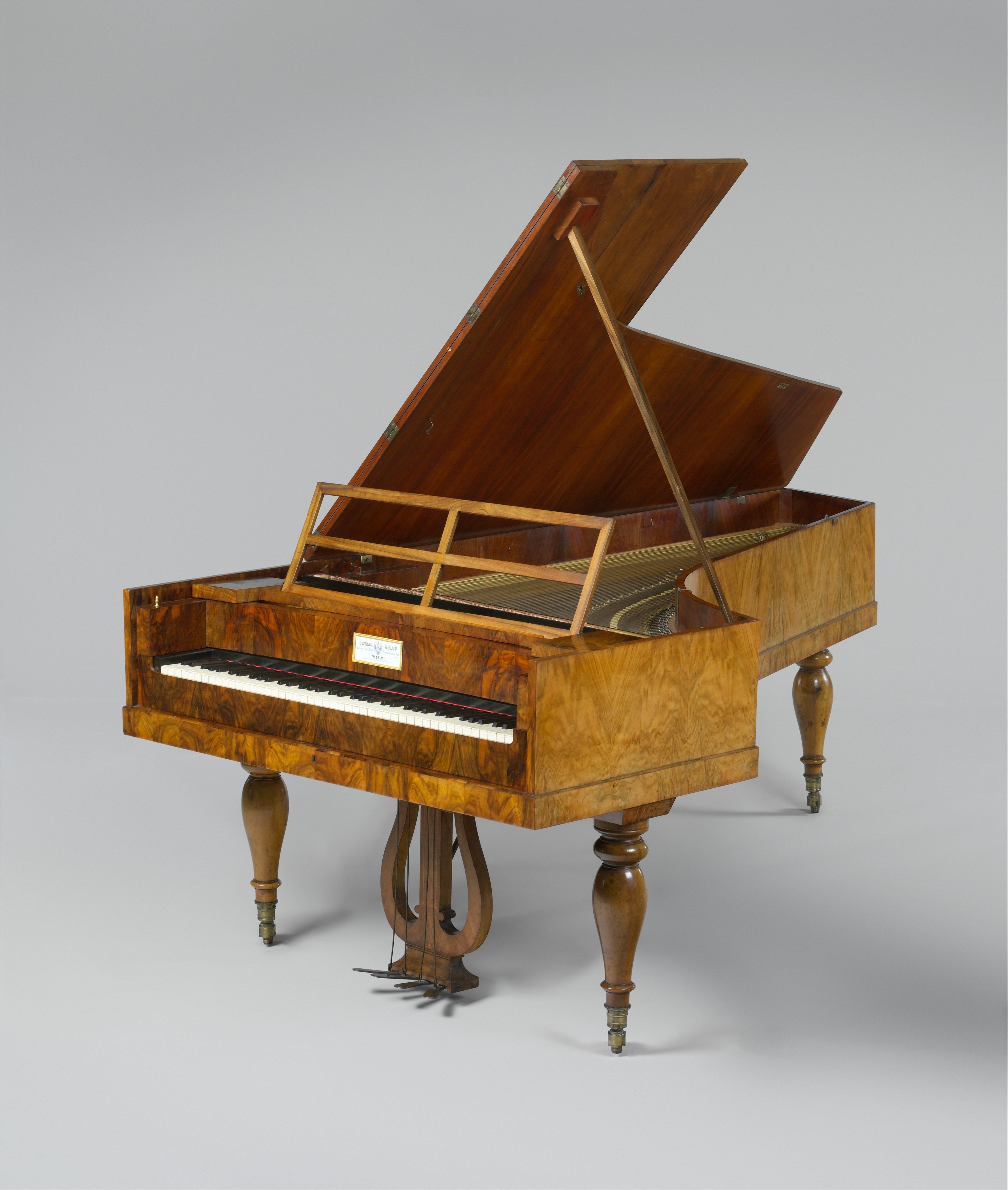
The Metropolitan Museum’s collection captures both ends of this arc. A late-18th-century German square piano (object 505724) — built of oak, ebony and bone, donated through the Crosby Brown Collection in 1889 — stands for the early domestic instrument that brought the fortepiano into ordinary households. An Austrian fortepiano of around 1838 (object 503647), built of walnut-veneered spruce and oak and acquired in 2001 in memory of Frederick P. Rose, sits at the very edge of the period: built in the same decade that Schumann was beginning his composing career, it represents the fully developed Viennese instrument just before its eclipse by the iron-frame grand.
Construction & Materials
A Viennese fortepiano of the late 18th century has a thin spruce soundboard, a wooden frame, parallel-strung steel and brass strings of relatively light gauge, and small leather-covered hammers. Its compass is typically five octaves (FF–f3) on Mozart-era instruments, expanding to six octaves on instruments built for Beethoven, and to six and a half by the 1830s. The English fortepiano, by contrast, used a heavier wooden frame, thicker stringing and more substantial hammers, producing a fuller singing tone with slower decay.
Both schools used hand-operated stops, or knee levers, to drive the una corda and damper functions before the modern foot pedal became standard around 1800. The MET’s Austrian instrument from around 1838 sits at the late stage of this evolution: a Viennese-school instrument with broad compass, foot pedals and a still-light action.
How It’s Played
Fortepiano technique differs from modern piano technique in several practical ways. The lighter action and shallower key-dip require finger touch rather than arm weight; the smaller dynamic range demands more careful gradation rather than physical force; and the shorter sustain means that texture is built up through articulation, ornament and pedal release rather than through legato sostenuto. Players approaching the fortepiano from the modern instrument typically need months to recalibrate touch and pedalling.
Una corda and damper effects are central to the sound. On many instruments the player can divide the dampers into bass and treble halves, allowing partial damping that has no equivalent on the modern piano.
Cultural Significance
The fortepiano is the instrument on which the Classical and early Romantic piano repertoire was composed. The Mozart concertos, the Beethoven sonatas through opus 90, and most of Schubert’s solo works exist as they do because of the specific dynamic and timbral characteristics of these instruments. From the 1970s onward the historical performance movement has restored the fortepiano to wide concert use, and recordings on period instruments by Malcolm Bilson, Robert Levin, Andreas Staier, Kristian Bezuidenhout and others have changed the way much of this repertoire is now heard.
The fortepiano also remains important to instrument-builders and conservatories. Modern copies of Walter, Stein and Graf instruments are made in workshops from Boston to Tokyo, and the major historical-performance programmes at Eastman, the Royal College of Music and the Conservatorium van Amsterdam all teach the instrument as a separate discipline.
Notable Examples & Recordings
The MET’s Austrian fortepiano of around 1838 (object 503647) and late-18th-century German square piano (object 505724) are documented in the Musical Instruments department. The Smithsonian, the Russell Collection in Edinburgh, the Cobbe Collection at Hatchlands Park and the Yale Collection of Musical Instruments all hold further significant examples.
For listening:
- Malcolm Bilson, Mozart Piano Concertos (with the English Baroque Soloists) — Walter-style fortepiano in the central concerto literature.
- Andreas Staier, Schubert: Impromptus and Moments musicaux — Graf-style instrument in the late Schubert solo works.
- Robert Levin, Beethoven Piano Sonatas — across multiple period instruments tracking Beethoven’s career.
- Kristian Bezuidenhout, Mozart: Keyboard Music — a complete cycle on a copy of an Anton Walter fortepiano.
Related Instruments
- – the plucked-string keyboard the fortepiano gradually replaced.
- Clavichord – the quietest early keyboard, with tangents striking the strings; a parallel branch to the fortepiano.
- – the modern descendant, dating from the iron-frame and felt-hammer revolutions of the 1830s onward.
- – the rectangular-cased domestic form of the fortepiano common from 1770 to 1860.
Where to Hear It
Fortepiano recitals are a standard part of the early-music festival circuit at Utrecht, Bruges, Boston and Berkeley. Major museum collections in New York, Edinburgh, Hamburg and Vienna display playable instruments and host occasional public performances. Online, the Cobbe Collection and the Smithsonian Channel hold short demonstration recordings of Cristofori, Walter and Broadwood-style instruments.
- Wikipedia: Fortepiano
- The MET: Fortepiano (object 503647)
- The MET: Square Piano (object 505724)
- Wikimedia Commons: Fortepiano
Learning Resources
Most fortepiano players come to the instrument after several years on the modern piano. The standard route is through a historical performance programme at a conservatory; institutions in Amsterdam, Bremen, Eastman, Indiana, the Royal Academy of Music in London and the Tokyo University of the Arts all maintain serious fortepiano departments. Important pedagogical references include Malcolm Bilson’s lecture-DVD Knowing the Score, Sandra Rosenblum’s Performance Practices in Classic Piano Music, and the historical treatises of C. P. E. Bach and Carl Czerny. New copies of Walter or Stein-style instruments by leading builders run from approximately 25,000 to 60,000 USD.
Frequently Asked Questions
What is the difference between a fortepiano and a modern piano?
A fortepiano has a wooden frame, leather hammers, light parallel stringing and a clear, articulate sound with shorter sustain. A modern piano has an iron frame, felt hammers, much heavier stringing and a fuller, longer-sustaining tone. The shift between the two happened mainly between about 1825 and 1860.
Who invented the fortepiano?
Bartolomeo Cristofori, working in Florence at the Medici court, built the first known examples around 1700. Three of his instruments survive, the earliest dated 1720.
Did Mozart and Beethoven play fortepianos?
Yes. Mozart’s keyboard music was composed for Viennese fortepianos by Anton Walter and Stein. Beethoven moved through Walter, Stein, Streicher, Erard and Broadwood instruments across his career.
Are old fortepianos in museums?
Yes. The Metropolitan Museum holds an Austrian fortepiano of around 1838 (object 503647) and a late-18th-century German square piano (object 505724), both in its Musical Instruments department.
Why is fortepiano playing a separate skill?
The lighter action, shorter sustain, smaller dynamic range and historical pedalling and ornamentation conventions all differ enough from the modern piano that conservatories now teach it as a distinct programme. Most leading fortepiano players have studied both instruments.


