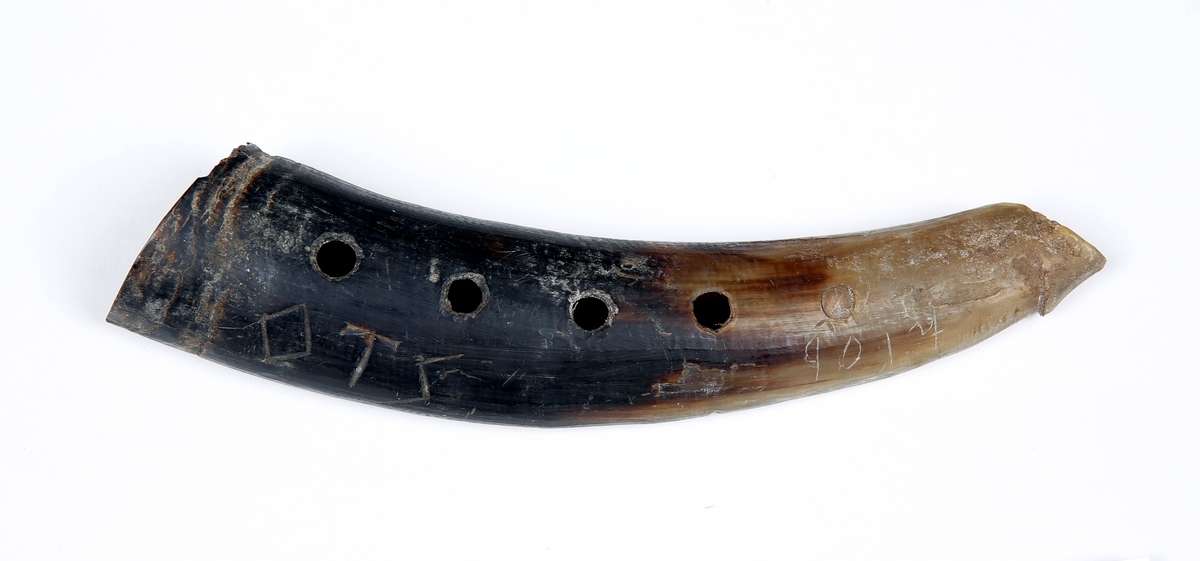
Image: Glomdal Museum, CC BY-SA 4.0 — via Wikimedia Commons
Tungehorn
| Category | Wind (single-reed folk horn) |
|---|---|
| Country of origin | Norway |
| Classification | type of musical instrument, woodwind instrument |
| Wikipedia | en.wikipedia.org |
| Wikidata | Q6746165 |
Overview
The tungehorn is a traditional Norwegian wind instrument, a single-reed horn historically used by shepherds and farmers for signalling and folk music. Its name literally means “tongue-horn”, referring to a vibrating tongue (a reed) cut into the body of the instrument itself. It produces a strong, slightly nasal sound that carries over long distances.
Origin & History
Folk reed horns of this kind are documented across Scandinavia and other parts of Europe, varying in size and material. In Norway the tungehorn has historically been associated with rural life, where it was used for calling livestock, signalling between farms or summer pastures, and accompanying folk dances. Surviving examples date from various periods, and the playing tradition has been kept alive by folk-music revivalists.
How It’s Played
A short tube — sometimes a section of cow horn, sometimes wood — has a single idioglot reed cut directly into its surface, meaning the reed is part of the instrument body rather than a separate piece attached to it. The player blows into one end and the reed vibrates. Pitch is controlled by finger holes along the tube. Because the reed is part of the body, the timbre is distinct from clarinet-style instruments where a cane reed is fitted to a mouthpiece.
Cultural Significance
The tungehorn forms part of the broader Norwegian folk-music heritage, alongside the hardanger fiddle and various lurs and bukkehorn. It featured both in working life and in informal music-making, and today is heard in folk-music education, festivals, and recordings of traditional Norwegian repertoire.
Related Instruments
- – another Norwegian horn instrument
- – a long Bronze Age and folk Scandinavian horn
- – a Norwegian overtone flute
- Hardanger fiddle – a Norwegian sympathetic-string fiddle
- – a related Nordic folk wind
Frequently Asked Questions
Is the tungehorn made of cow horn?
Sometimes yes, sometimes wood. The defining feature is the single reed cut into the body, not the material of the body itself.
Is it like a clarinet?
It is also a single-reed instrument, but the reed is integral to the body (idioglot), giving it a different sound and construction.
Is the tungehorn still played?
Yes, mostly within the Norwegian folk-music revival and educational settings.