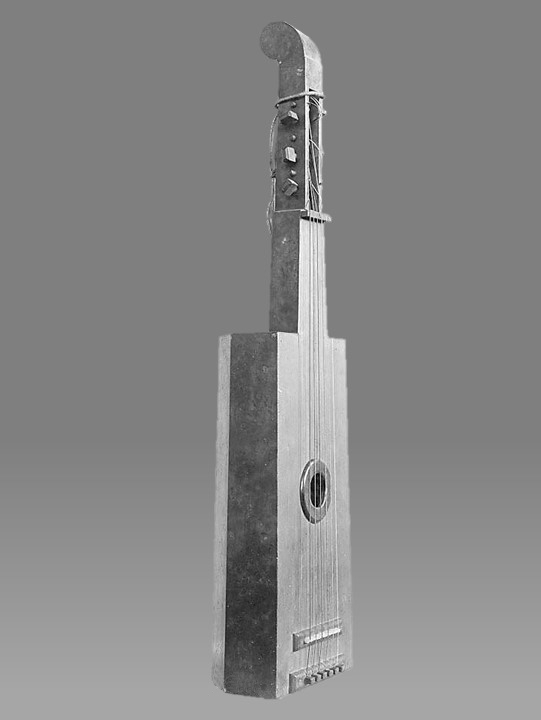

Russian guitar
Семиструнная гитара (semistrunnaya gitara)
| Category | Regional |
|---|---|
| Country of origin | Russia (late 18th century) |
| Classification | necked, flat-backed, plucked lute |
| Wikipedia | en.wikipedia.org |
| Wikidata | Q948603 |
Overview
The Russian guitar — known in Russian as the semistrunnaya gitara (семиструнная гитара, “seven-string guitar”) and affectionately as the semistrunka — is an acoustic seven-string instrument developed in Russia in the final years of the 18th century. It shares most of its construction with the Spanish guitar, but is tuned to an open G major chord by default: D2 / G2 / B2 / D3 / G3 / B3 / D4 reading from low string to high. In some classical literature the lowest D is retuned down to C; the standard “Gypsy” or “Romani” repertoire stays in standard open-G tuning.
The instrument is sometimes called the the “Gypsy guitar” because of its long association with the urban Romani musical tradition of Russia, Ukraine, and Eastern Europe; its 19th- and 20th-century repertoire blends Russian art-song, Romani urban-romance song, military romance, and Soviet bardic singer-songwriter traditions.
Origin & History
The Russian guitar appeared in Russia toward the end of the 18th century. The traditional attribution to Andrei Sychra (1773-1850) overstates a single inventor’s role — the instrument was already in circulation when Sychra started out — but Sychra was the central figure in establishing the Russian guitar’s classical school. He composed and arranged over a thousand pieces; seventy-five works were republished by the music publisher Stellovsky in the 1840s, again by Gutheil during the 1880s, and again under Soviet imprint during 1926.
The 19th century was the instrument’s classical golden age, with composer-performers including Mikhail Vysotsky, Aleksandr Vetrov, and Vasily Sarenko producing concert and salon repertoire alongside the substantial body of arrangements of Russian folk and art song. The instrument was the standard guitar of urban Russian musical life for the entire 19th century; the six-string Spanish guitar arrived in Russia much later than in Western Europe and did not displace the seven-string until the Soviet era.
In the 20th century the Russian guitar became closely associated with the Romani urban-romance tradition (Vyalcheva, Liyalov-Russu, the Romen Theatre of Moscow) and with the Soviet bardic singer-songwriter movement of the 1960s and 1970s — Bulat Okudzhava, Vladimir Vysotsky (the most famous of all Soviet songwriters), and Alexander Galich all accompanied themselves on the seven-string Russian guitar. Vysotsky’s instrument is the most recognisable image of the Russian guitar in the modern cultural imagination.
Construction & Materials
The Russian guitar is built like a Spanish classical guitar but with seven strings rather than six. The body is typically spruce-topped with a maple, mahogany, or cypress back and sides, with a 12-fret neck-to-body junction (in older instruments) or a 14-fret junction (in modern reproductions). Total scale length is similar to a classical guitar: 630 to 660 mm. Seven tuning machines are arranged on a slotted headstock; bridges are tied-on like a classical guitar.
Strings are traditionally gut, today nylon for the trebles and silver-wound nylon or wound steel for the basses. The open-G tuning produces lower string tension overall than standard Spanish-guitar tuning, which gives the instrument its characteristic warmer, slightly looser tone. Modern Russian instruments are made by the Gibson, Etalon (Russia), and Sankt-Peterburg factories, with hand-built instruments by individual luthiers including Sergey Belogolovtsev and Igor Boldyrev commanding higher prices on the specialist market.
How It’s Played
The instrument is played seated in the standard classical guitar position, with the right hand fingerstyle (no plectrum in classical and most Romani repertoire). The open-G tuning means that simply strumming all seven strings with the left hand removed from the fingerboard produces a complete G major chord — the harmonic basis of much of the repertoire. Chord shapes for other keys are entirely different from those of the standard six-string guitar, and learning the Russian guitar effectively requires unlearning the Spanish-guitar fingering system.
Standard technique includes single-note melody, chord-melody arrangements, the rapid sweep-strum patterns characteristic of the Romani tradition, and the right-hand thumb-and-fingers picking patterns developed in the 19th-century classical school. Capo use is common in song accompaniment to transpose the open-G key to the singer’s range.
Cultural Significance
The Russian guitar is one of the central instruments of Russian and Soviet popular music across two centuries. The 19th-century Russian classical-guitar repertoire — Sychra, Vysotsky (Mikhail), Vetrov, Sarenko, Lebedev — is a substantial body of art music almost entirely unknown outside Russia. The Romani urban-romance tradition (the romansy genre) is inseparable from the seven-string instrument; recordings of Anna Vyalcheva, Tamara Tsereteli, and the singers of the Romen Theatre define a distinct sub-genre.
The Soviet bardic movement — Bulat Okudzhava (1924-1997), Vladimir Vysotsky (1938-1980), Alexander Galich (1918-1977) — used the Russian guitar as the standard accompaniment instrument for songs that became central to late-Soviet cultural life. Vysotsky’s harsh delivery and the seven-string’s open chord behind it remain a defining sound of the period. The instrument has experienced a small revival in the post-Soviet decades, with the Romani tradition continued by performers including Vadim Kolpakov and the classical tradition revived by guitarists including Oleg Timofeyev.
Notable Examples & Recordings
- Recording landmarks: Vladimir Vysotsky (the complete song catalogue, 1960-80), Bulat Okudzhava (the songs of the Arbat), Alexander Galich (political-protest songs), Vadim Kolpakov (Romani solo and ensemble work), Oleg Timofeyev (revival of the 19th-century classical Russian-guitar repertoire), the Romen Theatre Romani song archive.
Related Instruments
- Guitar — the standard six-string Spanish guitar.
- Seven-string guitar — the broader category including Brazilian and modern jazz/metal seven-string variants.
- Baritone guitar — a different low-tuned guitar variant.
- Bouzouki — a related Eastern-European long-necked plucked string instrument.
- Domra — a traditional Russian round-bodied long-neck plucked instrument.
- Balalaika — the triangular-bodied Russian folk-song accompanist.
- Cigar-box guitar — a comparable open-tuning folk-string tradition from a different culture.
Where to Hear It
Live: Romani musical theatres in Moscow (Romen Theatre) and St Petersburg, and concert appearances by classical Russian-guitar revivalists. The Romen Theatre has been the central institutional home of the Russian Romani musical tradition since 1931. The instrument also appears regularly at Russian-diaspora festivals across Western Europe, Israel, and the United States.
- Wikipedia: Russian guitar
- Wikidata: Russian guitar (Q948603)
- DBpedia: Russian guitar
- Wikimedia Commons: Russian guitars
Learning Resources
A student Russian guitar costs around 200 to 500 USD; a Sankt-Peterburg or Etalon factory instrument 600 to 1,500 USD; a hand-built instrument by a contemporary Russian luthier 2,000 USD and up. Standard methods include the Sychra and Vysotsky 19th-century method books (republished in Soviet and post-Soviet editions), Aleksandr Sykorskiy’s Samouchitel igry na semistrunnoy gitare (a widely-used 20th-century self-instruction manual), and the modern Oleg Timofeyev Russian Guitar Anthology with recorded examples.
Frequently Asked Questions
Why does the Russian guitar have seven strings?
The seven-string design and open-G tuning emerged together in late-18th-century Russia and were standard from the start. The standard explanation is that the additional bass string and the open tuning together made the instrument particularly suited to chord-and-melody self-accompaniment of song — the central use across all its historical genres.
Can a regular guitar player switch to the Russian guitar?
Mechanically yes, but the open-G tuning means that almost no chord shape transfers from the standard six-string guitar. Playing fluently requires learning the entire chord system from the start.
Why is it called the the “Gypsy guitar”?
Because of its long association with the urban Romani musical tradition of 19th- and 20th-century Russia. The Romen Theatre of Moscow has been the central institutional home of Russian Romani music since 1931, and the seven-string guitar is the standard accompaniment instrument of that tradition.
Did Vladimir Vysotsky really play a Russian guitar?
Yes. The seven-string Russian guitar was Vysotsky’s standard accompaniment instrument throughout his career, and the open-G tuning shaped many of his most famous song settings.
Is the Russian guitar related to the Brazilian seven-string?
Only distantly. The Brazilian violão de sete cordas is a separately developed instrument with a low-C added below standard six-string tuning rather than open-G tuning across all seven strings. The two instruments are in the same family but represent independent late-19th- to mid-20th-century adaptations of the standard guitar.

