.jpg)
.jpg)

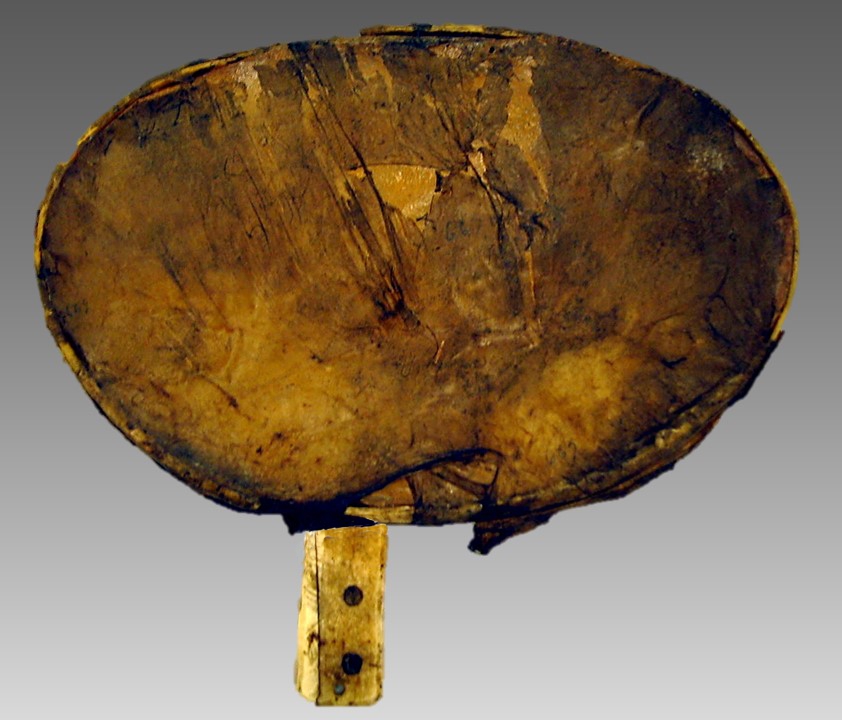
Qilaut
| Category | Percussion (frame drum) |
|---|---|
| Country of origin | Inuit (Arctic North America and Greenland) |
| Classification | frame drum |
| Wikipedia | en.wikipedia.org |
| Wikidata | Q3196570 |
Overview
The qilaut is a single-headed frame drum traditionally used by Inuit communities across the Arctic, from northern Alaska and Canada to Greenland. It is large, light, and held by a short wooden handle. Despite its simple construction, the qilaut occupies a central place in Inuit musical and ceremonial life, accompanying song, dance, and historically also shamanic practice.
Origin & History
Frame drums of this type have been used in Inuit cultures for centuries. The qilaut shares the broader form found across circumpolar peoples but has its own playing technique, repertoire, and ceremonial role. The frame is traditionally bent from a single piece of wood, and the membrane was historically made from the bladder or skin of marine mammals; modern versions sometimes use synthetic materials.
How It’s Played
The qilaut is held by its handle in one hand and struck on the rim or frame, not the centre of the head, with a thin beater. The player rotates the drum while striking, producing a distinctive shifting sound. Traditional Inuit drum dance, piheq, involves rhythmic playing combined with personal songs and dance movements, often performed in a qaggi (community gathering house) on long winter evenings.
Cultural Significance
In many Inuit communities the drum dance is more than entertainment: it is a way of telling stories, settling disputes through the older “drum song” tradition, and connecting with ancestors. Christian missionary influence in the nineteenth and twentieth centuries discouraged the practice in some regions, but contemporary Inuit musicians and cultural organisations have actively revived qilaut playing as part of language and heritage initiatives.
Related Instruments
- – an Irish frame drum with a related shape but very different playing style
- Bendir – a North African frame drum
- Daf – a Persian frame drum often used in spiritual music
- – a large Indigenous North American ceremonial drum
- Riq – an Arabic small frame drum
Frequently Asked Questions
How is the qilaut different from a hand drum?
The qilaut is held by a handle and struck on the rim, not on the head with the hand. The motion of the drum and the rim strikes give it a distinctive sound.
Is the qilaut still played today?
Yes. Drum dance has been actively revived in many Inuit communities and is performed at cultural events, festivals, and language programmes.
What was the traditional drum head made of?
Historically it was made from the membrane of a marine mammal. Today both traditional materials and synthetic substitutes are used.
Image: photograph by Hubert Wilkins, CC BY 2.0 (Wikimedia Commons).
