


Accordion
accordion / akkordeon / fisarmonica
| Category | Aerophones |
|---|---|
| Country of origin | Central Europe |
| Classification | type of musical instrument |
| Wikipedia | en.wikipedia.org |
| Wikidata | Q79838 |
Listen
Audio: Necz0r, Public domain / via Wikimedia Commons
Audio: Johann Pascher, CC BY-SA 3.0 / via Wikimedia Commons
Audio: Vion Nicolas, CC BY 2.0 fr / via Wikimedia Commons

Overview
The accordion is a hand-held free-reed aerophone in which a folded bellows pumps air past tuned metal reeds, sounding chords or single notes when the player presses keys or buttons on either end. It has spread further and faster than any other 19th-century invention in folk music, and now anchors traditions from Argentine tango to Cajun two-step to Russian bayan virtuosity.
The instrument carries a built-in dual identity. On one end the right hand plays melody. On the other end the left hand normally plays preset bass notes and chord buttons in the so-called Stradella system. This division — melody right, accompaniment left — is what makes a single player able to function as a small ensemble.
Origin & History
The accordion’s birth is unusually precise. Cyrill Demian and his sons patented their Akkordion in Vienna in May 1829, with a name coined from the German Akkord (chord) to describe its left-hand chord buttons. Within twenty years the design had spread across Europe and established centres of manufacture in France, Italy and Russia. The closely related concertina (patented in London five years later by Charles Wheatstone) and the bandoneon (developed in Germany around 1840) sit alongside the accordion as siblings in the broader free-reed family.
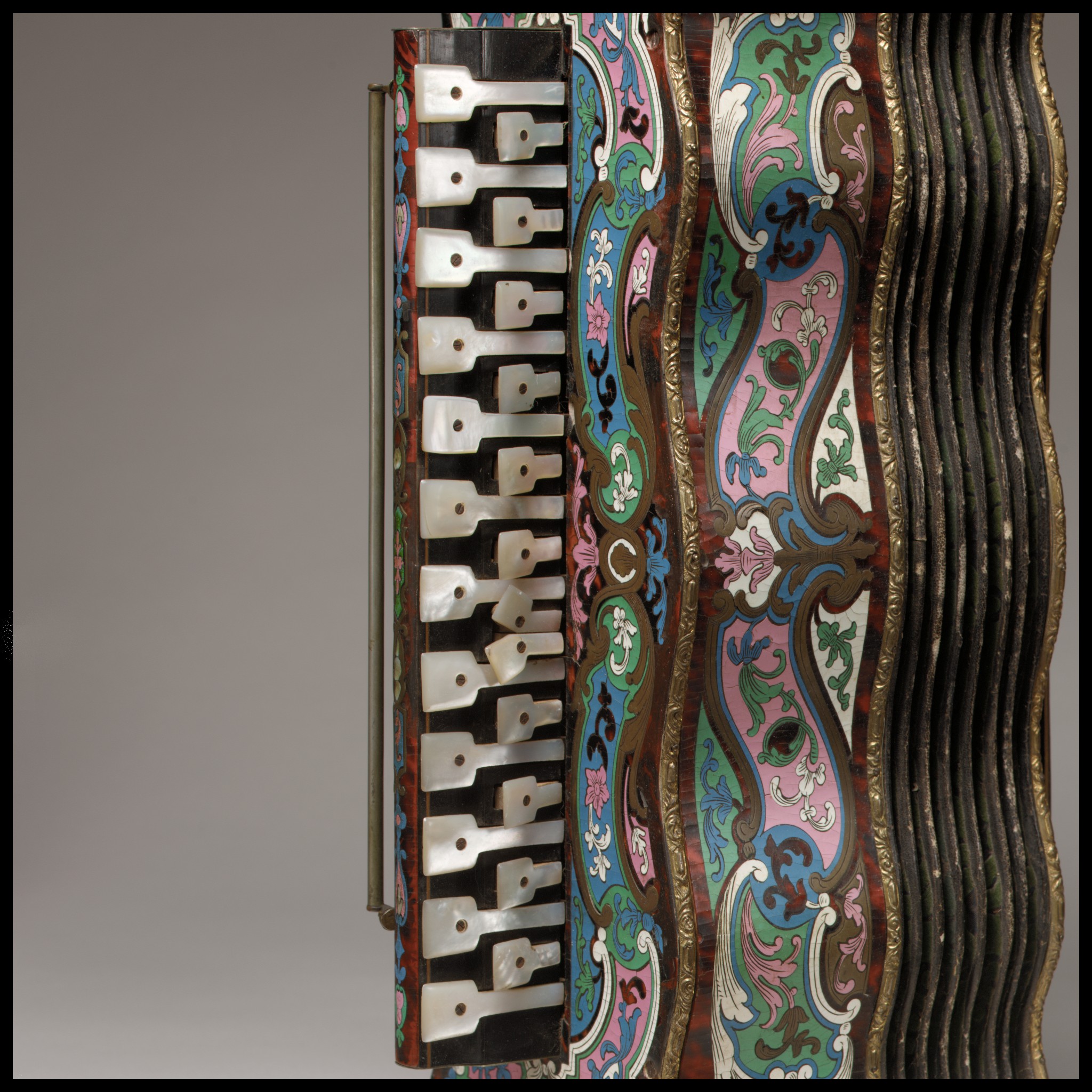
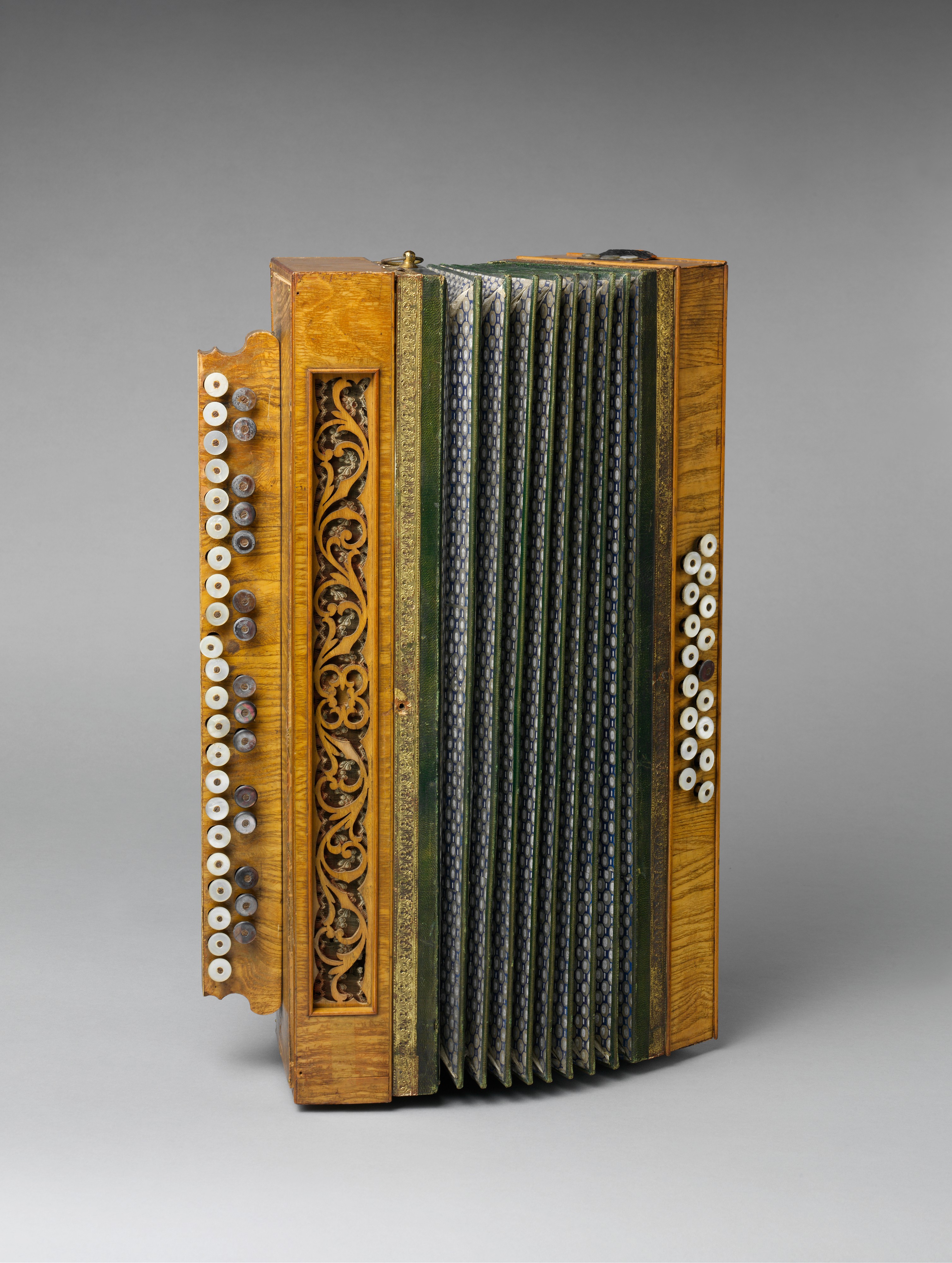
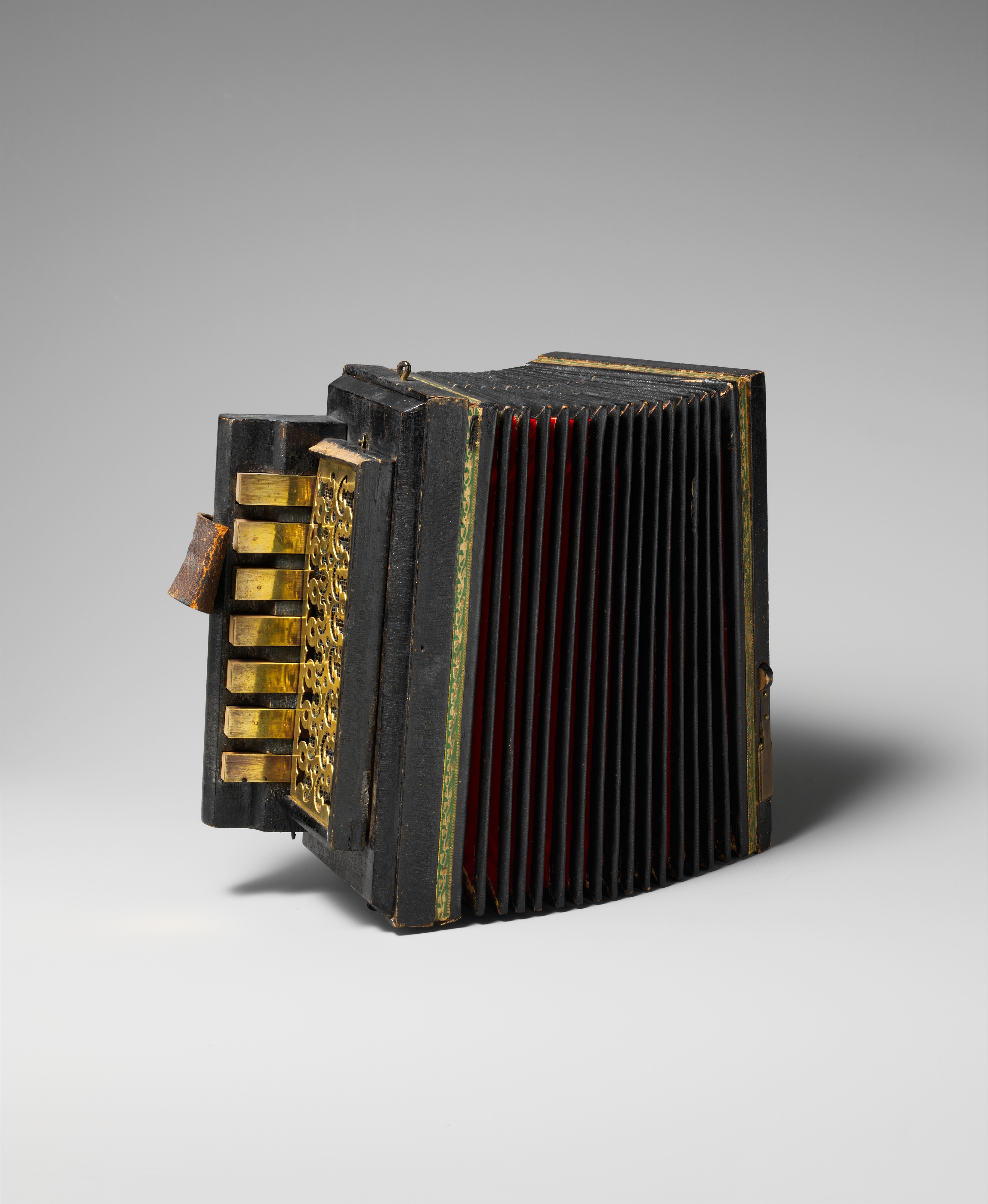
The Metropolitan Museum’s Musical Instruments department holds three accordions that document the post-patent decades. The earliest is a French accordion of 1850-55 (MET object 503502), built from wood, metal, mastic, brass, tortoiseshell, gilt brass, mother-of-pearl and silver foil — a parlour instrument with the high decorative finish typical of the period. A Russian instrument of 1870-80 (MET 501874) shows the design as it adapted in Russian workshops on the way to the modern bayan. A possibly Belgian accordion of around 1890 (MET 503731) in wood, mother-of-pearl, leather and paper documents the late-19th-century shift toward sturdier, less decorated working instruments.
By 1900 the accordion was already established in Italian-American immigrant communities, in French bal-musette, in German Volksmusik, and in countless other regional traditions worldwide.
Construction & Materials
The Hornbostel-Sachs system places the accordion in 412.132 (free-reed instruments with bellows). The body is a wooden case in two halves, joined by a folded cardboard or leather bellows. Inside each half sit banks of free reeds — small steel tongues clamped at one end and free to vibrate at the other — riveted into reed blocks. Each reed sounds a fixed pitch when air passes across it.
The MET specimens illustrate the material range. The 1850-55 French instrument’s combination of mother-of-pearl, gilt brass and tortoiseshell marks it as a luxury parlour piece. The 1890 instrument’s leather and paper construction shows the move to working-instrument economy. The Russian 1870-80 example uses the materials that would soon be standardised in the bayan tradition.
The two main melody systems are the piano keyboard (used on most Western European and American piano accordions) and the chromatic button system (used on the Russian bayan and most Central European concert instruments). The diatonic button system, with bisonoric reeds — different notes on push and pull — is standard in many folk traditions including Cajun, Quebecois and Tex-Mex.
How It’s Played
The player straps the instrument to the chest and shoulders, with the bellows opening and closing horizontally between the hands. The right hand operates the melody keyboard or buttons; the left hand operates the bass and chord buttons; both hands together control the bellows direction. Bellows control is the heart of accordion technique — it determines dynamics, articulation and phrasing in the same way that bow control does on a violin.
Air efficiency matters: a skilled player phrases music to keep the bellows from running out at awkward moments, often by varying chord voicings to use less air on long passages.
Cultural Significance
Few instruments have so many overlapping cultural roles. In France the accordion is inseparable from Parisian musette. In Argentina the closely related bandoneon defines tango. In Russia the bayan is a concert instrument with a major classical repertoire. In Mexico and the US Southwest the diatonic button accordion drives norteño and conjunto. In Louisiana it is the lead voice of Cajun and zydeco music. In Brazil the forró tradition rests on it. In Ireland and Scotland it has become a standard ceilidh instrument.
That breadth has occasionally cost the instrument prestige in classical-music circles, but the modern concert literature — Sofia Gubaidulina, Toshio Hosokawa, Magnus Lindberg — has changed perceptions over the past forty years.
Notable Examples & Recordings
The three MET accordions (objects 503502, 501874 and 503731) bracket the four decades after Demian’s 1829 Vienna patent across three national traditions. For listening, recordings by Astor Piazzolla (bandoneon), Friedrich Lips (bayan), Yuri Shishkin (bayan), Galliano (jazz accordion), Clifton Chenier (zydeco) and Flaco Jiménez (Tex-Mex) cover much of the modern stylistic range.
Related Instruments
- Bandoneon – the German-developed cousin central to Argentine tango
- Concertina – the smaller hexagonal English cousin
- – the Russian chromatic button accordion
- Harmonica – the smallest free-reed family member, sharing the same reed technology
- Sheng – the Chinese mouth-blown free-reed organ that inspired 19th-century European inventors
Where to Hear It
The accordion appears in the popular and folk music of dozens of countries. Cajun dance halls in Louisiana, tango milongas in Buenos Aires, bal-musette venues in Paris, Russian conservatoire recitals, and Mexican baile halls all feature the instrument as a central voice. Major festivals dedicated to the accordion are held in Castelfidardo (Italy), Klingenthal (Germany) and Trossingen (Germany). The Wikimedia Commons category gathers performance images and clips across all branches.
- Wikipedia: Accordion
- The MET: Accordion 1850-55 (object 503502)
- The MET: Accordion ca. 1890 (object 503731)
- The MET: Accordion 1870-80 (object 501874)
- Wikimedia Commons: Accordions
Learning Resources
Beginners should choose a system before buying — piano accordion, chromatic button, or diatonic button — because the systems are not interchangeable. Method books by Palmer-Hughes are widely used for piano accordion in the United States. For Cajun diatonic accordion, Dirk Powell and Steve Riley have produced influential method materials. For bayan, the Russian-language Lipsy method is the standard in conservatoires.
Frequently Asked Questions
What family is the accordion in?
It is a free-reed aerophone with bellows, classed as 412.132 in the Hornbostel-Sachs system.
Who invented the accordion?
Cyrill Demian patented the Akkordion in Vienna in May 1829. The closely related concertina was patented in London by Charles Wheatstone in 1834.
What is the difference between a piano accordion and a button accordion?
A piano accordion has a piano keyboard for the right hand. A button accordion uses small buttons. Button accordions further divide into chromatic systems (every button gives one fixed pitch) and diatonic systems (each button gives different notes on push and pull).
Are old accordions in museums?
Yes. The Metropolitan Museum of Art holds three 19th-century accordions in its Musical Instruments department: a French instrument of 1850-55 (object 503502), a Russian instrument of 1870-80 (object 501874) and a possibly Belgian instrument of around 1890 (object 503731).
Why does the accordion appear in so many different folk traditions?
The instrument is portable, loud enough to lead a dance band without amplification, and capable of producing both melody and harmony at once — a unique combination that fitted the 19th-century needs of dance music in many countries simultaneously.
Is the accordion difficult to learn?
Single-line melody playing is reachable within weeks. Coordinating the two hands and the bellows for full ensemble-style accompaniment takes longer — most players consider serious bellows control a multi-year project.


