.jpg)
.jpg)
.jpg)
.jpg)

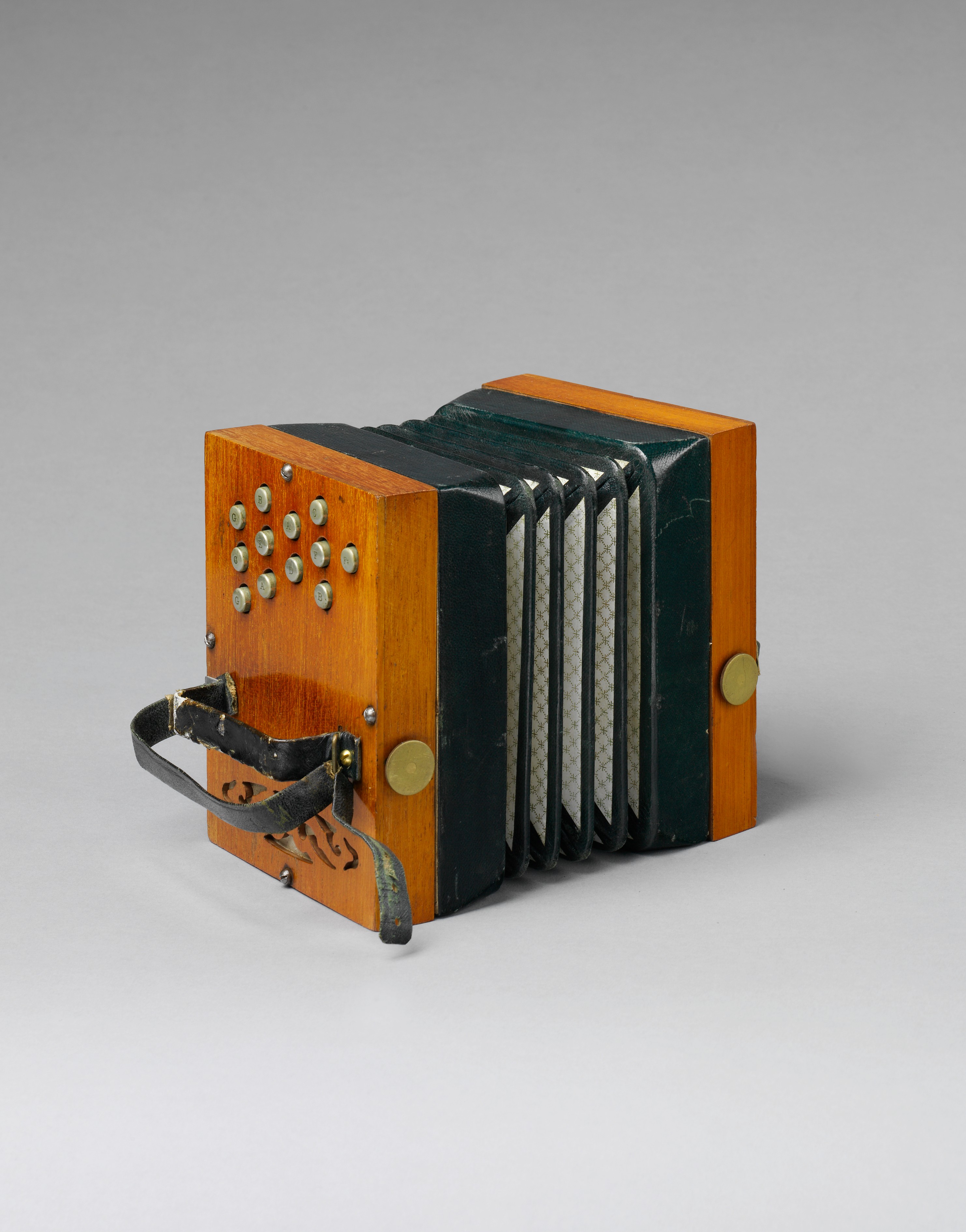
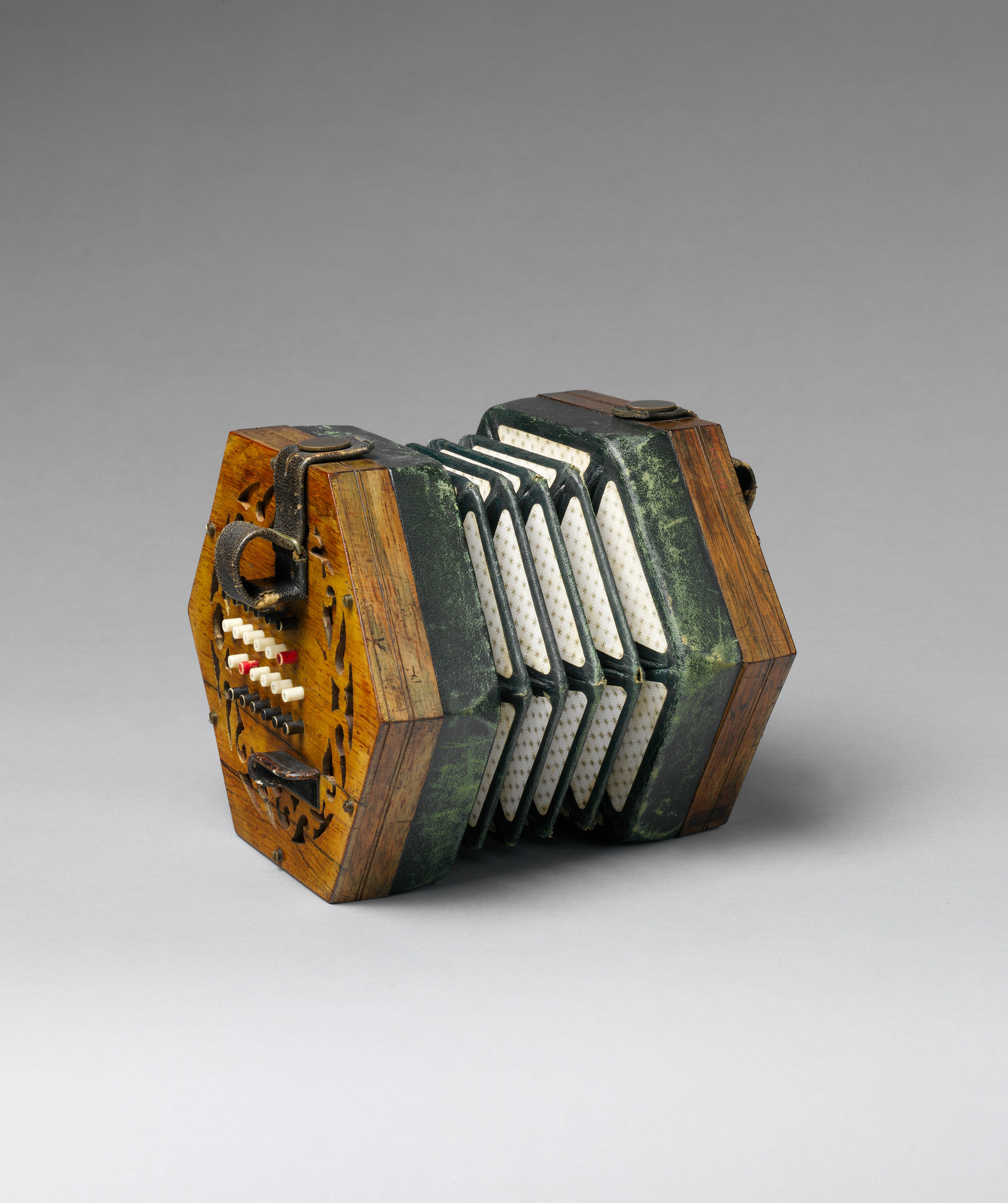

Concertina
concertina
| Category | Wind |
|---|---|
| Country of origin | United Kingdom / Germany |
| Wikipedia | en.wikipedia.org |
| Wikidata | Q593050 |
Listen
Audio: Alexander Prince, Public domain / via Wikimedia Commons
Audio: Organic Beat Cooperative, CC BY-SA / via Internet Archive

Overview
The concertina is a small free-reed bellows instrument with hexagonal, square, or octagonal end-plates carrying buttons that control individual notes. The Hornbostel-Sachs system classifies it as 412.132 — a set of free reeds — placing it in the same broad family as the harmonica, accordion, harmonium, and ultimately the Chinese sheng from which all of these instruments are descended.
Unlike the larger accordion, the concertina has buttons (not piano keys) and a single button per note, and the player typically presses one button at a time rather than playing chordal blocks. Different regional traditions have developed very different fingering systems and repertoires, with the result that “the concertina” is best understood as a small family of related but distinct instruments rather than a single one.
Origin & History
For an instrument of any age, the concertina has an unusually well-defined birthdate: DBpedia gives a development window of 1829 to 1834. Two parallel inventions — Charles Wheatstone’s English concertina, patented in London in 1829, and Carl Friedrich Uhlig’s German concertina, introduced in Chemnitz in 1834 — together established the design. Both instruments came out of the broader free-reed boom of the 1820s and 1830s, in which European inventors experimented widely with the free-reed principle they had learned from East Asian instruments such as the sheng.
The Metropolitan Museum of Art’s two surviving British concertinas date from very close to the invention itself. Object 503682 is dated 1831–37, made of rosewood, nickel-silver, leather, paper, ivory, and tortoiseshell, with a mahogany case. Object 503683 is dated 1855–60, made of mahogany (or possibly mahogany-stained), leather, paper, brass, and nickel-silver. The two together document the rapid stabilisation of the design in British workshops within roughly thirty years of Wheatstone’s original patent.
By the closing decades of the 1800s the instrument had become a major popular force across Britain, Ireland, much of continental Europe, and the British colonial world. It went through a steep decline in the early-to-mid 20th century — overtaken in popular use by the larger accordion and by the gramophone — before being revived from the 1960s onward by makers such as Colin Dipper and the broader folk-music revival.
Construction & Materials
A concertina has two hexagonal (or sometimes square or octagonal) wooden end-plates connected by a multi-fold leather and cardboard bellows. Each end-plate carries a row of metal reeds mounted in a wooden reed-pan, with corresponding buttons protruding through the outer face of the end-plate. Pressing a button opens a leather valve, allowing air through the reed when the bellows are pumped.
Three main systems exist. The English concertina, invented by Wheatstone, has a unisonoric layout — each button produces the same note on push and pull — and is laid out so that the scale alternates between the two hands. The Anglo concertina, derived from Uhlig’s German design, is bisonoric — each button produces a different note on push than on pull — and is most closely associated with Irish traditional music. The Duet concertina, like the English, is unisonoric, but its layout assigns the bass register to the player’s left side and the treble register to the right, making two-part playing easier to manage.
The MET’s two surviving 19th-century specimens (objects 503682 and 503683) are both English-system instruments, reflecting the dominance of the Wheatstone design in mid-19th-century British workshops.
How It’s Played
The player holds the concertina between the two hands, with the thumbs (or thumb and a single finger, depending on the system) supporting the end-plates and the remaining fingers operating the buttons. The bellows is pumped between the two hands, providing air to the reeds.
On the English system, the player typically alternates buttons between the two hands to produce a melodic line, with the scale alternating between left and right. On the Anglo system, the bass register is assigned to one hand and the melody to the other, with frequent push-pull bellows changes used to access the right notes. The Anglo style is particularly suited to Irish traditional music because the push-pull alternation supports the strong rhythmic patterns of jigs and reels.
Cultural Significance
The concertina is most strongly associated today with two distinct traditions: English concertina with British folk and music-hall traditions, and Anglo concertina with Irish music — particularly the East Clare and West Clare regional styles. The instrument is also central to South African Boer music, to the vallenato tradition of Colombia (where it was once dominant before being largely replaced by the larger accordion), and to several other regional folk traditions worldwide.
Within the Irish tradition, generations of County Clare players have made the Anglo concertina a defining voice of that regional style. Players such as the late Mrs Crotty (Elizabeth Markham), Noel Hill, Mary MacNamara, and Niall Vallely have shaped the modern technique and brought the instrument to international audiences through tours, recordings, and tuition. The English concertina has been similarly revived through players including Alistair Anderson and the broader English folk-music scene.
Notable Examples & Recordings
The Metropolitan Museum of Art’s two surviving 19th-century British concertinas (objects 503682 and 503683) are particularly useful because they bracket the early-to-mid 19th-century development of the instrument. For listening, recordings by Mrs Crotty, Noel Hill, Mary MacNamara, Niall Vallely (Irish Anglo), and Alistair Anderson, Simon Thoumire (English) together cover the instrument’s expressive range across both major systems.
Related Instruments
- Accordion – the larger free-reed bellows instrument with piano keys or larger button systems
- Bandoneón – the larger square-plated free-reed instrument central to Argentine tango
- Harmonica – the smaller free-reed mouth instrument in the same family
- Sheng – the Chinese mouth-organ that is the historical ancestor of all free-reed instruments
- – the small bisonoric button accordion related to the Anglo concertina
Where to Hear It
Pub sessions in Ireland (especially around County Clare) and English folk-music festivals are the natural settings for the concertina. The instrument also appears regularly in South African Boer music, in cross-cultural folk projects, and in occasional appearances in classical and contemporary chamber music.
- Wikipedia: Concertina
- The MET: Concertina, 1831–37 (object 503682)
- The MET: Concertina, 1855–60 (object 503683)
- Wikimedia Commons: Concertina
Learning Resources
Beginners need to choose between the English, Anglo, and Duet systems before starting; switching later is broadly possible but typically requires substantial relearning. The Anglo system is generally recommended for students wanting to play Irish traditional music, while the English system is the more common starting point for British and continental folk repertoire. Several senior players offer structured online tuition, and most reputable concertina makers provide beginner instruments at a price below that of an accordion.
Frequently Asked Questions
Where does the concertina come from?
Charles Wheatstone patented the English concertina in London in 1829, and Carl Friedrich Uhlig developed the German (later “Anglo”) concertina in Chemnitz in 1834. Both instruments emerged from the broader European free-reed boom of the 1820s and 1830s.
What is the difference between English and Anglo concertinas?
The English concertina is unisonoric — each button produces the same note on push and pull — and is laid out with the scale alternating between the two hands. The Anglo concertina is bisonoric — each button produces a different note on push than on pull — and is most closely tied to Irish music sessions.
How is the concertina related to the accordion?
Both are free-reed bellows instruments and share the same Hornbostel-Sachs class. The concertina is smaller, has buttons rather than piano keys, and typically plays one note per button rather than chordal blocks. Both descend ultimately from the European free-reed experimentation of the 1820s and 1830s, itself inspired by the Chinese sheng.
Are old concertinas displayed in museums?
Yes. New York’s Metropolitan Museum of Art holds at least two well-documented mid-19th-century British concertinas (objects 503682 and 503683), made within a few decades of the instrument’s invention.
Is the concertina difficult to learn?
The basics of producing a clean tone and playing simple melodies are reasonably approachable, especially on the English system. The push-pull bellows control of the Anglo system, and the rhythmic feel of Irish traditional music, typically take longer to develop.


