
Uilleann Pipes
píobaí uilleann
| Category | Wind |
|---|---|
| Country of origin | Ireland |
| Wikipedia | en.wikipedia.org |
| Wikidata | Q543833 |
Listen
Audio: EncycloPetey, CC BY-SA 3.0 / via Wikimedia Commons
Audio: Edmund Hyland, PD / via Internet Archive
Audio: Tommy Martin, PD / via Internet Archive

Overview
Sweet-toned, bellows-driven, and much more elaborate than most other bagpipes, the uilleann pipes are widely regarded as Ireland’s signature wind instrument. A complete set comprises a chanter, three drones, and three keyed regulators that allow the piper to add chordal accompaniment without using the chanter at all. Wikipedia describes the instrument as Ireland’s defining national bagpipe; DBpedia classifies it within the Hornbostel-Sachs mixed class 422.122.2 & 422.221.1, sitting in the woodwind/aerophone/bagpipe family.
Where the Scottish Great Highland bagpipes are loud, outdoor, and often associated with military and ceremonial settings, the uilleann pipes are quiet, indoor, and built for the close detail of Irish traditional dance music and slow airs. They are also generally regarded as one of the more technically demanding bagpipes in the world to play well.
Origin & History
DBpedia places the development of the modern uilleann pipes between the middle of the eighteenth century and the opening years of the nineteenth, an era stretching across the island of Ireland — a window that aligns with the conventional dating used by most modern players. The instrument grew out of an earlier set of related Irish and Scottish bellows-blown pipes — including the Scottish “Union pipes” — through a series of mid-18th-century improvements that added the regulators, expanded the chanter range, and standardised the bag pressure.
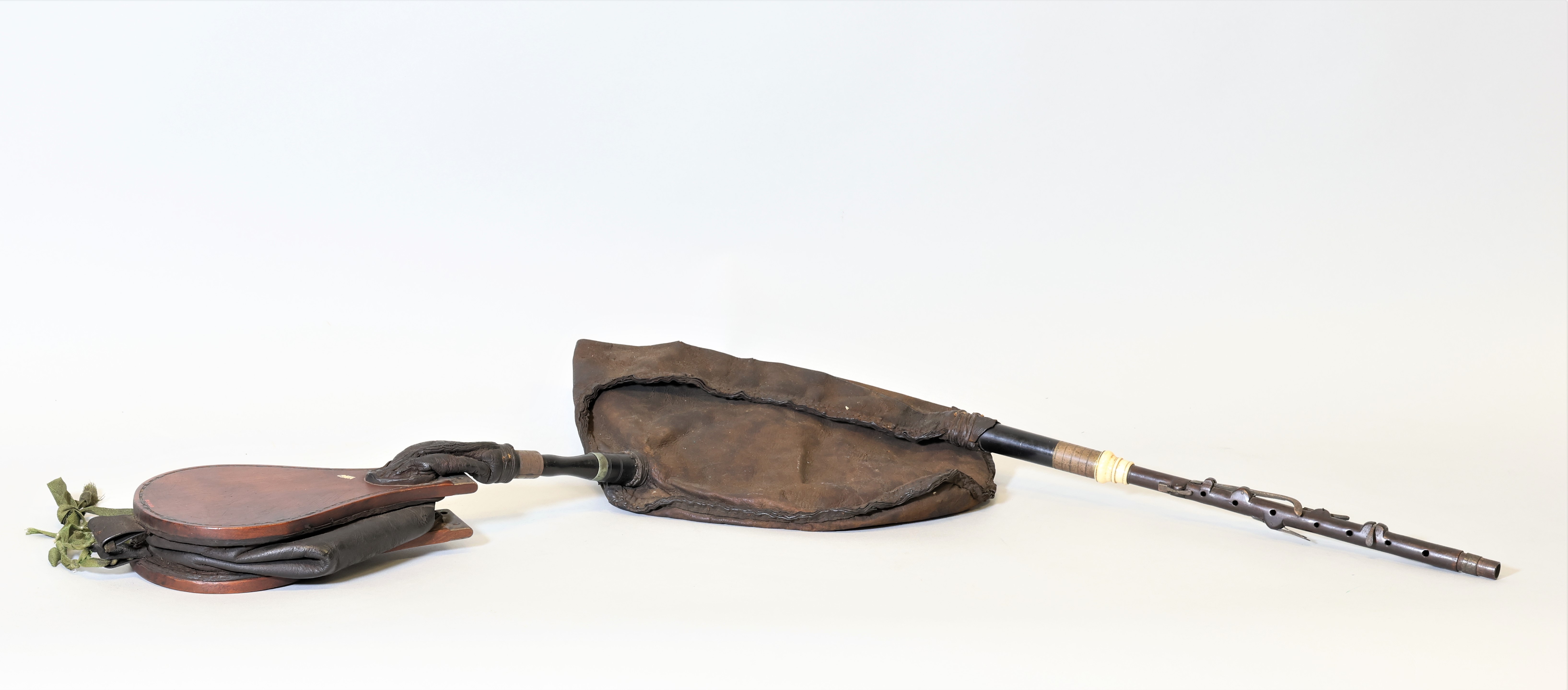
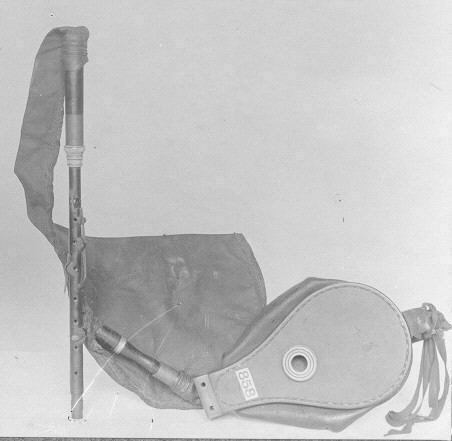
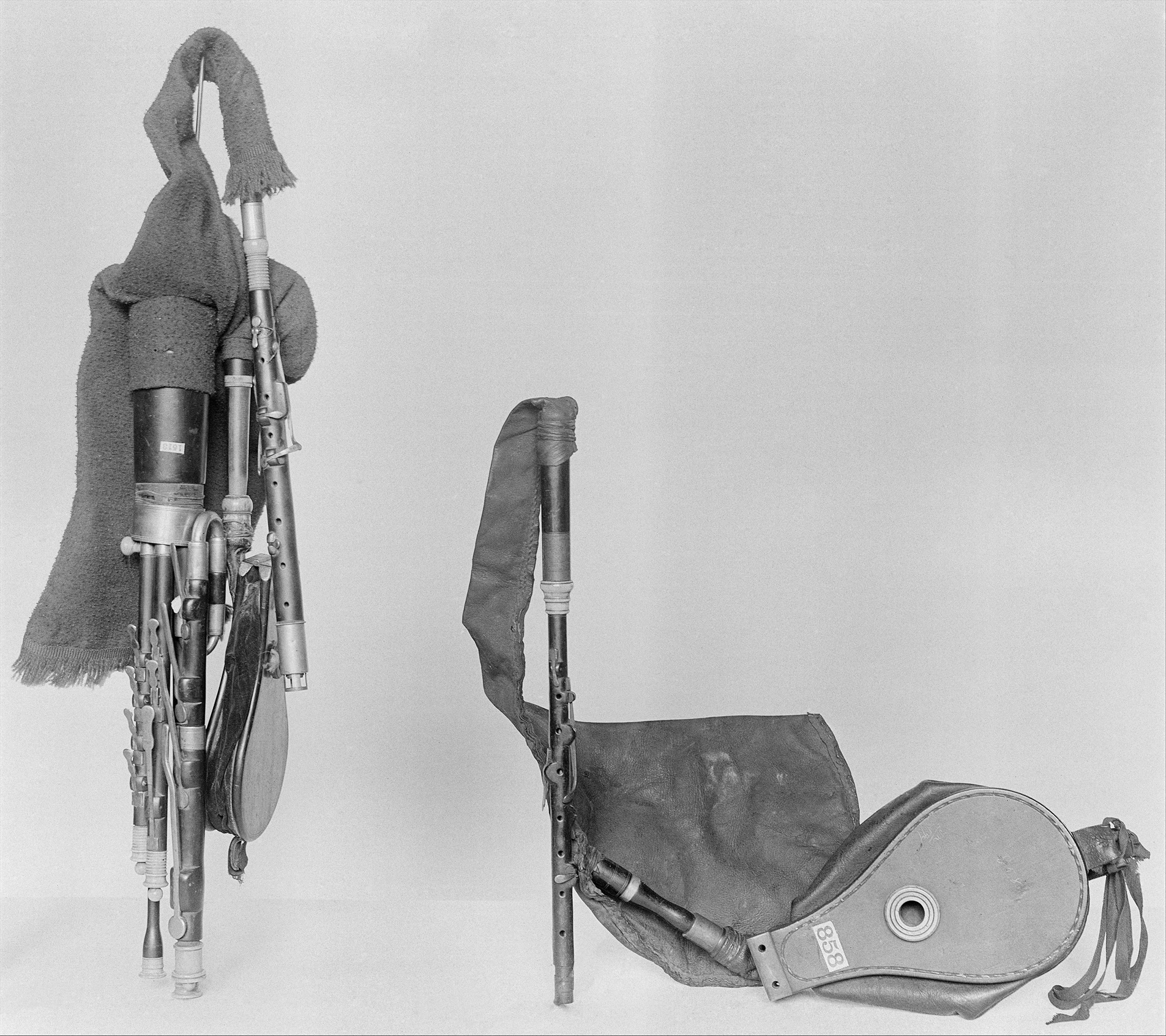
Two specimens at the Metropolitan Museum of Art help make the relationship between the Irish and Scottish traditions visible. Object 501469 is an Irish Uilleann Pipe of indeterminate date, made of sheepskin, ivory, brass, wood, and leather. Object 502088 is a Scottish Union Pipe from the opening decades of the 1800s, made of wood, velvet, leather, cloth, ivory, and metal. Both instruments are bellows-blown and share many design features; the early-19th-century overlap of the names “uilleann pipes” and “Union pipes” is one of the more confusing chapters in bagpipe history, and the two MET specimens together help illustrate why.
By the late 19th and early 20th centuries the uilleann pipes had nearly disappeared, surviving only through a small number of dedicated players. The modern revival, led from the mid-20th century by makers and players associated with Na Píobairí Uilleann (founded in 1968), has dramatically expanded the number of active players and brought the instrument back into widespread use in Irish traditional music.
Construction & Materials
A complete uilleann set is made up of four principal elements: a bellows, a bag, a chanter, and a stock that mounts the drones and regulators. Strapped against the player’s right side, the bellows is worked by the right elbow to feed the bag, which sits underneath the left arm. There is no blowpipe at all — uilleann pipes are mouth-free, which is part of why the player can sing or speak while playing.
The chanter is a long conical wooden tube with a double reed and seven finger holes plus one thumb hole. Unlike most other bagpipes, the uilleann chanter has a fully developed second octave, accessed by additional pressure on the bag. The bottom end of the chanter sits on the player’s leg (resting on a small leather “popping strap”) and can be lifted briefly to articulate notes — a technique called staccato playing that is unique to the uilleann pipes.
The drones — three of them, tuned to D in successive octaves — produce the continuous background tonic. The three regulators are short keyed chanters mounted alongside the drones; the player operates their keys with the heel or side of the right wrist to produce simple chords beneath the melody.
How It’s Played
Sitting down, the player straps one device under each side: bellows on the right, bag on the left. A steady pumping motion from the right elbow drives the bellows and replenishes the bag, which is then squeezed between body and left arm to keep pressure on chanter and drones constant. The fingers of both hands operate the chanter; the right wrist or heel of the right hand presses the regulator keys to add chordal accompaniment.
This combination of breath-free bellows pumping, two-handed chanter fingering, and right-wrist regulator work makes the uilleann pipes one of the more physically demanding instruments in any tradition. Most players take several years to develop the basic coordination and many more to develop full mastery of the regulators.
Cultural Significance
The uilleann pipes are at the heart of Irish traditional music, regularly heard in pub sessions, concert tours, and recordings of reels, jigs, hornpipes, slow airs, and other dance forms. The instrument has also become widely recognised internationally through the recordings of players such as Séamus Ennis, Willie Clancy, Liam O’Flynn (of Planxty), Davy Spillane, Paddy Keenan, Jerry O’Sullivan, and many others.
Na Píobairí Uilleann (NPU), founded in Dublin in 1968, has been central to the modern revival of the instrument, providing tuition, archival recordings, and support for instrument makers. UNESCO inscribed uilleann piping on its Representative List of the Intangible Cultural Heritage of Humanity in 2017.
Notable Examples & Recordings
Two surviving specimens at the Met (objects 501469 and 502088) are particularly useful because they document both the Irish uilleann tradition and the Scottish Union pipe tradition from which it largely diverged. For listening, recordings by Séamus Ennis, Willie Clancy, Liam O’Flynn, Paddy Keenan, Davy Spillane, and Jerry O’Sullivan together cover the instrument’s expressive range and its various stylistic schools.
Related Instruments
- Border pipes – the bellows-blown Scottish pipes of the Borders region
- – the bellows-blown English pipes of the north-east
- – the 18th-century instrument from which the uilleann pipes most directly derive
- – the bellows-blown Scottish chamber pipes
- – the broader bellows-blown Iberian bagpipe family
Where to Hear It
Irish traditional music sessions, concerts, and festivals — particularly the Willie Clancy Summer School in County Clare, the Tionól organised by Na Píobairí Uilleann, and major Irish festivals such as Fleadh Cheoil na hÉireann — are the natural settings for the uilleann pipes. The instrument also appears regularly in film scoring, in cross-cultural projects, and in popular Irish-influenced music worldwide.
- Wikipedia: Uilleann pipes
- The MET: Uilleann Pipe (object 501469)
- The MET: Union Pipe, early 19th century (object 502088)
- Wikimedia Commons: Uilleann pipes
Learning Resources
The uilleann pipes are notoriously expensive and slow to start. A complete concert outfit with three regulators is about as costly as a quality acoustic guitar — sometimes several times more — and most students begin with a practice set (chanter, bag, and bellows only) before adding the drones and finally the regulators. Na Píobairí Uilleann maintains a structured graded tuition system, online resources, and an extensive archive of historical recordings and tunes. The Willie Clancy Summer School in County Clare is one of the major annual gatherings for uilleann piping students worldwide.
Frequently Asked Questions
How are uilleann pipes different from Scottish Highland bagpipes?
The uilleann pipes are bellows-blown rather than mouth-blown, played sitting down, and have three drones plus three keyed regulators that allow chordal accompaniment. Their tone is much sweeter and quieter than the Highland pipes, and they have a fully developed second octave on the chanter.
Where does the name “uilleann” come from?
The Irish word uilleann means “elbow” and refers to the elbow-pumped bellows that supply air to the bag. The instrument was historically also called the “Union pipes” (especially in Scotland), and the relationship between the two names is one of the more confusing chapters in bagpipe history.
What are the regulators for?
The three regulators are short keyed chanters mounted alongside the drones. The player operates their keys with the heel or side of the right wrist to produce simple chords beneath the melody, allowing a single piper to provide both melody and chordal accompaniment.
Are old uilleann pipes displayed in museums?
Yes. New York’s Metropolitan Museum of Art holds an Irish Uilleann Pipe (object 501469) and a closely related Scottish Union Pipe (object 502088), spanning the late 18th and 19th centuries.
Are uilleann pipes difficult to learn?
Yes — they are widely regarded as one of the more technically demanding bagpipes in the world. Most students start with a practice set and add components in stages over several years, with full regulator playing typically not introduced until the chanter and drones are well under control.


