Border Pipes
Border pipes / Lowland pipes
| Category | Wind |
|---|---|
| Country of origin | Scotland / Northern England |
| Wikipedia | en.wikipedia.org |
| Wikidata | Q652470 |
Overview
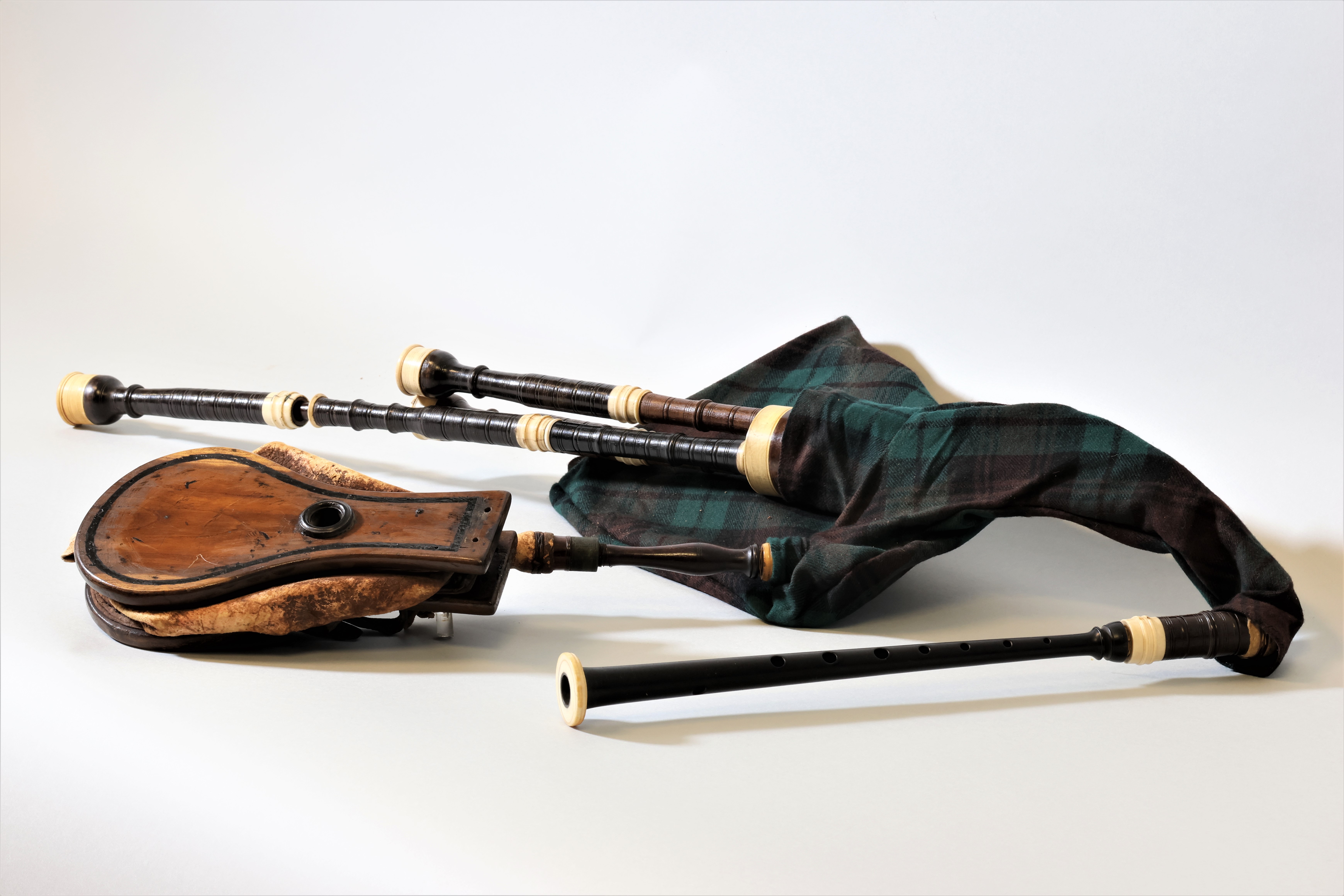
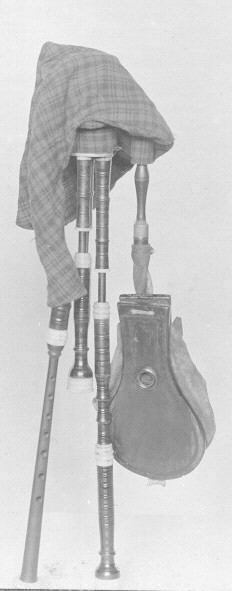
The border pipes (also known as Lowland pipes or Scottish smallpipes’ larger relative) are a bellows-blown bagpipe of the Scottish Borders and northern England. Unlike the better-known , the border pipes are inflated by an arm-driven bellows rather than by the player’s mouth, which keeps the reeds dry and produces a softer, indoor-suited tone. They have a conical-bored chanter and typically two or three drones strapped together in a single common stock.
Origin & History
Bellows-blown bagpipes are documented across the Scottish Lowlands and the northern English Border counties from at least the late seventeenth and early eighteenth centuries. Surviving instruments and pictorial evidence from the eighteenth century show the broad outlines of the modern border pipes already in place, with chanter and drones in a single common stock and a narrow conical chanter bore.
Through the nineteenth century the border pipes declined as the Highland pipes — promoted by the British Army and by Highland regiments — became the dominant Scottish pipes. The instrument was largely silent for much of the twentieth century until the modern Scottish folk revival, beginning in the 1960s and accelerating from the 1980s onward, brought the border pipes back into active life. Makers including Hamish Moore, Nigel Richard, and others built new instruments based on surviving historical examples, and players such as Hamish Moore, Iain MacInnes, and Fred Morrison helped re-establish a living repertoire.
How It’s Played
The player straps a small bellows under the right arm and pumps it with the elbow to fill the bag, which is held under the left arm. The chanter, played with both hands, has a conical bore similar in profile to the Highland chanter and a corresponding bright, focused tone, but at a lower pitch and slightly softer volume. Two or three drones — typically a bass and one or two tenors — sound continuous notes underneath the chanter melody.
The standard scale is a nine-note mixolydian or modal scale similar to that of the Highland pipes, allowing much of the same melodic material to be played. The sound is loud enough for ceilidh dancing and for ensemble work with fiddle, accordion, and guitar, but soft enough to be played comfortably indoors.
Cultural Significance
The border pipes embody a Lowland Scottish piping tradition distinct from, and in some ways older than, the now-dominant Highland tradition. Their revival has been part of a broader recovery of Lowland Scots musical, linguistic, and literary culture since the late twentieth century. The pipes are now standard at folk festivals across Scotland, northern England, Brittany, and the wider Celtic music network.
In England, the closely related Northumbrian smallpipes preserve a parallel bellows-blown tradition and are often played alongside the border pipes in ensembles spanning the Anglo-Scottish border region.
Related Instruments
- – the famous mouth-blown Scottish pipes
- Northumbrian smallpipes – the bellows-blown smallpipes of north-east England
- Uilleann pipes – the bellows-blown Irish pipes
- – the smaller modern revival pipes related to the border pipes
- Gaita – the Iberian mouth-blown bagpipe of a different but related family
Where to Hear It
Recordings by Hamish Moore, Iain MacInnes, Fred Morrison, Gary West, and the Scottish folk groups Old Blind Dogs and Battlefield Band feature the border pipes prominently. Albums by the Scottish piping band Lau and various trios pairing border pipes with fiddle and accordion are also widely available.
Learning Resources
The border pipes are taught at the National Piping Centre in Glasgow, the Royal Conservatoire of Scotland, and at folk-music summer schools across Scotland and England. Method books by Matt Seattle, Iain MacInnes, and others provide both technique and a substantial repertoire of older Border manuscripts.
Frequently Asked Questions
Are border pipes the same as Highland pipes?
No. Border pipes are bellows-blown, lower-pitched, and softer; Highland pipes are mouth-blown, higher-pitched, and far louder.
How many drones do border pipes have?
Usually two or three, all mounted in a single common stock that lies across the player’s chest.
Where are border pipes traditionally played?
The Scottish Borders and the northern English border counties, especially Northumberland.
Can a Highland piper play border pipes?
The fingering is similar enough that Highland pipers can transfer the basic technique quickly; the bellows action and the softer reeds require some adjustment.


